Recent Articles

Microbial populations hardly ever grow logistically and never sublinearly

José Camacho-Mateu, Aniello Lampo, Mario Castro, and José A. Cuesta

Phys. Rev. E 111, 044404 (2025) - Published 4 April, 2025

Challenging the conventional logistic model, this study shows that microbial growth follows a generalized θ-logistic model, accounting for environmental fluctuations. The findings show microbial growth is never sublinear, with significant implications for macroecological patterns and the mechanisms governing microbial ecosystem stability.

#BiophysicsSpotlight #TimelyTopic #AdvancingField

Quadrilateral particle arrangement within shocks in a two-dimensional dusty plasma

Anton Kananovich and J. Goree

Phys. Rev. E 111, 045201 (2025) - Published 4 April, 2025

Physical meaning of principal component analysis for classical lattice systems with translational invariance

Su-Chan Park (박수찬)

Phys. Rev. E 111, 045301 (2025) - Published 4 April, 2025

Driving of an open quantum system at finite temperature across first- and second-order quantum phase transitions

Felipe Matus and Pavel Cejnar

Phys. Rev. E 111, 044104 (2025) - Published 3 April, 2025

Generalized correlations in disordered dynamical systems: Insights from the many-species Lotka-Volterra model

Sebastian H. Castedo, Joshua Holmes, Joseph W. Baron, and Tobias Galla

Phys. Rev. E 111, 044202 (2025) - Published 3 April, 2025

Migration feedback induces emergent ecotypes and abrupt transitions in evolving populations

Casey O. Barkan and Shenshen Wang

Phys. Rev. E 111, 044403 (2025) - Published 3 April, 2025

Hyperbolic embedding of brain networks detects regions disrupted by neurodegeneration in Alzheimer's disease

Alice Longhena, Martin Guillemaud, Fabrizio De Vico Fallani, Raffaella Migliaccio, and Mario Chavez

Phys. Rev. E 111, 044402 (2025) - Published 2 April, 2025

Alzheimer’s disease disrupts the brain’s connectivity structure, through processes such as progressive neuronal loss and brain atrophy. In this study, the authors propose a method based on a hyperbolic representation of brain networks to characterize brain regions with connectivity anomalies. They show that the method successfully identifies regions affected by neurodegeneration, opening the door to use it as a biomarker for disease progression.

#BiophysicsSpotlight #Interdisciplinary

Unveiling the hidden weak universality of the Ziff-Gulari-Barshad model

Henrique A. Fernandes and Roberto da Silva

Phys. Rev. E 111, 044101 (2025) - Published 1 April, 2025

Martingale drift of Langevin dynamics and classical canonical spin statistics. II.

Ken Sekimoto

Phys. Rev. E 111, 044102 (2025) - Published 1 April, 2025

Solutions of first-passage time problems: A biscaling approach

Talia Baravi, David A. Kessler, and Eli Barkai

Phys. Rev. E 111, 044103 (2025) - Published 1 April, 2025

Ring-shaped linear waves and solitons in a square lattice of acoustic waveguides

I. Ioannou Sougleridis, O. Richoux, V. Achilleos, G. Theocharis, and D. J. Frantzeskakis

Phys. Rev. E 111, 044201 (2025) - Published 1 April, 2025

Bayesian ecoevolutionary game dynamics

Arunava Patra, Joy Das Bairagya, and Sagar Chakraborty

Phys. Rev. E 111, 044401 (2025) - Published 1 April, 2025

Simulating squirmers with smoothed particle dynamics

Xinwei Cai, Kuiliang Wang, Gaojin Li, and Xin Bian

Phys. Rev. E 111, 045401 (2025) - Published 1 April, 2025

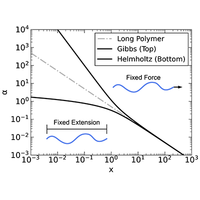
Stretching semiflexible polymers: Gibbs versus Helmholtz ensembles

Nigel T. Andersen and Jeff Z. Y. Chen

Phys. Rev. E 111, 045402 (2025) - Published 1 April, 2025

Stretching experiments have long been used to investigate the physical properties of single polymers and biopolymers by measuring their response to end-to-end separation. Despite decades of experimental and simulation data, a unifying theoretical framework remains elusive. This paper provides a universal perspective, revealing that for semiflexible polymers like DNA, all such data collapse onto two fundamental scaling curves.

#UniversalBehavior #SoftMatterSpotlight #ClassicalProblem

Gaussian fluctuations of nonreciprocal systems

Sergei Shmakov, Glasha Osipycheva, and Peter B. Littlewood

Phys. Rev. E 111, 034133 (2025) - Published 28 March, 2025

Time-harmonic waves in Korteweg and nematic-Korteweg fluids

Patrick E. Farrell and Umberto Zerbinati

Phys. Rev. E 111, 035413 (2025) - Published 28 March, 2025

Optimal form of time-local non-Lindblad master equations

Tobias Becker and André Eckardt

Phys. Rev. E 111, 034132 (2025) - Published 27 March, 2025

Electron acceleration in ambient air using tightly focused ultrashort infrared laser beams

Marianna Lytova, François Fillion-Gourdeau, Simon Vallières, Sylvain Fourmaux, Stéphane Payeur, Jeffrey Powell, François Légaré, and Steve MacLean

Phys. Rev. E 111, 035210 (2025) - Published 27 March, 2025

Reservoir computing with state-dependent time delay

G. O. Danilenko, A. V. Kovalev, D. S. Citrin, A. Locquet, D. Rontani, and E. A. Viktorov

Phys. Rev. E 111, 035313 (2025) - Published 27 March, 2025

Line tension from dual-geometry sessile droplet measurements: Combining contact-angle size-dependence data for axisymmetric and cylindrical droplets to determine the line tension

Dmitry V. Tatyanenko and Konstantin D. Apitsin

Phys. Rev. E 111, 035503 (2025) - Published 27 March, 2025

Sign In to Your Journals Account

Filter

Recent Issues

Vol. 114, Iss. 4
October 2026
Vol. 114, Iss. 3
September 2026
Vol. 114, Iss. 2
August 2026
Vol. 114, Iss. 1
July 2026
Category
Article Type
Section

Filter

Article Lookup

Enter a citation