Recent Articles

Phase separation on deformable membranes: Interplay of mechanical coupling and dynamic surface geometry

Antonia Winter, Yuhao Liu, Alexander Ziepke, George Dadunashvili, and Erwin Frey

Phys. Rev. E 111, 044405 (2025) - Published 10 April, 2025

Combining theoretical analysis with numerical simulations, this study shows that long-range membrane-mediated interactions in phase-separating proteins alter equilibrium states, driving pattern formation instead of simple phase separation. This work provides a systematic framework for describing phase-separation dynamics on membranes modulated by protein density.

#BiophysicsSpotlight #Interdisciplinary #WellStructured

Messenger size optimality in cellular communications

Arash Tirandaz, Abolfazl Ramezanpour, Vivi Rottschäfer, Mehrad Babaei, Andrei Zinovyev, and Alireza Mashaghi

Phys. Rev. E 111, 044406 (2025) - Published 10 April, 2025

Enhanced terahertz emission from the wakefield of CO2-laser-created plasma

Srimanta Maity and Garima Arora

Phys. Rev. E 111, 045205 (2025) - Published 10 April, 2025

Principal component analysis for percolation with and without data preprocessing

Nan Qi and Sheng-Jun Wang

Phys. Rev. E 111, 045303 (2025) - Published 10 April, 2025

Filling spherical surfaces by mixed triangle and square tiles

Han Xie, Yao Li, and Jeff Z. Y. Chen

Phys. Rev. E 111, 045408 (2025) - Published 10 April, 2025

Self-propelled motion of induced-charge electrophoretic Janus particles in viscoelastic fluids

Keita Saito, Ryunosuke Kawano, Chisato Sadamatsu, Yasutaka Iwashita, and Yasuyuki Kimura

Phys. Rev. E 111, 045409 (2025) - Published 10 April, 2025

Unavoidable multilevel biaxial symmetry breaking in chiral hybrid liquid crystals

Jin-Sheng Wu, Marina Torres Lázaro, Souvik Ghosh, Haridas Mundoor, Henricus H. Wensink, and Ivan I. Smalyukh

Phys. Rev. E 111, 045410 (2025) - Published 10 April, 2025

Transient asymmetry during elastic snap-through: The interplay between imperfections and oscillations

Andrea Giudici, Weicheng Huang, Qiong Wang, Yuzhe Wang, Mingchao Liu, Sameh Tawfick, and Dominic Vella

Phys. Rev. E 111, 045503 (2025) - Published 10 April, 2025

Microscopic fluctuations in the spreading fronts of circular wetting liquid droplets

J. M. Marcos, J. J. Meléndez, R. Cuerno, and J. J. Ruiz-Lorenzo

Phys. Rev. E 111, 045504 (2025) - Published 10 April, 2025

Instability of the ferromagnetic phase under random fields in an Ising spin glass with correlated disorder

Hidetoshi Nishimori

Phys. Rev. E 111, 044109 (2025) - Published 9 April, 2025

Percolation of k×k square tiles deposited under equilibrium conditions on square lattices

N. M. De La Cruz Feliz, F. O. Sanchez-Varretti, N. De La Cruz Félix, and A. J. Ramirez-Pastor

Phys. Rev. E 111, 044110 (2025) - Published 9 April, 2025

Vector resonant relaxation and statistical closure theory: Direct interaction approximation

Sofia Flores and Jean-Baptiste Fouvry

Phys. Rev. E 111, 044111 (2025) - Published 9 April, 2025

Anomalous thermodiffusion, absolute negative mobility, and reverse heat transport in a single quantum dot

Yanchao Zhang and Xiaolong Lü

Phys. Rev. E 111, 044112 (2025) - Published 9 April, 2025

Identifying robust features of community structure in complex networks

Karsten N. Economou, Cassie R. Norman, and Wendy C. Gentleman

Phys. Rev. E 111, 044303 (2025) - Published 9 April, 2025

Theory of friction for periodic water structures moving through a subnanometer carbon nanotube

A. W. C. Lau and J. B. Sokoloff

Phys. Rev. E 111, 045103 (2025) - Published 9 April, 2025

Nonempirical approximation for the ionic thermal contribution to the equations of state based on average-atom models

A. A. Ovechkin, P. A. Loboda, and P. A. Sapozhnikov

Phys. Rev. E 111, 045204 (2025) - Published 9 April, 2025

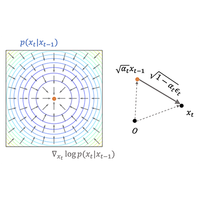
Data augmentation using diffusion models to enhance inverse Ising inference

Yechan Lim, Sangwon Lee, and Junghyo Jo

Phys. Rev. E 111, 045302 (2025) - Published 9 April, 2025

In the context of generative machine learning, diffusion models, inspired by principles of statistical mechanics, have shown exceptional capability in representing data probability distributions. This study demonstrates that diffusion models can effectively learn sample distributions and generate new samples that closely resemble the observed data. The work highlights a promising new avenue where machine learning models can contribute to solving complex problems in physics.

#AdvancingField #TimelyTopic #MachineLearningSpotlight

Coordinated stress-structure self-organization in granular packing

Xiaoyu Jiang, Takashi Matsushima, and Raphael Blumenfeld

Phys. Rev. E 111, 045406 (2025) - Published 9 April, 2025

Absolute negative mobility of an inertial deformable particle under steady laminar flows

Fu-jun Lin, Jia-le Wu, Wei Lin, and Jing-jing Liao

Phys. Rev. E 111, 045407 (2025) - Published 9 April, 2025

Solitons in quasiperiodic lattices with fractional diffraction

Eduard Pavlyshynets, Luca Salasnich, Boris A. Malomed, and Alexander Yakimenko

Phys. Rev. E 111, 044206 (2025) - Published 8 April, 2025
Sign In to Your Journals Account

Filter

Recent Issues

Vol. 114, Iss. 4
October 2026
Vol. 114, Iss. 3
September 2026
Vol. 114, Iss. 2
August 2026
Vol. 114, Iss. 1
July 2026
Category
Article Type
Section

Filter

Article Lookup

Enter a citation