Highlights

Critical transitions in pancreatic islets

D. Korošak, S. Postić, A. Stožer, B. Podobnik, and M. Slak Rupnik

Phys. Rev. E 111, 034405 (2025) - Published 12 March, 2025

By gradually increasing and then decreasing glucose levels in pancreatic islets, this experimental study shows that β-cell activity exhibits hysteresis, indicating a first-order transition. These results highlight the islets’ role as tipping elements driving abrupt insulin release.

Links regulate deflection fluctuations in the sensory cells of hearing

Riccardo Marrocchio and Dáibhid Ó Maoiléidigh

Phys. Rev. E 111, 034403 (2025) - Published 11 March, 2025

Fluctuations of stereocilia, filamentous rods in the inner ear, regulate hearing sensitivity, but their dependence on viscoelastic coupling remains unclear. This study develops a mathematical model linking mechanical properties to deflection fluctuations, showing how elastic and viscous links reduce noise and improve auditory signal detection.

Correction-to-scaling exponent for percolation and the Fortuin-Kasteleyn Potts model in two dimensions

Yihao Xu, Tao Chen, Zongzheng Zhou, Jesús Salas, and Youjin Deng

Phys. Rev. E 111, 034108 (2025) - Published 7 March, 2025

In percolation theory, a key quantity is the size distribution of clusters. In two dimensions, its scaling behavior at the critical point is known exactly, including a universal correction-to-scaling exponent. The authors extend the result for this exponent to clusters in a set of Potts models, presenting a theoretical argument for a conjectured expression that is confirmed by numerical results.

Cyclic random graph models predicting giant molecules in hydrocarbon pyrolysis

Perrin E. Ruth, Vincent Dufour-Décieux, Christopher Moakler, and Maria K. Cameron

Phys. Rev. E 111, 034303 (2025) - Published 6 March, 2025

The authors use a random graph model to predict molecule size distribution in hydrocarbon pyrolysis. The high temperatures and high pressure of pyrolysis make the system ergodic, so that many molecular configurations can form. The authors demonstrate that the method is accurate for distributions of both large and small molecules. In addition, it has low computational cost. They expect that this method may be extendable to other chemical systems under extreme conditions.

Nonlinear classification of neural manifolds with contextual information

Francesca Mignacco, Chi-Ning Chou, and SueYeon Chung

Phys. Rev. E 111, 035302 (2025) - Published 6 March, 2025

Despite progress in artificial intelligence and neuroscience, the theoretical understanding of how neural networks learn complex functions remains sparse. One promising avenue involves analyzing the geometric properties of network representations, i.e., the activity of neural populations, and their impact on task performance using statistical physics methods. Existing approaches have been restricted to linear probes. The authors overcome this limitation by proposing a theoretical framework to address non-linearly-separable representations leveraging contextual information, a ubiquitous paradigm in brain computation. The findings allow for future investigations into high-dimensional representation efficiency and analyses of biological and artificial datasets, promising relevant implications for neuroscience and deep learning.

Direction selection of metachronal waves in hydrodynamic coordination of cilia

Rachel R. Bennett

Phys. Rev. E 111, 034402 (2025) - Published 4 March, 2025

Metachronal waves emerge when hydrodynamically coupled cilia synchronize their beating. This manuscript investigates the link between individual cilium dynamics and collective properties of emergent metachronal waves. It is shown that when the size of individual cilia is taken into account, the interactions between cilia break the symmetry, affecting the selection of a stable direction of metachronal waves.

Hyperedge overlap drives synchronizability of systems with higher-order interactions

Santiago Lamata-Otín, Federico Malizia, Vito Latora, Mattia Frasca, and Jesús Gómez-Gardeñes

Phys. Rev. E 111, 034302 (2025) - Published 3 March, 2025

This study explores the nuanced interplay between the structural organization of complex systems and their synchronization stability, specifically focusing on the effects of higher-order interactions encapsulated in hypergraphs and simplicial complexes. By developing a novel hyperedge overlap matrix, the authors quantify the overlap between different orders of interaction and investigate their distinct impacts on the dynamics of coupled chaotic oscillators. The findings provide significant insights into how microscopic structural features within higher-order systems influence their overall synchronizability.

Dynamics of fluid-driven fractures across material heterogeneities

Sri Savya Tanikella, Marie C. Sigallon, and Emilie Dressaire

Phys. Rev. E 111, 025504 (2025) - Published 28 February, 2025

Macroscopic heterogeneities in a material can greatly influence the propagation of a fracture inside it. To study this, the authors experimentally investigate fracture profiles formed by injection of a fluid into a two-layer hydrogel block. They propose a theoretical model based on scaling arguments that yields good agreement with the experimental results.

Multimotor cargo navigation in microtubule networks with various mesh sizes

Mason Grieb, Nimisha Krishnan, and Jennifer L. Ross

Phys. Rev. E 111, 024413 (2025) - Published 27 February, 2025

This experimental study examines kinesin-driven transport using quantum-dot-based cargoes in dense microtubule networks. Results show that increasing motor number and network density enhances cargo distance, association time, and speed. These findings highlight how motor number and network density can physically regulate cargo movement.

Role of cellular filamentation in bacterial aggregation and cluster-cluster assembly

Samuel Charlton, Gavin Melaugh, Davide Marenduzzo, Cait MacPhee, and Eleonora Secchi

Phys. Rev. E 111, 024410 (2025) - Published 25 February, 2025

This experimental and computational study examines factors that control aggregation dynamics and cluster-cluster assembly of filamentous and nonfilamentous bacteria. Results should be of interest for practical applications, such as bioreactors and water remediation, in which aggregation is a key step in the process.

Nonequilibrium thermodynamic foundation of the grand-potential phase field model

Jin Zhang, James A. Warren, and Peter W. Voorhees

Phys. Rev. E 111, L022104 (2025) - Published 25 February, 2025

In the context of the nonequilibrium thermodynamics of phase field models, ensuring that energy decreases during evolution is critical for thermodynamic consistency. Contrary to the common understanding of grand-potential phase field models, the authors show that it is the Helmholtz energy that decreases during evolution rather than the grand potential. This finding is relevant for assuring thermodynamic consistency of phase field models and their computational implementations.

Ligand-induced receptor multimerization achieves specificity enhancement of kinetic proofreading without associated costs

Duncan Kirby and Anton Zilman

Phys. Rev. E 111, 024408 (2025) - Published 20 February, 2025

This paper investigates models of two mechanisms used by cells to enhance specificity of signaling pathways. In the kinetic proofreading mechanism, the ligand-bound receptor must pass through a sequence of states before reaching the signaling state. In the multimeric receptor signaling mechanism, receptor subunits are bound by a multivalent ligand to form a signaling complex. A key result of this paper is that the multimeric receptor is capable of achieving the same maximum specificity as the kinetic proofreading receptor.

Expected correlation in time-series analysis

Theodore MacMillan, James P. Hilditch, and Nicholas T. Ouellette

Phys. Rev. E 111, 024121 (2025) - Published 14 February, 2025

The authors show that there is often an inevitable degree of expected order and predictability in time series. In particular, there is a lower bound on the expected correlation time that increases with the length of the series. This result shows that a certain degree of correlation is induced when time-series data is aggregated, quantifying a possible source of bias towards high correlations.

Stochastic model for the turbulent ocean heat flux under Arctic sea ice

S. Toppaladoddi and A. J. Wells

Phys. Rev. E 111, 025101 (2025) - Published 12 February, 2025

Arctic sea ice is one of the most sensitive components of the Earth’s climate system, and it is difficult to predict its evolution because of challenges in modeling the effects of the underlying ocean. The authors develop a simplified stochastic model for the turbulent heat flux from the ocean to the ice that shows good agreement with observational data.

Discrete generative diffusion models without stochastic differential equations: A tensor network approach

Luke Causer, Grant M. Rotskoff, and Juan P. Garrahan

Phys. Rev. E 111, 025302 (2025) - Published 7 February, 2025

In machine learning, diffusion models are a paradigm for generative modeling. This study introduces a novel approach applicable to discrete systems using tensor networks. This allows modeling the diffusion process exactly, eliminating the need for stochastic differential equations. Integrating the above with Markov-chain Monte Carlo, the authors are able to learn efficient nonlocal proposal updates, in turn leading to effective sampling of complex Boltzmann-like distributions. The combined framework presented here has promise particularly for rare-event sampling.

Protocol dependence for avalanches under constant stress in elastoplastic models

Tristan Jocteur, Eric Bertin, Romain Mari, and Kirsten Martens

Phys. Rev. E 111, 024101 (2025) - Published 3 February, 2025

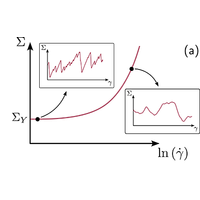
Amorphous solids, for example glasses and granular materials, display intermittent plastic deformation events known as avalanches near the yielding transition. It is typically assumed that the characteristics of the avalanches do not depend on the driving protocol (e.g., controlling strain or stress). The two-dimensional simulations of an elastoplastic model presented in this study highlight the complex interplay between the initial elastic state, the driving protocol, and the dynamics of avalanche propagation, thus challenging the assumption of universality of the avalanche statistics.

Data-driven discovery of self-similarity using neural networks

Ryota Watanabe, Takanori Ishii, Yuji Hirono, and Hirokazu Maruoka

Phys. Rev. E 111, 024301 (2025) - Published 3 February, 2025

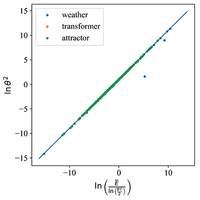
This study introduces a method based on neural networks to discover self-similarity in physical systems. Traditional methods employ assumed models, while here the authors are able to identify the self-similarity parameters from data directly and extract the exponents characterizing the scale-transformation symmetries. The method can be put to use with any self-similar physical system, with potential applications in various areas, for example materials science and fluid dynamics.

Polymer dynamics under tension: Mean first passage time for looping

Wout Laeremans, Anne Floor den Ouden, Jef Hooyberghs, and Wouter G. Ellenbroek

Phys. Rev. E 111, 025401 (2025) - Published 3 February, 2025

Previous studies on the formation of loops in polymers under tension relied on barrier escape methods to predict looping times. This work revisits the problem, deriving a scaling law for freely jointed chains under tension, and demonstrating that the looping time inversely scales with the equilibrium looping probability.

First-passage times to a fractal boundary: Local persistence exponent and its log-periodic oscillations

Yilin Ye, Adrien Chaigneau, and Denis S. Grebenkov

Phys. Rev. E 111, 014153 (2025) - Published 29 January, 2025

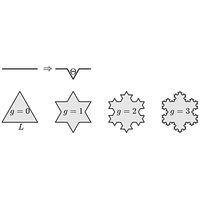
It is possible to calculate the statistics of first-passage times to various targets, including to small targets and extended boundaries. Here, the authors ask what happens if the target is the fractal self-similar boundary of the Koch snowflake, and the particle starts from a fixed location near that boundary. They find two regimes that have well-known features, and a third, intermediate regime with a local persistence exponent that exhibits log-periodic oscillations.

Low-dimensional model for adaptive networks of spiking neurons

Bastian Pietras, Pau Clusella, and Ernest Montbrió

Phys. Rev. E 111, 014422 (2025) - Published 24 January, 2025

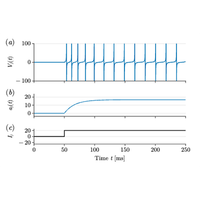
Exact neuronal firing rate models provide a link between microscopic dynamics of individual spiking neurons and macroscopic variables. These authors extend the model to include a form of spike frequency adaptation and reduce its dimension. The reduced-dimension model facilitates analysis and reveals collective oscillations in the spiking neuronal network.

Sign In to Your Journals Account

Filter

Section

Filter

Article Lookup

Enter a citation