Highlights

Precision kinematic Sunyaev-Zel’dovich measurements across halo mass and redshift with DESI DR2 and ACT DR6. II. Bright galaxy survey and emission-line galaxies

B. Hadzhiyska et al. (DESI Collaboration)

Phys. Rev. D 114, 083541 (2026) - Published 29 October, 2026

How galaxies expel gas is a big unknown and limits surveys in what they can measure. In this pair of papers, the DESI and ACT collaborations combine galaxy redshifts from DESI DR2 with high-resolution microwave maps from ACT DR6 to study the gas distribution around galaxies to unprecedented precision using the kinematic Sunyaev-Zel’dovich effect. They find strong evidence that the gas does not trace dark matter profiles and that there is gas redistribution beyond gravitational collapse.

Precision kinematic Sunyaev-Zel’dovich measurements across halo mass and redshift with DESI DR2 and ACT DR6. I. Luminous red galaxies

F. J. Qu et al. (DESI Collaboration)

Phys. Rev. D 114, 083540 (2026) - Published 29 October, 2026

How galaxies expel gas is a big unknown and limits surveys in what they can measure. In this pair of papers, the DESI and ACT collaborations combine galaxy redshifts from DESI DR2 with high-resolution microwave maps from ACT DR6 to study the gas distribution around galaxies to unprecedented precision using the kinematic Sunyaev-Zel’dovich effect. They find strong evidence that the gas does not trace dark matter profiles and that there is gas redistribution beyond gravitational collapse.

Gravitational Compton scattering at the fourth post-Minkowskian order

Giacomo Brunello, Mario Meo, and Sid Smith

Phys. Rev. D 114, 085022 (2026) - Published 22 October, 2026

Classical relativistic scattering of a gravitational wave off a non-spinning compact object is approached in this paper as Compton scattering of a graviton using worldline quantum field theory (WQFT) methods. The amplitude is computed to the 4th post-Minkowskian (4PM) order. This impressive result corresponds to a three-loop computation in WQFT. Its consistency with independent black hole perturbation theory methods is established.

From quivers to geometry: 5D conformal matter

Antoine Bourget, Mario De Marco, Michele Del Zotto, Julius F. Grimminger, and Andrea Sangiovanni

Phys. Rev. D 114, 086009 (2026) - Published 9 October, 2026

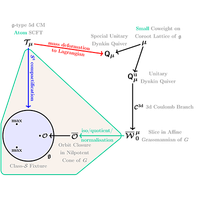
This paper completes another segment in understanding and classifying the 5-dimensional supersymmetric conformal field theories (SCFT). The authors show that a class of 5-dimensional special unitary quiver gauge theories admit a UV (high energy) completion in terms of 5-dimensional conformal matter SCFTs, which can be explicitly engineered via M-theory on a singular Calabi-Yau threefold.

Pseudo-Cℓ approach to directional stacking

Lea Harscouet, Amy Wayland, and David Alonso

Phys. Rev. D 114, 083516 (2026) - Published 9 October, 2026

The information available from the oriented stacking of astrophysical fields is shown to be recoverable through the use of an appropriately constructed cross-power spectrum that takes account of the spin associated with the preferred orientation. The method is applicable to effects like the moving lens effect and the directional Sunyaev-Zeldovich effect.

Effective description of lensed gravitational waves diffracted by stellar fields

Miguel Zumalacárregui and Xikai Shan

Phys. Rev. D 114, 063038 (2026) - Published 18 September, 2026

Gravitational waves lensed by galaxies and clusters can also be diffracted by the stars and compact remnants embedded within them, leaving frequency-dependent signatures in the observed signal that are computationally expensive to model. This paper introduces Reduced-Order Stochastic Diffraction, an efficient framework for modeling these complex microlensing effects with a computationally inexpensive surrogate model. The method can be readily incorporated into Bayesian GW analyses and adapted to different detectors, sources, and microlens populations. It therefore opens a new avenue for probing stellar populations through gravitational-wave lensing.

Comprehensive effective field theory framework for coherent elastic neutrino-nucleus scattering

Gang Li, Chuan-Qiang Song, Feng-Jie Tang, and Jiang-Hao Yu

Phys. Rev. D 114, 055032 (2026) - Published 18 September, 2026

Coherent elastic neutrino-nucleus scattering provides crucial information for precision studies of neutrinos as well as searches for dark matter and other new physics. This paper develops a comprehensive Effective Field Theory treatment up to dimension eight which can account for new physics effects from energies above 100 GeV down to nuclear scales in a consistent manner. The authors include renormalization effects, careful power counting and matching of different theories at the appropriate scales, and possible UV completions of the effective operators.

Rescuing overabundant dark matter with a strongly first order phase transition in the dark sector

Peisi Huang, Anibal D. Medina, and Carlos E. M. Wagner

Phys. Rev. D 114, 055004 (2026) - Published 4 September, 2026

This paper studies dark matter in a spontaneously broken hidden U(1). The initial overabundant dark matter density is generated through the freeze-out mechanism. Because the subsequent first order phase transition becomes supercooled, the vacuum transition generates entropy, diluting the DM density to its current value. The MeV–GeV transition also produces nano-Hz gravitational waves potentially detectable by pulsar timing arrays such as NANOGrav.

Analytic force-free jet from disk-fed rotating black holes

Luis Villarin and Ian Vega

Phys. Rev. D 114, 043069 (2026) - Published 26 August, 2026

Rotating black holes are thought to drive some of the Universe’s most powerful outflows. A new analytic model finds that the energy carried away from a slowly rotating black hole is set mainly by its spin and magnetic flux at the horizon rather than the details of the surrounding accretion disk.

Precision lattice calculation of the hadronic contribution to the running of the electroweak gauge couplings

Alessandro Conigli, Dalibor Djukanovic, Georg von Hippel, Simon Kuberski, Harvey B. Meyer, Kohtaroh Miura, Konstantin Ottnad, Andreas Risch, and Hartmut Wittig

Phys. Rev. D 114, 034508 (2026) - Published 13 August, 2026

Photon calibration techniques for high resolution cryogenic detectors

W. Matava and M. R. Williams

Phys. Rev. D 114, 032007 (2026) - Published 12 August, 2026

Advanced cryogenic detectors, e.g. qubit-based sensors or Kinetic Inductance Detectors (KIDs), often offer resolutions larger than a single detected photon’s energy. The authors demonstrate that commonly used statistical methods for calibration of such detectors can introduce systematic biases, leading to inaccurate energy scale and resolution measurements. This stems from an assumption of independence between detector resolution and photon number, which breaks down once realistic effects like position-dependent phonon collection efficiency or Fano fluctuations are taken into account. Finally, a method of correcting for said effects is proposed.

Superconformal index and localizing higher derivative supergravity

Florian Gaar, Jerome P. Gauntlett, Jaeha Park, and James Sparks

Phys. Rev. D 114, L021904 (2026) - Published 22 July, 2026

Computing the exact (all corrections included) on-shell action for black holes remains an outstanding problem. Working within the framework of AdS/CFT and using a powerful technique, equivariant localization, the authors evaluate the on-shell action for D=5 AdS rotating, charged black holes when higher-derivative quantum corrections are turned on. They also find a precise match with the superconformal index in a Cardy-like limit of the dual N = 1 superconformal field theory in four dimensions.

When JIMWLK evolution really matters: The example of incoherent diffraction

T. Lappi and D. N. Triantafyllopoulos

Phys. Rev. D 114, 014036 (2026) - Published 17 July, 2026

The JIMWLK evolution equations describe high-energy scattering and the gluon saturation regime of QCD. As an infinite hierarchy of coupled, non-linear equations, approximations are required to make any phenomenological predictions. One widely-used approximation in which one assumes many quantities are Gaussian-distributed random variables, is known to be accurate for a simple class of initial conditions. The authors explicitly demonstrate that this Gaussian approximation fails to accurately describe full JIMWLK evolution beyond this simplest configuration, which may have significant implications for heavy ion collisions.

Electric accumulation of millicharged particles

Asher Berlin, Zachary Bogorad, Peter W. Graham, and Harikrishnan Ramani

Phys. Rev. D 114, 015016 (2026) - Published 10 July, 2026

Decades-old experiments have now been enlisted to set new bounds on the properties of a hypothetical particle that bears a tiny fraction of the electron’s charge.

How to identify the dead cone in the top-quark jet

Stefan Kluth, Wolfgang Ochs, and Redamy Perez-Ramos

Phys. Rev. D 113, 114048 (2026) - Published 26 June, 2026

The dead cone is the angular region about the momentum direction of a heavy quark in which QCD radiation is suppressed. While well-studied and even experimentally validated for bottom quarks, observing the dead cone for the most massive quark, the top, is exceedingly subtle because of its nearly immediate decay. The authors present a thorough study of the dead cone for top quarks, and establish techniques that can be used to isolate this intriguing effect from the physics of its decay.

Constraining neutrino-nucleon form factors with charged-current scattering at the Electron-Ion Collider

Guang Yang and Praveen Kumar

Phys. Rev. D 113, 116031 (2026) - Published 22 June, 2026

This study investigates the potential of electron–proton scattering at the Electron–Ion Collider to constrain the neutrino–nucleon axial form factor with unprecedented precision. By exploiting a free-proton target, the proposed measurements largely avoid nuclear-model uncertainties and offer a promising avenue for advancing the precision frontier of neutrino interaction physics.

Glimpse into the ultrametric spectrum

An Huang and Christian Baadsgaard Jepsen

Phys. Rev. D 113, 126021 (2026) - Published 15 June, 2026

p-adic string theory asks how much of string physics really depends on ordinary spacetime geometry. Quantum gravity may replace smooth short-distance geometry with more primitive or nonlocal structures; p-adic models provide a laboratory where the notion of distance is very different. This manuscript tests whether one of the most basic stringy signatures – the rapid high-energy growth of states – survives in such a setting. Simple tree models fail, but a natural p-adic spectrum on the unit circle reproduces the usual coarse string entropy growth, with log-periodic corrections. The result probes which aspects of string thermodynamics are geometric and which are more universal.

Neutrino decays as a natural explanation of the neutrino mass tension

Guillermo Franco Abellán

Phys. Rev. D 113, 123527 (2026) - Published 11 June, 2026

A disagreement over neutrino-mass estimates might be resolved by assuming that neutrinos decay into hypothetical massless particles.

Initial data of effective field theories of relativistic viscous fluids and gravity

Lorenzo Gavassino, Áron D. Kovács, and Harvey S. Reall

Phys. Rev. D 113, 124022 (2026) - Published 9 June, 2026

The authors propose a “reduction of order” approach to deal with unphysical degrees of freedom that arise in relativistic viscous hydrodynamics and in gravitational effective field theories, not at the equation of motion level but in the initial data, expressing the data for the unphysical variables in terms of those for the physical ones. They also show that the apparent loss of Lorentz invariance is not an issue if one works only in those frames where the assumptions of the effective field theory are manifestly valid.

Probing composite structure and spin-orbit coupling with GPDs in He4

Antonio Garcia Vallejo and Matthew D. Sievert

Phys. Rev. D 113, 114014 (2026) - Published 8 June, 2026

Generalized parton distributions (GPDs) encode information of all components of partonic momentum, potentially enabling three-dimensional spatial resolution of a nucleon’s substructure. The authors extend previous formulations of GPDs through a Wigner transform, and demonstrate its utility for the Helium-4 nucleus. The resulting master formula for GPDs manifests a novel spin-orbit coupling that did not appear in earlier implementations and implies additional composite structure.

Sign In to Your Journals Account

Filter

Filter

Article Lookup

Enter a citation