Physrevd.96
NEWS AND COMMENTARY

Scanning Earth’s Interior with Neutrinos

August 8, 2017

Future neutrino experiments may provide tomographic scans of Earth’s interior by viewing solar neutrinos that pass through our planet’s layers.  

Synopsis on:
A. N. Ioannisian, A. Yu. Smirnov, and D. Wyler
Phys. Rev. D 96, 036005 (2017)


Physrevlett.119
NEWS AND COMMENTARY

Neutron-Star Implosions as Heavy-Element Sources

August 7, 2017

A dramatic scenario in which a compact black hole eats a spinning neutron star from inside might explain a nearby galaxy’s unexpectedly high abundance of heavy elements.

Viewpoint on:
George M. Fuller, Alexander Kusenko, and Volodymyr Takhistov
Phys. Rev. Lett. 119, 061101 (2017)


Prdv95i1112

Key image
EDITORS' SUGGESTION

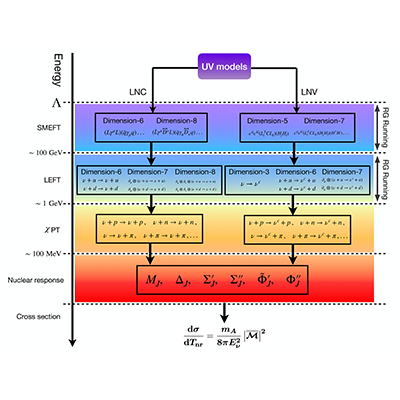
Updated T2K measurements of muon neutrino and antineutrino disappearance using 1.5×10²¹ protons on target

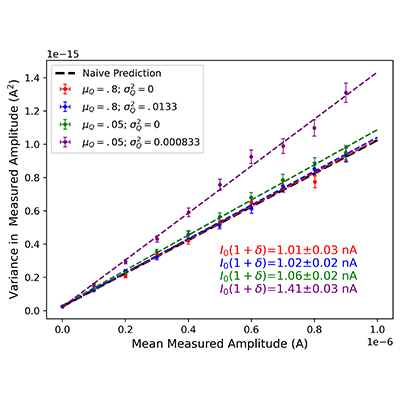
T2K measured the neutrino mass difference δm322 and the mixing angle θ23 both for neutrinos and, separately, for anti-neutrinos. Their results for the mass difference and mixing angle are not only highly competitive, but, since they show no difference in these two modes, provide important evidence that CPT is not violated within the accuracy of their measurements.

K. Abe et al. (The T2K Collaboration)
Phys. Rev. D 96, 011102(R) (2017)


Physrevlett.119
NEWS AND COMMENTARY

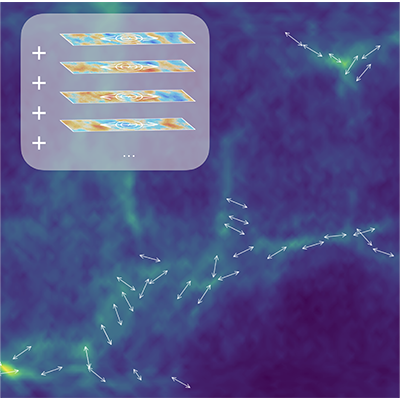
Spinning Black Holes May Grow Hair

July 24, 2017

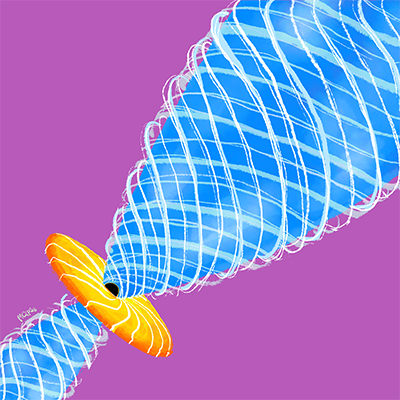
A spinning black hole may lose up to 9% of its mass by spontaneously growing “hair” in the form of excitations of a hypothetical particle field with a tiny mass.

Viewpoint on:
William E. East and Frans Pretorius
Phys. Rev. Lett. 119, 041101 (2017)


Key image
EDITORS' SUGGESTION

New constraints on the free-streaming of warm dark matter from intermediate and small scale Lyman-α forest data

Using data on the Lyman-α spectra obtained by the X-shooter and HIRES/MIKE spectrographs, bounds on warm dark matter are computed using state-of-the-art analysis. This places a new best lower limit of 5.3 keV on the mass of thermal relic dark matter.

Vid Iršič et al.
Phys. Rev. D 96, 023522 (2017)


Key image
EDITORS' SUGGESTION

New Kaluza-Klein instantons and the decay of AdS vacua

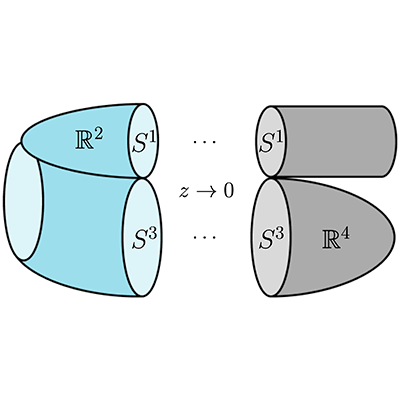
By performing clever manipulations of complicated equations of motion, the authors obtain new instanton solutions of eleven-dimensional supergravity. These results support a previously proposed conjecture that all non-supersymmetric anti-de-Sitter (AdS) vacua must be unstable.

Hirosi Ooguri and Lev Spodyneiko
Phys. Rev. D 96, 026016 (2017)


Key image
EDITORS' SUGGESTION

Lattice calculation of electric dipole moments and form factors of the nucleon

The authors reexamine the form of the expression used to extract the nucleon EDM from lattice QCD calculations and discover a subtle additional subtraction due to mixing between form factors. They check their claim by comparing with a different method to compute the EDM. Applying their correction to previous computations they obtain more consistent results, albeit now all consistent with a vanishing EDM within errors.

M. Abramczyk et al.
Phys. Rev. D 96, 014501 (2017)

Current Issues

Vol. 96, Iss. 3-4 — August 2017

View Current Issues

Events

Physics Next Workshops
Thursday Aug. 24th, 2017 - Saturday Aug. 26th, 2017
Hyatt Place Long Island hotel, Long Island, NY

The American Physical Society is initiating a new series of international workshops. These Physics Next workshops will be aimed at fostering new and emerging areas of physics research, focusing on topics that straddle traditional subject boundaries and are starting to “emerge from the noise.”

The upcoming workshop is titled “Physics Next: From Quantum Fields to Condensed Matter,” and will take place on August 24 - 26, 2017. More information.

Announcements

APS Cultivates ORCID Links
July 18, 2017

On July 18, 2017, APS, along with the Institute of Physics Publishing (IOPP), has taken an important step towards working more closely with the Open Researcher and Contributor ID (ORCID) system of unique identifiers by signing the ORCID open letter requiring the collection of ORCID iDs in their publishing processes.

APS Joins the Initiative for Open Citations (IO4C)
July 11, 2017

Starting on July 11, APS will begin participating in the Initiative for Open Citations (I4OC), a collaboration among scholarly publishers to make information freely available about what papers are cited by a given journal article. This information had always been available to those subscribing to the Physical Review journals, but now the citation data will be open to all.

More Announcements

Meet The Editors

16th Meeting High Energy Astrophysics Division
August 20-24
Sun Valley, Idaho

Rashmi Ray

Contact the editors at prd@aps.org

Trending in PRD

Sign up to receive regular email alerts from Physical Review D

Log In

Cancel
×

Search


Article Lookup

Paste a citation or DOI

Enter a citation
×