Recent Articles

Feasibility of quantum state teleportation in proton systems

H. Witała

Phys. Rev. C 113, 054001 (2026) - Published 4 May, 2026

Properties of isoscalar giant multipole resonances in medium-mass singly-closed-shell nuclei: A semimicroscopic description

M. L. Gorelik and M. H. Urin

Phys. Rev. C 113, 054301 (2026) - Published 4 May, 2026

Coherent absorption dynamics: The dual role of off-diagonal couplings in weakly bound nuclei

Hao Liu, Jin Lei, and Zhongzhou Ren

Phys. Rev. C 113, 054601 (2026) - Published 4 May, 2026

Bayesian inference of heavy-quark dissipation and jet transport parameters from D-meson observables in heavy-ion collisions at energies available at the CERN Large Hadron Collider

Xu-Fei Xue, Zi-Xuan Xu, Wei Dai, Jiaxing Zhao, and Ben-Wei Zhang

Phys. Rev. C 113, 054902 (2026) - Published 4 May, 2026

Cross section of the process e++e−→Ξ0+Ξ¯0 in the vicinity of charmonium ψ(3770) and in the charmonium (-like) state including the D-meson loop and three-gluon contributions

Azad I. Ahmadov

Phys. Rev. C 113, 055203 (2026) - Published 4 May, 2026

Magnetic fields and the favorability of chiral density waves in neutron stars

M. Moazami, B. Khanbabaei, and B. Pourhassan

Phys. Rev. C 113, 055801 (2026) - Published 4 May, 2026

Total absorption spectroscopy of two isomers in Cu70 influencing nucleosynthesis signatures

E. K. Ronning et al.

Phys. Rev. C 113, 055802 (2026) - Published 4 May, 2026

Erratum: High-spin structure and multiphonon γ vibrations in very neutron-rich Ru114 [Phys. Rev. C 83, 054317 (2011)]

E. H. Wang, E. Y. Yeoh (杨韵颐), S. J. Zhu (朱胜江), J. H. Hamilton, K. Li, A. V. Ramayya, Y. X. Liu (刘艳鑫), J. K. Hwang, S. H. Liu, J. G. Wang (王建国), Y. Sun (孙扬), J. A. Sheikh, G. H. Bhat, Y. X. Luo, J. O. Rasmussen, I. Y. Lee, H. B. Ding (丁怀博), L. Gu (顾龙), Q. Xu (徐强), Z. G. Xiao (肖志刚), and W. C. Ma

Phys. Rev. C 113, 059901 (2026) - Published 4 May, 2026

Contrasting decays of 3-quasiparticle isomers in W173: A discerning test of K conservation and K mixing

S. K. Tandel, Harsh Kumar, Saket Suman, P. Chowdhury, F. G. Kondev, R. V. F. Janssens, M. P. Carpenter, D. J. Hartley, T. Lauritsen, C. J. Lister, and D. Seweryniak

Phys. Rev. C 113, L051301 (2026) - Published 4 May, 2026

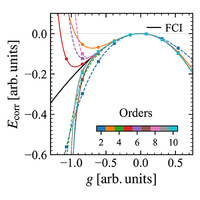
Stochastic many-body perturbation theory for high-order calculations

X. Zhen, R. Z. Hu, J. C. Pei, and F. R. Xu

Phys. Rev. C 113, L051302 (2026) - Published 4 May, 2026

The authors introduce a perturbation theory quantum Monte Carlo (PTQMC) method to compute high-order many-body perturbative corrections. The approach avoids exponential scaling inherent to conventional constructions of high-rank excitation operators. Benchmark calculations for the Richardson pairing model reproduce exact many-body perturbation-theory calculations up to 16th order even in strongly divergent regimes. The results are relevant for future applications of PTQMC to realistic nuclear matter and finite nuclei, as well as for the systematic assessment of perturbative uncertainties in ab-initio nuclear theory.

Collective effects in O-O and Ne-Ne collisions at sNN=5.36 TeV from a hybrid approach

Lucas Constantin, Niklas Götz, Carl B. Rosenkvist, and Hannah Elfner

Phys. Rev. C 113, 054901 (2026) - Published 1 May, 2026

Investigation of the K¯−Li6 interaction and the search for the Λ(1405) resonance

Ahmad Naderi Beni and Sajjad Marri

Phys. Rev. C 113, 055201 (2026) - Published 1 May, 2026

K*(892) resonance suppression in Ar+Sc collisions at energies available at the CERN Super Proton Synchrotron

Amine Chabane, Tom Reichert, Jan Steinheimer, and Marcus Bleicher

Phys. Rev. C 113, 055202 (2026) - Published 1 May, 2026

Investigation of shell evolution with entanglement entropy

D. Xu, A. T. Kruppa, J. G. Li, and H. F. Zhang

Phys. Rev. C 113, 044332 (2026) - Published 30 April, 2026

C12-induced total reaction cross sections based on the intranuclear cascade model

Masahiro Nakano, Yuji Yamaguchi, and Yusuke Uozumi

Phys. Rev. C 113, 044918 (2026) - Published 30 April, 2026

High-voltage and electrode system for a cryogenic experiment to search for the neutron electric dipole moment

M. A. Blatnik, S. M. Clayton, S. A. Currie, B. W. Filippone, M. Makela, C. M. O'Shaughnessy, N. S. Phan, J. C. Ramsey, G. V. Riley, A. Roberts, T. Sandborn, T. J. Schaub, G. M. Seidel, E. Smith, I. L. Smythe, J. Surbrook, W. Wei, W. Yao, and T. M. Ito

Phys. Rev. C 113, 045503 (2026) - Published 30 April, 2026

The neutron electric dipole moment (nEDM) is a key probe of CP violation and physics beyond the Standard Model. Experimental sensitivity scales with the applied electric field, making higher fields essential for improved measurements. A 1994 proposal to perform an nEDM experiment in superfluid 4He suggested several potential advantages, including in-situ production of ultracold neutrons with reduced loss and the possibility of higher electric fields. Here, the authors report the outcome of a comprehensive program to develop the high-voltage and electrode system for such an experiment, including new insights into relevant physical phenomena and detailing selected technical solutions with their corresponding experimental demonstrations. The results demonstrate the necessary technology for operation at electric fields up to E=75 kV/cm, compared with E≈10 kV/cm in recent nEDM experiments—a major step toward significantly enhanced sensitivity.

Quantum simulations of Green's functions for small superfluid systems

Samuel Aychet-Claisse, Denis Lacroix, Vittorio Somà, and Jing Zhang

Phys. Rev. C 113, 044324 (2026) - Published 29 April, 2026

Low-energy electric and magnetic dipole excitations in Er166

T. Shizuma, M. Omer, R. Hajima, M. Koizumi, T. Takahashi, Y. Tsunoda, and T. Otsuka

Phys. Rev. C 113, 044325 (2026) - Published 29 April, 2026

Novel fast-timing measurement and nature of partial seniority symmetry breaking in N=50 isotones

W. H. Wei et al.

Phys. Rev. C 113, 044326 (2026) - Published 29 April, 2026

Radiative strength functions from the energy-localized Brink-Axel hypothesis

Oliver C. Gorton, Konstantinos Kravvaris, Jutta E. Escher, and Calvin W. Johnson

Phys. Rev. C 113, 044327 (2026) - Published 29 April, 2026

Radiative strength functions (RSFs) are crucial inputs for statistical nuclear reaction codes but are difficult to calculate because they require wave functions of highly excited states. The authors used large-scale shell model calculations to identify a key result of the energy-localized Brink-Axel hypothesis: the shape of the RSF evolves smoothly with wave-function energy. Combined with an efficient Lanczos strength-function method, this insight leads to a practical new approach for computing RSFs which was validated for 24Mg and provided novel results for 56Fe. The method is expected to simplify RSF calculations while motivating the use of energy-dependent RSFs in modern reaction codes.

Sign In to Your Journals Account

Filter

Recent Issues

Vol. 114, Iss. 4
October 2026
Vol. 114, Iss. 3
September 2026
Vol. 114, Iss. 2
August 2026
Vol. 114, Iss. 1
July 2026
Category
Article Type
Section

Filter

Article Lookup

Enter a citation