Recent Articles

Inertial rotational diffusion and magnetic relaxation of the spin system in a strong magnetic field

Sergei V. Titov, William J. Dowling, Vasiliy A. Shchelkonogov, and Anton S. Titov

Phys. Rev. B 107, 174426 (2023) - Published 17 May, 2023

Neural-network-backed effective harmonic potential study of the ambient pressure phases of hafnia

Sebastian Bichelmaier, Jesús Carrete, Ralf Wanzenböck, Florian Buchner, and Georg K. H. Madsen

Phys. Rev. B 107, 184111 (2023) - Published 17 May, 2023

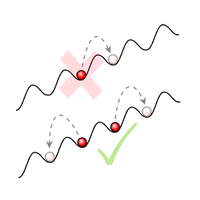
Machine learning methods, and in particular neural-network force fields (NNFF), are bridging the gap between macroscopically relevant parameters and quantum mechanical simulations. This work describes an NNFF training strategy and uses it as the back end for an effective harmonic potential study of phase transitions in hafnia. While good agreement with experiment is found regarding the monoclinic-tetragonal transition, the commonly assumed transition to a Fm3¯m cubic phase is found to be unlikely for the stoichiometric material

Stochastic magnetic tunnel junction with easy-plane dominant anisotropy

Jonathan Z. Sun, Christopher Safranski, Philip Trouilloud, Christopher D'Emic, Pouya Hashemi, and Guohan Hu

Phys. Rev. B 107, 184433 (2023) - Published 17 May, 2023

Super-paramagnetic fluctuation of a nanomagnet, when confined by a strong easy-plane anisotropy, can yield GHz speed random signal. A magnetic tunnel junction converts such moment movement into conductance fluctuation, and is useful as an entropy source for modern computing circuits. Here, the authors experimentally explore the base-line behavior of easy-plane magnetic tunnel junctions in the super-paramagnetic limit, using a CMOS back-end integrated fabrication process, and introduce some measurement methodologies to identify factors in device materials and fabrication in need of future optimization.

Near zero energy Caroli–de Gennes–Matricon vortex states in the presence of impurities

Bruna S. de Mendonça, Antonio L. R. Manesco, Nancy Sandler, and Luis G. G. V. Dias da Silva

Phys. Rev. B 107, 184509 (2023) - Published 17 May, 2023

Fermi surface symmetric mass generation

Da-Chuan Lu, Meng Zeng, Juven Wang, and Yi-Zhuang You

Phys. Rev. B 107, 195133 (2023) - Published 17 May, 2023

Mapping quantum geometry and quantum phase transitions to real space by a fidelity marker

Matheus S. M. de Sousa, Antonio L. Cruz, and Wei Chen

Phys. Rev. B 107, 205133 (2023) - Published 17 May, 2023

Explicit derivation of the chiral and generic helical edge states for the Kane-Mele model: Closed expressions for the wave function, dispersion relation, and spin rotation

Fatemeh Rahmati, Mohsen Amini, Morteza Soltani, and Mozhgan Sadeghizadeh

Phys. Rev. B 107, 205408 (2023) - Published 17 May, 2023

Bosonization of the interacting Su-Schrieffer-Heeger model

Tony Jin, Paola Ruggiero, and Thierry Giamarchi

Phys. Rev. B 107, L201111 (2023) - Published 17 May, 2023

Hallmarks of orbital-flavored Majorana states in Josephson junctions based on oxide nanochannels

Alfonso Maiellaro, Jacopo Settino, Claudio Guarcello, Francesco Romeo, and Roberta Citro

Phys. Rev. B 107, L201405 (2023) - Published 17 May, 2023

Low-frequency spin dynamics of the quasi-two-dimensional S = 12 antiferromagnet BaCdVO(PO4)2

T. A. Soldatov and A. I. Smirnov

Phys. Rev. B 107, 174423 (2023) - Published 16 May, 2023

Néel vector switching and terahertz spin-wave excitation in Mn2Au due to femtosecond spin-transfer torques

Markus Weißenhofer, Francesco Foggetti, Ulrich Nowak, and Peter M. Oppeneer

Phys. Rev. B 107, 174424 (2023) - Published 16 May, 2023

Observation of hybrid magnetic skyrmion bubbles in Fe3Sn2 nanodisks

Lingyao Kong, Jin Tang, Weiwei Wang, Yaodong Wu, Jialiang Jiang, Yihao Wang, Junbo Li, Yimin Xiong, Mingliang Tian, and Haifeng Du

Phys. Rev. B 107, 174425 (2023) - Published 16 May, 2023

It has been widely established that there exist two types of magnetic bubbles. Here, the authors present the theory and experiment of a novel three-dimensional bubble state, referred to as the type-III bubble, which is composed of Néel-twisted skyrmions with topological charge Q = -1 in the near-surface layers and type-II bubbles with Q = 0 in the interior layers. Furthermore, the authors demonstrate a method for creating the type-III bubble and the topological magnetic transformation among the three types of bubbles.

Magnon dynamics in a skyrmion-textured domain wall of antiferromagnets

Seungho Lee, Kouki Nakata, Oleg Tchernyshyov, and Se Kwon Kim

Phys. Rev. B 107, 184432 (2023) - Published 16 May, 2023

The novel interaction of a skyrmion-textured domain wall and magnons is investigated theoretically for 2D antiferromagnets with the aid of supersymmetric quantum mechanics. The scattering of propagating magnons at the domain wall is found to be governed by the emergent magnetic field coming from the skyrmion texture of the domain wall, which gives rise to the tunable spin Nernst effect. The exact theoretical analysis also yields new nonreciprocal magnons, bound to the topologically textured domain wall.

Rotational symmetry protected edge and corner states in Abelian topological phases

Naren Manjunath, Abhinav Prem, and Yuan-Ming Lu

Phys. Rev. B 107, 195130 (2023) - Published 16 May, 2023

Fractonic Luttinger liquids and supersolids in a constrained Bose-Hubbard model

Philip Zechmann, Ehud Altman, Michael Knap, and Johannes Feldmeier

Phys. Rev. B 107, 195131 (2023) - Published 16 May, 2023

Dynamical constraints have drastic consequences for the properties of many-particle quantum systems. Here, the authors study the quantum ground state phases in a fracton system of interacting bosons with dipole conservation. Through a combination of low-energy field theory and tensor network simulations, they identify a novel dipole Luttinger liquid phase as well as a fracton analogue of a supersolid state.

Dipole condensates in tilted Bose-Hubbard chains

Ethan Lake, Hyun-Yong Lee, Jung Hoon Han, and T. Senthil

Phys. Rev. B 107, 195132 (2023) - Published 16 May, 2023

The authors study a Bose-Hubbard model whose dynamics conserves the total center of mass, a situation which arises in strongly tilted optical lattices. Center of mass conservation is shown to dramatically alter the nature of the quantum phase diagram, which hosts several types of unusual gapless phases. These results hint at a wealth of interesting phenomena waiting to be uncovered in the physics of kinetically constrained many-body systems.

Electronic transport in bent carbon nanotubes

Eric Kleinherbers, Thomas Stegmann, and Nikodem Szpak

Phys. Rev. B 107, 195424 (2023) - Published 16 May, 2023

Realization of flat bands by lattice intercalation in kagome metals

Dongwook Kim and Feng Liu

Phys. Rev. B 107, 205130 (2023) - Published 16 May, 2023

Impact of Sb degrees of freedom on the charge density wave phase diagram of the kagome metal CsV3Sb5

Ethan T. Ritz, Rafael M. Fernandes, and Turan Birol

Phys. Rev. B 107, 205131 (2023) - Published 16 May, 2023

Machine learning the spectral function of a hole in a quantum antiferromagnet

Jackson Lee, Matthew R. Carbone, and Weiguo Yin

Phys. Rev. B 107, 205132 (2023) - Published 16 May, 2023

Sign In to Your Journals Account

Filter

Recent Issues

Vol. 114, Iss. 24
15 October 2026
Vol. 114, Iss. 23
15 October 2026
Vol. 114, Iss. 22
15 October 2026
Vol. 114, Iss. 21
1 October 2026
Category
Article Type
Section

Filter

Article Lookup

Enter a citation