Recent Articles

Effectuating tunable valley selection via multiterminal monolayer graphene devices

Shrushti Tapar and Bhaskaran Muralidharan

Phys. Rev. B 107, 205415 (2023) - Published 24 May, 2023

Born approximation study of the strong disorder in magnetized surface states of a topological insulator

R. S. Akzyanov

Phys. Rev. B 107, 205416 (2023) - Published 24 May, 2023

Effects of random alloy disorder, shape deformation, and substrate misorientation on the exciton lifetime and fine structure splitting of GaAs/AlxGa1−xAs(111) quantum dots

Geoffrey Pirard, Francesco Basso Basset, Sergio Bietti, Stefano Sanguinetti, Rinaldo Trotta, and Gabriel Bester

Phys. Rev. B 107, 205417 (2023) - Published 24 May, 2023

Ferrorotational domain walls revealed by electric quadrupole second harmonic generation microscopy

Xiaoyu Guo, Rachel Owen, Austin Kaczmarek, Xiaochen Fang, Chandan De, Youngjun Ahn, Wei Hu, Nishkarsh Agarwal, Suk Hyun Sung, Robert Hovden, Sang-Wook Cheong, and Liuyan Zhao

Phys. Rev. B 107, L180102 (2023) - Published 24 May, 2023

Thermal radiation in asymmetrically driven coupled non-linear photonic cavities

Bertrand Braeckeveldt and Bjorn Maes

Phys. Rev. B 107, 174310 (2023) - Published 23 May, 2023

Majorana gap formation in the anisotropic Kitaev model with ordered flux configuration

Akihiro Hashimoto, Yuta Murakami, and Akihisa Koga

Phys. Rev. B 107, 174428 (2023) - Published 23 May, 2023

Magnon dispersion in ferromagnetic SrRuO3

K. Jenni, S. Kunkemöller, A. Tewari, R. A. Ewings, Y. Sidis, A. Schneidewind, P. Steffens, A. A. Nugroho, and M. Braden

Phys. Rev. B 107, 174429 (2023) - Published 23 May, 2023

Magnetic excitations in the itinerant magnet SrRuO3 were studied by the combination of various neutron scattering techniques. Although a Heisenberg local-moment model well describes the low-energy magnon dispersion, severe suppression of intensities and stiffening of the dispersion at high energies, as well as a strong broadening, are clear finger prints of the itinerant character of magnetism in SrRuO3.

Erratum: Rotatory power reversal induced by magnetic current in bi-isotropic media [Phys. Rev. B 106, 144430 (2022)]

Pedro D. S. Silva and Manoel M. Ferreira, Jr.

Phys. Rev. B 107, 179902 (2023) - Published 23 May, 2023

Quasielastic neutron scattering probing H− dynamics in the H− conductors LaH3−2xOx

Hiromu Tamatsukuri, Keiga Fukui, Soshi Iimura, Takashi Honda, Tomofumi Tada, Youichi Murakami, Jun-ichi Yamaura, Yoshio Kuramoto, Hajime Sagayama, Takeshi Yamada, Masato Matsuura, Kaoru Shibata, Maiko Kofu, Yukinobu Kawakita, Kazutaka Ikeda, Toshiya Otomo, and Hideo Hosono

Phys. Rev. B 107, 184114 (2023) - Published 23 May, 2023

Emergence of large spin-charge interconversion at an oxidized Cu/W interface

Inge Groen, Van Tuong Pham, Stefan Ilić, Andrey Chuvilin, Won Young Choi, Edurne Sagasta, Diogo C. Vaz, Isabel C. Arango, Nerea Ontoso, F. Sebastian Bergeret, Luis E. Hueso, Ilya V. Tokatly, and Fèlix Casanova

Phys. Rev. B 107, 184438 (2023) - Published 23 May, 2023

Generalization of interlayer tunneling models to cuprate superconductors with charge density waves

Hércules Santana and E. V. L. de Mello

Phys. Rev. B 107, 184514 (2023) - Published 23 May, 2023

Twist-angle dependent proximity induced spin-orbit coupling in graphene/topological insulator heterostructures

Thomas Naimer and Jaroslav Fabian

Phys. Rev. B 107, 195144 (2023) - Published 23 May, 2023

The authors investigate the proximity-induced spin-orbit coupling in twisted graphene/topological insulator (Bi2Se3 and Bi2Te3) heterostructures from first principles. Fitting the band structures around the graphene Dirac cone to an established spin-orbit Hamiltonian yields the twist angle dependencies of the spin-orbit couplings. Amongst other findings, an interesting form of the Rashba spin-orbit coupling arises for such structures. It entails a large radial component of the in-plane spin structure around the Dirac cone, which can be used to realize collinear charge-to-spin conversion.

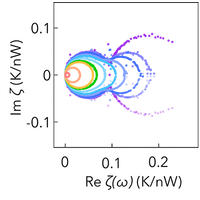
Calorimetric measurement of nuclear spin-lattice relaxation rate in metals

A. Khansili, A. Bangura, R. D. McDonald, B. J. Ramshaw, A. Rydh, and A. Shekhter

Phys. Rev. B 107, 195145 (2023) - Published 23 May, 2023

Rabi, in atomic beams, and, later, Purcell, in solids, led the way in using nuclear spins as a probe of orbital and spin dynamics of electrons. These studies use radio frequency pulses to disturb the nuclear spins from their equilibrium with electrons and then monitor their relaxation. This paper expands the range of materials where electron dynamics can be accessed via their interaction with nuclear spins – this time, using ultrafast nanocalorimeters instead of radio frequency spectrometers.

Magnetic excitations in the topological semimetal YbMnSb2

Siobhan M. Tobin, Jian-Rui Soh, Hao Su, Andrea Piovano, Anne Stunault, J. Alberto Rodríguez-Velamazán, Yanfeng Guo, and Andrew T. Boothroyd

Phys. Rev. B 107, 195146 (2023) - Published 23 May, 2023

Basal-plane heat transport in graphite thin films

Yangyu Guo, Xiao-Ping Luo, Zhongwei Zhang, Samy Merabia, Masahiro Nomura, and Sebastian Volz

Phys. Rev. B 107, 195430 (2023) - Published 23 May, 2023

Structural and electronic properties of Tl films on Ag(111): From (3×3) surface alloy to moiré superstructure

Patrick Härtl, Sven Schemmelmann, Peter Krüger, Markus Donath, and Matthias Bode

Phys. Rev. B 107, 205144 (2023) - Published 23 May, 2023

Surface alloys between the heavy metals Bi, Pb, or Sb and noble metals, such as Ag(111), are known for their giant Rashba splitting. Although thallium (Tl) should result in isostructural surface alloys, its structural and electronic properties remained elusive. The authors present here a detailed work on the structural and electronic properties of Tl films epitaxially grown on Ag(111) surfaces. By combining experimental LEED, AES, STM/STS, and IPE with ab initio band structure and charge distribution calculations, the s,pz-derived surface state of the TlAg2 surface alloy is identified, with a weak, but finite, Rashba splitting.

Random magnetic field and the Dirac Fermi surface

Chao-Jung Lee and Michael Mulligan

Phys. Rev. B 107, 205145 (2023) - Published 23 May, 2023

Quantum hydrodynamic model for noble metal nanoplasmonics

Qiang Zhou, Wancong Li, Zi He, Pu Zhang, and Xue-Wen Chen

Phys. Rev. B 107, 205413 (2023) - Published 23 May, 2023

Quantum pathways of carrier and coherent phonon excitation in bismuth

Azize Koç, Isabel Gonzalez-Vallejo, Matthias Runge, Ahmed Ghalgaoui, Klaus Reimann, Laurenz Kremeyer, Fabian Thiemann, Michael Horn-von Hoegen, Klaus Sokolowski-Tinten, Michael Woerner, and Thomas Elsaesser

Phys. Rev. B 107, L180303 (2023) - Published 23 May, 2023

Ultrafast mid-infrared excitation of an electron-hole plasma breaks the crystal symmetry of bismuth transiently and opens alternative quantum pathways for the excitation of coherent lattice motions. Probing the transient crystal structure directly by femtosecond x-ray diffraction reveals oscillations of diffracted intensity at a frequency of 2.6 THz, which persist on a picosecond time scale. They reflect coherent wave packet motions along back-folded phonon coordinates in the crystal of reduced symmetry. Optically induced symmetry breaking thus allows for modifying phonon excitations.

Efficient method for quantum impurity problems out of equilibrium

Julian Thoenniss, Michael Sonner, Alessio Lerose, and Dmitry A. Abanin

Phys. Rev. B 107, L201115 (2023) - Published 23 May, 2023

Sign In to Your Journals Account

Filter

Recent Issues

Vol. 114, Iss. 24
15 October 2026
Vol. 114, Iss. 23
15 October 2026
Vol. 114, Iss. 22
15 October 2026
Vol. 114, Iss. 21
1 October 2026
Category
Article Type
Section

Filter

Article Lookup

Enter a citation