Recent Articles

Dual semi-Dirac cones in three-dimensional photonic crystals

Mingyan Li, Ran Mei, Dongyang Yan, Zhikai Ma, Fang Cao, Yadong Xu, Changqing Xu, and Jie Luo

Phys. Rev. B 109, 125432 (2024) - Published 27 March, 2024

Intrinsic spin-orbit torque mechanism for deterministic all-electric switching of noncollinear antiferromagnets

Yiyuan Chen, Z. Z. Du, Hai-Zhou Lu, and X. C. Xie

Phys. Rev. B 109, L121115 (2024) - Published 27 March, 2024

Coexistence of topological and normal insulating phases in electro-optically tuned InAs/GaSb bilayer quantum wells

M. Meyer, T. Fähndrich, S. Schmid, A. Wolf, S. S. Krishtopenko, B. Jouault, G. Bastard, F. Teppe, F. Hartmann, and S. Höfling

Phys. Rev. B 109, L121303 (2024) - Published 27 March, 2024

Topological insulators (TIs) based on InAs/GaSb bilayer quantum wells are appealing due to the electric field tuning between topological and normal insulating (NI) phases. Here, the authors report on the coexistence of NI and TI phases in electro-optically tuned InAs/GaSb bilayer quantum wells and helical edge channels in the bulk of the sample. These findings pave the way to the manipulation and utilization of helical edge channels by using spatially defined gates (optically or electrically), separating them from the physical edges.

In-plane exciton polaritons versus plasmon polaritons: Nonlocal corrections, confinement, and loss

Yonatan Gershuni and Itai Epstein

Phys. Rev. B 109, L121408 (2024) - Published 27 March, 2024

Disorder in the chalcogen layer in 1T−TaS2−xSex

Sharon S. Philip and Despina Louca

Phys. Rev. B 109, 094118 (2024) - Published 26 March, 2024

Locality bounds for quantum dynamics at low energy

Andrew Osborne, Chao Yin, and Andrew Lucas

Phys. Rev. B 109, 094310 (2024) - Published 26 March, 2024

High-throughput calculations of antiferromagnets hosting anomalous transport phenomena

Takuya Nomoto, Susumu Minami, Yuki Yanagi, Michi-To Suzuki, Takashi Koretsune, and Ryotaro Arita

Phys. Rev. B 109, 094435 (2024) - Published 26 March, 2024

Shear-induced phase behavior and topological defects in two-dimensional crystals

Federico Ghimenti, Misaki Ozawa, Giulio Biroli, and Gilles Tarjus

Phys. Rev. B 109, 104114 (2024) - Published 26 March, 2024

Evidence of ordering in Cu-Ni alloys from experimental electronic entropy measurements

Jonathan Paras and Antoine Allanore

Phys. Rev. B 109, 104206 (2024) - Published 26 March, 2024

Challenges of measuring spin Seebeck noise

Renjie Luo, Xuanhan Zhao, Tanner J. Legvold, Liyang Chen, Changjiang Liu, Deshun Hong, Anand Bhattacharya, and Douglas Natelson

Phys. Rev. B 109, 104429 (2024) - Published 26 March, 2024

Few-layer perovskite YMnO3: A first-principles study

Yaping Meng, Fanhao Jia, Shaowen Xu, Heng Gao, Wenbin Ouyang, Yongchang Li, Yaning Cui, Yin Wang, and Wei Ren

Phys. Rev. B 109, 104430 (2024) - Published 26 March, 2024

Spin wave mode coupling in antiskyrmions induced by rotational symmetry breaking

Zhen Cheng, Haoran Chen, Siying Huang, and Yizheng Wu

Phys. Rev. B 109, 104431 (2024) - Published 26 March, 2024

Experimental evidence for nonspherical magnetic form factor in Ru3+

Colin L. Sarkis, John W. Villanova, Casey Eichstaedt, Adolfo G. Eguiluz, Jaime A. Fernandez-Baca, Masaaki Matsuda, Jiaqiang Yan, Christian Balz, Arnab Banerjee, D. Alan Tennant, Tom Berlijn, and Stephen E. Nagler

Phys. Rev. B 109, 104432 (2024) - Published 26 March, 2024

Half-polarized neutron diffraction is used to measure the microscopic local magnetization density in the prototypical Kitaev material α-RuCl3, aiding in the determination of the elusive low-energy Hamiltonian. The magnetization density around each Ru3+ ion is seen to be anisotropic, with hybridization resulting in a significant fraction of the moment associated with Cl atoms. First-principles calculations that take into account both the spin and orbital magnetization via Wannier functions elucidate the origin of the anisotropy.

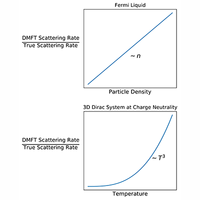
Adequacy of the dynamical mean field theory for low density and Dirac materials

Anqi Mu, Zhiyuan Sun, and Andrew J. Millis

Phys. Rev. B 109, 115154 (2024) - Published 26 March, 2024

Dynamical mean field theory – a powerful and widely used technique for calculating phase diagrams and transport properties of quantum materials – is shown to fail qualitatively for low carrier density systems and for materials with the Fermi surface near Dirac or Weyl points, because it underestimates the single particle scattering rate by a factor proportional to the density of electrons per unit cell. The problem is shown to arise because dynamical mean field theory relies on a local self-energy approximation that is invalidated by scattering kinematics in low-density systems. The results indicate that recent calculations of scattering rates and conductivity in Weyl metals should be reexamined.

Dissipative chiral channels, Ohmic scaling, and half-integer Hall conductivity from relativistic quantum Hall effect

Humian Zhou, Chui-Zhen Chen, Qing-Feng Sun, and X. C. Xie

Phys. Rev. B 109, 115305 (2024) - Published 26 March, 2024

Spectroscopy of hot electron pair emission from a driven quantum dot

Jens Schulenborg, Jonathan D. Fletcher, Masaya Kataoka, and Janine Splettstoesser

Phys. Rev. B 109, 115433 (2024) - Published 26 March, 2024

Erratum: Photoneutralization of charges in GaAs quantum dot based entangled photon emitters [Phys. Rev. B 105, 115301 (2022)]

Jingzhong Yang, Tom Fandrich, Frederik Benthin, Robert Keil, Nand Lal Sharma, Weijie Nie, Caspar Hopfmann, Oliver G. Schmidt, Michael Zopf, and Fei Ding

Phys. Rev. B 109, 119903 (2024) - Published 26 March, 2024

Topological Anderson insulating phases in the interacting Haldane model

João S. Silva, Eduardo V. Castro, Rubem Mondaini, María A. H. Vozmediano, and M. Pilar López-Sancho

Phys. Rev. B 109, 125145 (2024) - Published 26 March, 2024

Chiral spin liquid and quantum phase diagram of spin-12 J1−J2−Jχ model on the square lattice

Xiao-Tian Zhang, Yixuan Huang, Han-Qing Wu, D. N. Sheng, and Shou-Shu Gong

Phys. Rev. B 109, 125146 (2024) - Published 26 March, 2024

A chiral spin liquid (CSL) is an analog of the fractional quantum Hall state in spin systems. Recently, an interesting topic has been the coexistence of CSL and magnetic order, which is beyond the conventional understanding of the spin liquid. Here, the authors examine possible phase coexistence in the spin-½ square-lattice J1-J2-Jχ model, by using unbiased density matrix renormalization group calculations. The numerical data identify the CSL but find no evidence for the phase coexistence that was conjectured by mean-field calculations.

Absence of Weyl nodes in EuCd2As2 revealed by the carrier density dependence of the anomalous Hall effect

Yue Shi, Zhaoyu Liu, Logan A. Burnett, Seokhyeong Lee, Chaowei Hu, Qianni Jiang, Jiaqi Cai, Xiaodong Xu, Mo Li, Cheng-Chien Chen, and Jiun-Haw Chu

Phys. Rev. B 109, 125202 (2024) - Published 26 March, 2024

EuCd2As2 has been widely considered as a leading candidate for the ideal Weyl semimetal. However, a recent study challenged this view by discovering a substantial band gap in this system. Here, the authors successfully synthesize highly insulating EuCd2As2. It reveals a decrease of the anomalous Hall conductivity (AHC) by orders of magnitude as the carrier density decreases, contradicting the expected behavior of intrinsic AHC generated by the Weyl points. The results suggest that EuCd2As2 is a magnetic semiconductor rather than a Weyl semimetal.

Sign In to Your Journals Account

Filter

Recent Issues

Vol. 114, Iss. 24
15 October 2026
Vol. 114, Iss. 23
15 October 2026
Vol. 114, Iss. 22
15 October 2026
Vol. 114, Iss. 21
1 October 2026
Category
Article Type
Section

Filter

Article Lookup

Enter a citation