Recent Articles

Dynamical Casimir cooling in circuit QED systems

Sadeq S. Kadijani, Nicolás Del Grosso, Thomas L. Schmidt, and M. Belén Farias

Phys. Rev. B 109, 245417 (2024) - Published 14 June, 2024

Fidelity of the Kitaev honeycomb model under a quench

Wesley Roberts, Michael Vogl, and Gregory A. Fiete

Phys. Rev. B 109, L220406 (2024) - Published 14 June, 2024

Gravitational wave analogs in spin nematics and cold atoms

Leilee Chojnacki, Rico Pohle, Han Yan, Yutaka Akagi, and Nic Shannon

Phys. Rev. B 109, L220407 (2024) - Published 14 June, 2024

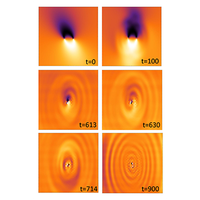
Gravitational waves, detectable in experiments such as LIGO, are challenging to reproduce. For this reason, it is important to identify analogs in other systems that can be studied on the “lab bench”. Here, the authors show how the Goldstone modes of spin nematic phases, found in magnets and cold atoms, are massless, spin-2 bosons in one-to-one correspondence with the gravitational waves in flat spacetime. Using simulations, the authors further illustrate a procedure for the generation and observation of such waves in a 23Na spinor condensate.

Small-angle neutron scattering signatures of magnetic hopfions

Konstantin L. Metlov and Andreas Michels

Phys. Rev. B 109, L220408 (2024) - Published 14 June, 2024

Identification of odd-frequency superconducting pairing in Josephson junctions

Subhajit Pal, Aabir Mukhopadhyay, Vivekananda Adak, and Sourin Das

Phys. Rev. B 109, L220504 (2024) - Published 14 June, 2024

High-field/high-frequency electron spin resonances of Fe-doped β−Ga2O3 by terahertz generalized ellipsometry: Monoclinic symmetry effects

Steffen Richter, Sean Knight, Oscar Bulancea-Lindvall, Sai Mu, Philipp Kühne, Megan Stokey, Alexander Ruder, Viktor Rindert, Viktor Ivády, Igor A. Abrikosov, Chris G. Van de Walle, Mathias Schubert, and Vanya Darakchieva

Phys. Rev. B 109, 214106 (2024) - Published 13 June, 2024

High-spin systems with reduced crystal symmetry reveal strongly anisotropic magnetic resonance. Identification of defect-related species requires us to disentangle effects such as anisotropic Zeeman or zero-field splitting, which can be very challenging using traditional magnetic resonance. Here, the authors propose and demonstrate a new cavity-free method for measuring electron paramagnetic resonance at high magnetic fields using frequency-tunable terahertz ellipsometry. Spin Hamiltonian parameters are obtained for the iron defect in monoclinic Ga2O3, and compared with results from advanced theory calculations.

Origin of zigzag antiferromagnetic order in XPS3 (X=Fe,Ni) monolayers

Ping Li, Xueyang Li, Junsheng Feng, Jinyang Ni, Zhi-Xin Guo, and Hongjun Xiang

Phys. Rev. B 109, 214418 (2024) - Published 13 June, 2024

Direct observation of current-induced nonlinear spin torque in Pt-Py bilayers

Toshiyuki Kodama, Nobuaki Kikuchi, Takahiro Chiba, Satoshi Okamoto, Seigo Ohno, and Satoshi Tomita

Phys. Rev. B 109, 214419 (2024) - Published 13 June, 2024

Possible metamagnetism in the high-pressure tetragonal phase of UTe2

T. Thebault, D. Braithwaite, G. Lapertot, D. Aoki, G. Knebel, and W. Knafo

Phys. Rev. B 109, 214420 (2024) - Published 13 June, 2024

Measurement-only dynamical phase transition of topological and boundary order in toric code and gauge Higgs models

Takahiro Orito, Yoshihito Kuno, and Ikuo Ichinose

Phys. Rev. B 109, 224306 (2024) - Published 13 June, 2024

Soft magnons in van der Waals multiferroic NiI2

Andi Cong and Ka Shen

Phys. Rev. B 109, 224419 (2024) - Published 13 June, 2024

Dipolar background field theory and dipolar braiding statistics

Jung Hoon Han

Phys. Rev. B 109, 235127 (2024) - Published 13 June, 2024

Polaronic mechanism of Nagaoka ferromagnetism in Hubbard models

Rhine Samajdar and R. N. Bhatt

Phys. Rev. B 109, 235128 (2024) - Published 13 June, 2024

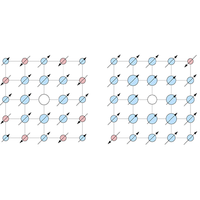
The Hubbard model, a key descriptor of strongly interacting electronic systems, typically features antiferromagnetic spin alignment. However, in certain idealized limits, the celebrated Nagaoka theorem predicts a ferromagnetic ground state. Here, the authors demonstrate how itinerant ferromagnetism arises in a host of real experimental systems without the infeasible constraints required by the Nagaoka theorem. In this universal mechanism, an individual dopant surrounds itself with a ferromagnetically aligned spin bubble, with the local polarons from multiple such dopants combining to create global ferromagnetic order.

Edge-passivation modulation of the transport properties in zigzag stanene nanoribbons

Yuan Li, Zhihui Chen, Xiaolin Su, Xinyu Cheng, Yueyue Wang, Gaofeng Xu, and Wu-Ming Liu

Phys. Rev. B 109, 235414 (2024) - Published 13 June, 2024

Multiply charged topological phonons in K2Pb2O3

Chenyang Wang, Lei Jin, Lu Tian, Wei-Wang Yu, Xiaoming Zhang, Guodong Liu, and Ying Liu

Phys. Rev. B 109, 235415 (2024) - Published 13 June, 2024

Photoinduced metallic Volkov-Pankratov states in a semi-Dirac material

SK Firoz Islam

Phys. Rev. B 109, 235416 (2024) - Published 13 June, 2024

High conductivity from cross-band electron pairing in flat-band systems

Maxim Trushin, Liangtao Peng, Gargee Sharma, Giovanni Vignale, and Shaffique Adam

Phys. Rev. B 109, 245118 (2024) - Published 13 June, 2024

A Fermi liquid of electrons is known to be unstable towards a superconducting state even with weak electron pairing. Here, the authors demonstrate theoretically that the Fermi liquid is also unstable to a frozen-like state that is enabled by electron pairing across the band touching point in a flat-band system. Like the surface of water covered by ice, this frozen Fermi liquid is hard to disturb making the electron flow immune to impurity scattering.

Thermal boundary conductance and thermal conductivity strongly depend on nearby environment

Khalid Zobaid Adnan and Tianli Feng

Phys. Rev. B 109, 245302 (2024) - Published 13 June, 2024

Photogalvanic phenomena in superconductors supporting intrinsic diode effect

S. V. Mironov, A. S. Mel'nikov, and A. I. Buzdin

Phys. Rev. B 109, L220503 (2024) - Published 13 June, 2024

Signatures of fragmentation for periodically driven fermions

Somsubhra Ghosh, Indranil Paul, and K. Sengupta

Phys. Rev. B 109, 214304 (2024) - Published 12 June, 2024
The occurrence of prethermal Hilbert space fragmentation (HSF) in periodically driven quantum systems has its roots in the emergence of additional, approximate, kinetic constraints at special driving frequencies. Here, the authors show that the out-of-time-ordered correlators (OTOCs) of a driven fermion chain with open boundary condition exhibit a signature of such HSF. At the special drive frequencies where such prethermal HSF occurs, the OTOCs display periodic unscrambling of information, which provides a yet unexplored, experimentally testable, marker for prethermal fragmentation.

Sign In to Your Journals Account

Filter

Recent Issues

Vol. 114, Iss. 24
15 October 2026
Vol. 114, Iss. 23
15 October 2026
Vol. 114, Iss. 22
15 October 2026
Vol. 114, Iss. 21
1 October 2026
Category
Article Type
Section

Filter

Article Lookup

Enter a citation