Recent Articles

Generalized Pitaevskii relation between rectifying and linear responses: Application to reciprocal magnetization induction

Hikaru Watanabe and Akito Daido

Phys. Rev. B 110, 014405 (2024) - Published 2 July, 2024

Universal chemical formula dependence of ab initio low-energy effective Hamiltonian in single-layer carrier-doped cuprate superconductors: Study using a hierarchical dependence extraction algorithm

Jean-Baptiste Morée and Ryotaro Arita

Phys. Rev. B 110, 014502 (2024) - Published 2 July, 2024

Trilayer multiorbital models of La4Ni3O10

Cui-Qun Chen, Zhihui Luo, Meng Wang, Wéi Wú, and Dao-Xin Yao

Phys. Rev. B 110, 014503 (2024) - Published 2 July, 2024

Nonlocality of local Andreev conductances as a probe for topological Majorana wires

Rodrigo A. Dourado, Poliana H. Penteado, and J. Carlos Egues

Phys. Rev. B 110, 014504 (2024) - Published 2 July, 2024

Efficient paths for local counterdiabatic driving

Stewart Morawetz and Anatoli Polkovnikov

Phys. Rev. B 110, 024304 (2024) - Published 2 July, 2024

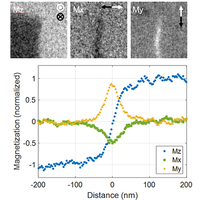
Internal structure dependent creep motion of domain walls driven by spin-transfer torques

Lucas Javier Albornoz, Rebeca Díaz Pardo, Aristide Lemaître, Sebastian Bustingorry, Javier Curiale, and Vincent Jeudy

Phys. Rev. B 110, 024403 (2024) - Published 2 July, 2024

Promising regimes for the observation of topological degeneracy in spin chains

Alexander Sattler and Maria Daghofer

Phys. Rev. B 110, 024404 (2024) - Published 2 July, 2024

Topological phase in the extended Haldane-Hubbard model with sublattice-dependent repulsion

Bao-Qing Wang, Can Shao, Takami Tohyama, Hong-Gang Luo, and Hantao Lu

Phys. Rev. B 110, 035107 (2024) - Published 2 July, 2024

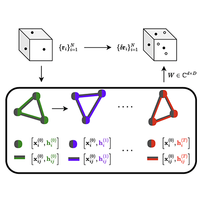
Message-passing neural quantum states for the homogeneous electron gas

Gabriel Pescia, Jannes Nys, Jane Kim, Alessandro Lovato, and Giuseppe Carleo

Phys. Rev. B 110, 035108 (2024) - Published 2 July, 2024

The immense parameter complexity of current neural-network quantum states (NQS) in continuous space renders their application to realistic physical systems impossible. Here, the authors rigorously motivate a many-body coordinate transformation as basis for a variational neural-network Ansatz, implement it via message-passing neural networks, and show a resulting reduction of two orders of magnitude in parameter complexity and convergence speed. With this, the authors open the door for future NQS studies of extended systems in the thermodynamic limit.

Isotropic behavior of oxygen vibrations in PbTiO3 investigated by Ti L2,3-edge electron energy-loss spectroscopy

I-C. Lin, M. Haruta, T. Nemoto, and H. Kurata

Phys. Rev. B 110, 035109 (2024) - Published 2 July, 2024

Computation of exciton binding energies in exciton condensation

Anna O. Schouten, LeeAnn M. Sager-Smith, and David A. Mazziotti

Phys. Rev. B 110, 035110 (2024) - Published 2 July, 2024

Exploring topological transport in Pt2HgSe3 nanoribbons: Insights for spintronic device integration

Rafael L. H. Freire, F. Crasto de Lima, Roberto H. Miwa, and A. Fazzio

Phys. Rev. B 110, 035111 (2024) - Published 2 July, 2024

Tensor network influence functionals in the continuous-time limit: Connections to quantum embedding, bath discretization, and higher-order time propagation

Gunhee Park (박건희), Nathan Ng, David R. Reichman, and Garnet Kin-Lic Chan

Phys. Rev. B 110, 045104 (2024) - Published 2 July, 2024

The authors describe here two developments of tensor network influence functionals for quantum impurity dynamics within the fermionic setting of the Anderson impurity model. The first provides the correct extension of the method to continuous time by introducing a related mathematical object. The second connects the dynamics described by a compressed tensor network influence functionals to that of a quantum embedding method with a time-dependent effective bath undergoing nonunitary dynamics. Using these concepts, the authors implement higher-order time propagators for the quench dynamics of the Anderson impurity model.

Periodic lattice microscopic rate equation model for upconversion dynamics and determination of energy transfer microparameters

Boyu Tian, Lin Fu, Yusong Wu, Guanyao Huang, and Tairan Fu

Phys. Rev. B 110, 045105 (2024) - Published 2 July, 2024

Large quantum nonreciprocity in plasmons dragged by drifting electrons

Debasis Dutta and Amit Agarwal

Phys. Rev. B 110, 045403 (2024) - Published 2 July, 2024

Collective plasmon modes, in the presence of unidirectional drift flow, acquire a nonreciprocal dispersion through the plasmonic Doppler effect. Here, the authors identify an additional quantum correction to the plasmonic Doppler shift arising from the quantum metric of the Bloch wavefunction. The authors show that the quantum plasmonic Doppler shift dominates in moiré systems, such as twisted bilayer graphene, leading to nonreciprocity up to 20%. These findings highlight the potential of moiré systems for innovative nonreciprocal photonic devices with applied direct current.

Capturing optoelectronic properties of Cs2AgSbBr6−xClx (x=0–6) double perovskites using many-body perturbation theory

Surajit Adhikari and Priya Johari

Phys. Rev. B 110, 014101 (2024) - Published 1 July, 2024

Kinetically constrained models constructed from dissipative quantum dynamics

Somnath Maity and Ryusuke Hamazaki

Phys. Rev. B 110, 014301 (2024) - Published 1 July, 2024

Effect of Ir growth pressure on the domain wall dynamics in Ta/Pt/Co/Ir/Ta stacks

P. Domenichini, Jeffrey A. Brock, J. Curiale, and A. B. Kolton

Phys. Rev. B 110, 014401 (2024) - Published 1 July, 2024

Dzyaloshinskii-Moriya interaction in Ni/Cu(001)

R. Allenspach, A. Bischof, B. Boehm, U. Drechsler, O. Reich, M. Sousa, S. Tacchi, and G. Carlotti

Phys. Rev. B 110, 014402 (2024) - Published 1 July, 2024

The authors experimentally identify here that domain walls in perpendicularly magnetized Ni films on Cu(001) are chiral – a clear sign of the Dzyaloshinskii-Moriya interaction (DMI) – up to thicknesses of 9 nm, much larger than anticipated for an interfacial effect. A detailed structural investigation shows that strain in the films is inhomogeneous and changes with thickness. The authors conclude that this misfit strain is providing the symmetry breaking interaction, suggesting a further “flavor” of DMI.

Crossover behavior at an exceptional point for quantum entanglement and correlation in a non-Hermitian XY spin system

Chuanzheng Miao, Yue Li, Jie Wang, Panpan Zhang, Qinghui Li, Lizhen Hu, Yuliang Xu, and Xiangmu Kong

Phys. Rev. B 110, 014403 (2024) - Published 1 July, 2024
Sign In to Your Journals Account

Filter

Recent Issues

Vol. 114, Iss. 24
15 October 2026
Vol. 114, Iss. 23
15 October 2026
Vol. 114, Iss. 22
15 October 2026
Vol. 114, Iss. 21
1 October 2026
Category
Article Type
Section

Filter

Article Lookup

Enter a citation