Recent Articles

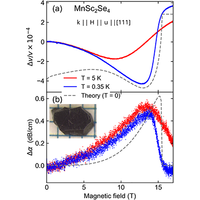
Magnon-phonon interactions in the spinel compound MnSc2Se4

J. Sourd, Y. Skourski, L. Prodan, V. Tsurkan, A. Miyata, J. Wosnitza, and S. Zherlitsyn

Phys. Rev. B 110, 094414 (2024) - Published 9 September, 2024

Magnetic frustration frequently leads to highly correlated spin fluctuations and novel ordered states. MnSc2X4 (X=S, Se) compounds are strongly frustrated magnets because of their diamond magnetic sublattice and the presence of competing ferromagnetic and antiferromagnetic interactions. From the ultrasound results for the longitudinal and transverse acoustic modes and a microscopic model based on linear spin-wave theory, the authors use here the magnon-phonon interactions to explore the quantum-spin fluctuations induced by the magnetic field in the frustrated magnet MnSc2Se4.

Magnetic field induced modification of the incommensurate antiferromagnetic structure of Fe-doped MnNiGe alloys

Riya Roy, Sanat Kumar Adhikari, Sambhu Charan Das, Rosni Roy, Kanai Mondal, Jhuma Sannigrahi, Sabyasachi Pramanick, Kalyanashis De, Dmitry Khalyavin, Devashibhai T. Adroja, Rajib Mondal, and Souvik Chatterjee

Phys. Rev. B 110, 094415 (2024) - Published 9 September, 2024

Unconventional superconductivity and paramagnetic Meissner response triggered by nonlocal pairing interaction in proximitized heterostructures

A. A. Kopasov and A. S. Mel'nikov

Phys. Rev. B 110, 094503 (2024) - Published 9 September, 2024

Oscillating-mode gap: An indicator of phase transitions in open quantum many-body systems

Taiki Haga

Phys. Rev. B 110, 104303 (2024) - Published 9 September, 2024

Real-space thermalization of locally driven quantum magnets

Ronald Melendrez, Bhaskar Mukherjee, Prakash Sharma, Arijeet Pal, and Hitesh J. Changlani

Phys. Rev. B 110, 104304 (2024) - Published 9 September, 2024

Classical spin models and basic magnetic interactions on 1/1-approximant crystals

Daniel Qvarngård and P. Henelius

Phys. Rev. B 110, 104414 (2024) - Published 9 September, 2024

Disentangling spin excitation continua in classical and quantum magnets using two-dimensional nonlinear spectroscopy

Emily Z. Zhang, Ciarán Hickey, and Yong Baek Kim

Phys. Rev. B 110, 104415 (2024) - Published 9 September, 2024

Two-dimensional coherent spectroscopy (2DCS) has emerged as a powerful tool for probing nonlinear excitation dynamics in quantum magnets, overcoming the limitations of traditional inelastic neutron scattering as a linear probe. The authors use here classical molecular dynamics simulations to compare the 2DCS responses of various models with large Kitaev interactions, revealing distinct features between quantum spin liquids, classical spin liquids, and large unit cell magnetic orders. These findings underscore the potential for 2DCS in disentangling the complex dynamics of frustrated magnetic systems.

Magnon-mediated quantum gates for superconducting qubits

Martijn Dols, Sanchar Sharma, Lenos Bechara, Yaroslav M. Blanter, Marios Kounalakis, and Silvia Viola Kusminskiy

Phys. Rev. B 110, 104416 (2024) - Published 9 September, 2024

Spin-orbit coupling induced orbital entanglement in a three-band Hubbard model

Petr A. Igoshev, Danil E. Chizhov, Valentin Yu. Irkhin, and Sergey V. Streltsov

Phys. Rev. B 110, 115110 (2024) - Published 9 September, 2024

Doping-tunable Fermi surface with persistent topological Hall effect in the axion candidate EuIn2As2

Jian Yan, Jianguo Si, Zhongzhu Jiang, Hanming Ma, Yoshiya Uwatoko, Bao-Tian Wang, Xuan Luo, Yuping Sun, and Minoru Yamashita

Phys. Rev. B 110, 115111 (2024) - Published 9 September, 2024

Real- and reciprocal space characterization of the three-dimensional charge density wave in quasi-one-dimensional CuTe

Fei Guo, Michele Puppin, Lukas Hellbrück, Arnaud Magrez, Eduardo B. Guedes, Igor Sokolović, and J. Hugo Dil

Phys. Rev. B 110, 115112 (2024) - Published 9 September, 2024

Conformal operator content of the Wilson-Fisher transition on fuzzy sphere bilayers

Chao Han, Liangdong Hu, and W. Zhu

Phys. Rev. B 110, 115113 (2024) - Published 9 September, 2024

Hofstadter spectrum of Chern bands in twisted transition metal dichalcogenides

Kryštof Kolář, Kang Yang, Felix von Oppen, and Christophe Mora

Phys. Rev. B 110, 115114 (2024) - Published 9 September, 2024

Twisted transition metal dichalcogenide bilayers feature topological flat bands at zero magnetic field, allowing the experimental observation of integer and fractional quantum anomalous Hall effects. This work studies the band structures of these systems under externally applied magnetic fields, uncovering a fingerprint of the zero field topology in the Hofstadter spectra. In particular, it emerges that the Landau-level-like behavior at zero flux can be understood using the band structures at finite flux.

Spin-orbital coupling induced isolated flat band in bismuthene with k-dependent spin texture

Shifang Li, Xizhi Shi, Jin Li, Chaoyu He, Tao Ouyang, Chao Tang, and Jianxin Zhong

Phys. Rev. B 110, 115115 (2024) - Published 9 September, 2024

Spin-resolved nonlocal transport in proximitized Rashba nanowires

Paweł Szumniak, Daniel Loss, and Jelena Klinovaja

Phys. Rev. B 110, 115413 (2024) - Published 9 September, 2024

Understanding electron transport mechanisms in monolayer MoS2 transistors: Impact of lattice phonon scattering and localized charge traps

Yakui Mu, Siyu Liu, Yanming Wang, Zhikun Liu, and Mingzhen Zhao

Phys. Rev. B 110, 115414 (2024) - Published 9 September, 2024

Resolving chiral transitions in one-dimensional Rydberg arrays with quantum Kibble-Zurek mechanism and finite-time scaling

Jose Soto Garcia and Natalia Chepiga

Phys. Rev. B 110, 125113 (2024) - Published 9 September, 2024

Hinge non-Hermitian skin effect in the single-particle properties of a strongly correlated f-electron system

Robert Peters and Tsuneya Yoshida

Phys. Rev. B 110, 125114 (2024) - Published 9 September, 2024

Closest Wannier functions to a given set of localized orbitals

Taisuke Ozaki

Phys. Rev. B 110, 125115 (2024) - Published 9 September, 2024

Scandium-based point defect in AlN for quantum information processing

Kamil Czelej, Mark E. Turiansky, Sai Mu, and Chris G. Van de Walle

Phys. Rev. B 110, 125116 (2024) - Published 9 September, 2024

Point defects in wide-band-gap semiconductors are leading qubit candidates for realizing quantum information processing. The authors investigate here the electronic structure and magneto-optical properties of scandium-related point defects in AlN, a material widely used in electronics and optoelectronics. The positively charged scandium−nitrogen-vacancy complex, which has a singlet ground state, exhibits a spin polarization cycle similar to the ST1 center in diamond, with long coherence time resulting from an electron spin being transferred to a nuclear spin, and large optically detected magnetic resonance readout contrast. These properties render the center promising for use as a quantum memory.

Sign In to Your Journals Account

Filter

Recent Issues

Vol. 114, Iss. 24
15 October 2026
Vol. 114, Iss. 23
15 October 2026
Vol. 114, Iss. 22
15 October 2026
Vol. 114, Iss. 21
1 October 2026
Category
Article Type
Section

Filter

Article Lookup

Enter a citation