Recent Articles

Massive higher-spin fields in the fractional quantum Hall effect

E. Bergshoeff, A. Campoleoni, G. Palumbo, and P. Salgado-Rebolledo

Phys. Rev. B 110, 235152 (2024) - Published 24 December, 2024

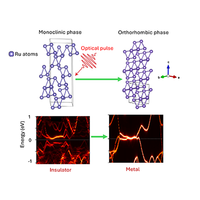
Origin of metal-insulator transitions in the parent compounds of ruthenium-pnictide superconductors

Niraj Aryal, Corey Melnick, Emil S. Bozin, Robert M. Konik, and Weiguo Yin

Phys. Rev. B 110, 235153 (2024) - Published 24 December, 2024

The authors explore here the origin of metal-to-insulator transition (MIT) in the parent compounds of recently discovered ruthenium pnictide superconductors. Using various first-principles calculations, such as density functional and dynamical mean-field theories, they rule out electronic correlation and Fermi surface nesting as the drivers for MIT. Instead, they suggest electron-phonon coupling as the most likely mechanism to induce the transition from an insulating monoclinic to a metallic orthorhombic phase. They propose ultrafast light-induced novel two-step MIT in these systems,which calls for further investigation.

Transport in open quantum systems in the presence of lossy channels

Katha Ganguly, Manas Kulkarni, and Bijay Kumar Agarwalla

Phys. Rev. B 110, 235425 (2024) - Published 24 December, 2024

Non-Hermitian multiterminal phase-biased Josephson junctions

Jorge Cayao and Masatoshi Sato

Phys. Rev. B 110, 235426 (2024) - Published 24 December, 2024

The authors predict here the realization of higher-dimensional exceptional points by combining the realms of non-Hermitian physics and multiterminal Josephson junctions. They demonstrate that the exceptional points emerge as stable lines and surfaces in the Andreev spectrum protected by non-Hermitian topology and controllable by the Josephson effect via the superconducting phases. The authors also show that the exceptional points mediate the formation of Andreev molecules and enhance their nonlocal Josephson effect, which is otherwise tiny.

Generative diffusion model for surface structure discovery

Nikolaj Rønne, Alán Aspuru-Guzik, and Bjørk Hammer

Phys. Rev. B 110, 235427 (2024) - Published 24 December, 2024

The generative diffusion method is adapted for use in connection with surface structure determination. The authors introduce here the concepts required to train a diffusion model on structures from small-cell density functional theory calculations. Using the diffusion model to generate large-cell surface structures, the authors demonstrate that highly plausible structures result. The efficiency of generating low-energy structures is compared to that of the random structure search method. Finally, using the diffusion method, a structure for a Ag-based surface-oxide grain boundary is proposed.

Erratum: Dynamics and condensation of polaritons in an optical nanocavity coupled to two-dimensional materials [Phys. Rev. B 109, 155432 (2024)]

Maria Vittoria Gurrieri, Emil V. Denning, Kristian Seegert, Philip T. Kristensen, and Jesper Mørk

Phys. Rev. B 110, 239902 (2024) - Published 24 December, 2024

Resonant inelastic x-ray scattering in the topological semimetal FeSi

Yao Shen, Anirudh Chandrasekaran, Jennifer Sears, Tiantian Zhang, Xin Han, Youguo Shi, Jiemin Li, Jonathan Pelliciari, Valentina Bisogni, Mark P. M. Dean, and Stefanos Kourtis

Phys. Rev. B 110, 245137 (2024) - Published 24 December, 2024

Theories for charge-driven nematicity in kagome metals

Francesco Grandi, Michael A. Sentef, Dante M. Kennes, and Ronny Thomale

Phys. Rev. B 110, 245138 (2024) - Published 24 December, 2024

Nematicity, the broken rotational symmetry of a lattice’s point group, is often linked to unconventional superconductivity. This work presents two theories for the nematic behavior in kagome metals. One theory suggests a d-wave charge Pomeranchuk instability, while the other attributes nematicity to fluctuations in one-dimensional charge order observed experimentally. Unlike iron-based superconductors, where spin-fluctuations drive nematicity, the kagome metals’ nematic tendencies are likely induced by charge fluctuations, offering a distinct mechanism for this behavior.

Biaxial strain tuning of excitons in monolayer MoSe2 by high-temperature physical vapor deposition

S. Patel, T. Faltermeier, S. Puri, R. Rodriguez, K. Reynolds, S. Davari, C. McPherson, H. O. H. Churchill, N. J. Borys, and H. Nakamura

Phys. Rev. B 110, 245310 (2024) - Published 24 December, 2024

Fluctuations of quantum coherences in the Anderson model are described by the quantum symmetric simple exclusion process

Ludwig Hruza and Tony Jin

Phys. Rev. B 110, L220202 (2024) - Published 24 December, 2024

Preparation and readout of Majorana qubits in magnet-superconductor hybrid systems

Dan Crawford, Roland Wiesendanger, and Stephan Rachel

Phys. Rev. B 110, L220505 (2024) - Published 24 December, 2024

Supersolid phase in the diluted Holstein model

Jingyao Meng, Yuxi Zhang, Rafael M. Fernandes, Tianxing Ma, and R. T. Scalettar

Phys. Rev. B 110, L220506 (2024) - Published 24 December, 2024

Experimental observation of boundary flat bands with topological spin textures

Yuanchuan Biao, Zhongbo Yan, and Rui Yu

Phys. Rev. B 110, L241110 (2024) - Published 24 December, 2024

The spin polarization of a boundary flat band (BFB) protected by chiral symmetry is typically fixed. The authors experimentally demonstrate here the realization of BFBs with momentum-dependent spin polarizations, exhibiting nontrivial topological windings across the boundary Brillouin zone in a circuit system. The so-called subchiral symmetry is the key symmetry responsible for the emergence of these additional topological properties. These findings establish BFBs as a promising new platform for exploring flat-band physics.

Higher-order gap ratios of singular values in open quantum systems

S. Harshini Tekur, M. S. Santhanam, Bijay Kumar Agarwalla, and Manas Kulkarni

Phys. Rev. B 110, L241410 (2024) - Published 24 December, 2024

Effect of thermal longitudinal spin fluctuations on the elastic properties of Ni3Nb

Ziyi Xiong, Wei Li, Zhihua Dong, Weiwei Xu, and Levente Vitos

Phys. Rev. B 110, 214109 (2024) - Published 23 December, 2024

Monoatomic orbital-based one-dimensional topological crystalline insulator

Gengming Liu, Violet Workman, Jiho Noh, Yuhao Ma, Taylor L. Hughes, Wladimir A. Benalcazar, and Gaurav Bahl

Phys. Rev. B 110, 214110 (2024) - Published 23 December, 2024

Nonthermal solid-solid phase transition in ferromagnetic iron

S. Azadi, J. S. Wark, and S. M. Vinko

Phys. Rev. B 110, 214434 (2024) - Published 23 December, 2024

Effects of Kitaev interaction on magnetic order and anisotropy

Lianchuang Li, Binhua Zhang, Zefeng Chen, Changsong Xu, and Hongjun Xiang

Phys. Rev. B 110, 214435 (2024) - Published 23 December, 2024

Origin of the gossamer ferromagnetism in MnTe

I. I. Mazin and K. D. Belashchenko

Phys. Rev. B 110, 214436 (2024) - Published 23 December, 2024

Coupling-dependent antiferromagnetic-ferromagnetic ordering in a pinwheel artificial spin ice

Anders Strømberg, Einar Digernes, Rajesh Vilas Chopdekar, Jostein Grepstad, and Erik Folven

Phys. Rev. B 110, 214437 (2024) - Published 23 December, 2024

Sign In to Your Journals Account

Filter

Recent Issues

Vol. 114, Iss. 24
15 October 2026
Vol. 114, Iss. 23
15 October 2026
Vol. 114, Iss. 22
15 October 2026
Vol. 114, Iss. 21
1 October 2026
Category
Article Type
Section

Filter

Article Lookup

Enter a citation