Recent Articles

Multistep transition between topological spin textures in van der Waals magnets

Yuheng Liu, Baishun Yang, and Yu Yan

Phys. Rev. B 111, 104427 (2025) - Published 20 March, 2025

Emergent intermediate phase in the J1−J2 XY model from tensor network approaches

Feng-Feng Song, Hanggai Nuomin, and Naoki Kawashima

Phys. Rev. B 111, 104428 (2025) - Published 20 March, 2025

Two-particle self-consistent approach combined with dynamical mean field theory: A real-frequency study of the square-lattice Hubbard model

Lei Geng, Jiawei Yan, and Philipp Werner

Phys. Rev. B 111, 115143 (2025) - Published 20 March, 2025

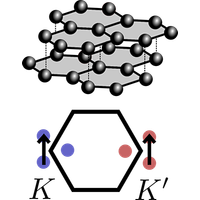
Switching between superconductivity and current density waves in Bernal bilayer graphene

Jun Ho Son, Yi-Ting Hsu, and Eun-Ah Kim

Phys. Rev. B 111, 115144 (2025) - Published 20 March, 2025

Recent experiments on Bernal-stacked bilayer graphene discovered superconductivity near the van Hove filling only when an in-plane magnetic field or proximate spin-orbit coupling lifts spin degeneracy. Inspired by the experiments, the authors theoretically study here competing ordering instabilities near the van Hove filling of the bilayer graphene with renormalization group methods. The study shows that breaking spin degeneracy would “switch” the balance between incommensurate current density wave that breaks translation, time-reversal, and C3 symmetry, and superconductivity to favor superconductivity.

Electron transport in bilayer graphene nanoconstrictions patterned using atomic force microscope nanolithography

Robert W. Rienstra, Nishat Sultana, En-Min Shih, Evan Stocker, Kenji Watanabe, Takashi Taniguchi, Curt A. Richter, Joseph Stroscio, Nikolai Zhitenev, and Fereshte Ghahari

Phys. Rev. B 111, 115145 (2025) - Published 20 March, 2025

Ab initio study on engineering the quantum anomalous Hall effect in the compensated antiferromagnet MnBi2Te4

Zeyu Li, Yulei Han, Wenhao Liang, and Zhenhua Qiao

Phys. Rev. B 111, 115416 (2025) - Published 20 March, 2025

Topological corner states in bilayer and trilayer systems with vertically stacked topological heterostructures

Natsuko Ishida, Motohiko Ezawa, Guangtai Lu, Wenbo Lin, Yasutomo Ota, Yasuhiko Arakawa, and Satoshi Iwamoto

Phys. Rev. B 111, 115418 (2025) - Published 20 March, 2025

Fate of poor man's Majoranas in the long Kitaev chain limit

Melina Luethi, Henry F. Legg, Daniel Loss, and Jelena Klinovaja

Phys. Rev. B 111, 115419 (2025) - Published 20 March, 2025

Comment on “Diamond (111) surface reconstruction and epitaxial graphene interface”

C. Goletti, F. Bechstedt, G. Bussetti, L. Ley, M. Marsili, O. Pulci, and P. Chiaradia

Phys. Rev. B 111, 117301 (2025) - Published 20 March, 2025

Reply to “Comment on “Diamond (111) surface reconstruction and epitaxial graphene interface””

B. P. Reed, M. E. Bathen, J. W. R. Ash, C. J. Meara, A. A. Zakharov, J. P. Goss, J. W. Wells, D. A. Evans, and S. P. Cooil

Phys. Rev. B 111, 117302 (2025) - Published 20 March, 2025

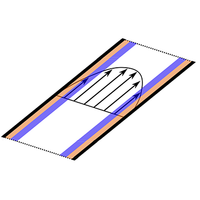
Near-hydrodynamic electron flow according to the linearized Boltzmann equation

Nitay Ben-Shachar, Joseph T. Johnson, Mahyar Madadi, Douglas R. Brumley, Jason Nassios, and John E. Sader

Phys. Rev. B 111, 125145 (2025) - Published 20 March, 2025

Disentanglement of overlapping spectrograms in attosecond time-resolved photoelectron spectroscopy of solids

Andreas Gebauer, Tillmann Schabbehard, Luis Maschmann, and Walter Pfeiffer

Phys. Rev. B 111, 125146 (2025) - Published 20 March, 2025

Hydrodynamics as the effective field theory of strong-to-weak spontaneous symmetry breaking

Xiaoyang Huang, Marvin Qi, Jian-Hao Zhang, and Andrew Lucas

Phys. Rev. B 111, 125147 (2025) - Published 20 March, 2025

Low-energy excitations in multiple modulation-doped CdTe/(CdMg)Te quantum wells

D. Yavorskiy, F. Le Mardelé, I. Mohelsky, M. Orlita, Z. Adamus, T. Wojtowicz, J. Wróbel, K. Karpierz, and J. Łusakowski

Phys. Rev. B 111, 125414 (2025) - Published 20 March, 2025

Hall field and odd viscosity in near-hydrodynamic electron flows

Nitay Ben-Shachar, Joseph T. Johnson, Mayhar Madadi, Douglas R. Brumley, Jason Nassios, and John E. Sader

Phys. Rev. B 111, L121107 (2025) - Published 20 March, 2025

The Hall or odd viscosity governs hydrodynamic electron flows in the presence of an applied magnetic field. Here, the authors report a rigorous asymptotic theory of near-hydrodynamic electron flows and demonstrate a rarefaction effect that competes with the Hall viscosity. This resolves the discrepancy of prior hydrodynamic theories in predicting the Hall resistivity in channel flow, providing insight into the flow physics and an alternative to numerical solutions of the Boltzmann equation.

Dynamic mass generation on two-dimensional electronic hyperbolic lattices

Noble Gluscevich, Abhisek Samanta, Sourav Manna, and Bitan Roy

Phys. Rev. B 111, L121108 (2025) - Published 20 March, 2025

The authors show here that two-dimensional hyperbolic lattices can be classified as Dirac liquids, Fermi liquids, and flat bands, respectively, featuring vanishing, constant, and diverging density of states near half-filling. On such curved quantum crystals, on-site Hubbard and nearest-neighbor Coulomb repulsion stabilize antiferromagnetic and charge density wave ground states, respectively. The requisite critical couplings for these orderings decrease with the increasing curvature in hyperbolic Dirac fluids, suggesting a curvature-induced weak-coupling quantum phase transitions therein. By contrast, these two orderings develop even for infinitesimal interactions in Fermi liquids and flat-band systems.

Stripe antiferromagnetic ground-state configuration of FeSe revealed by density functional theory

Luke Allen Myers, Nigel Lee En Hew, Shun-Li Shang, and Zi-Kui Liu

Phys. Rev. B 111, L121109 (2025) - Published 20 March, 2025

Chiral terahertz photocurrent in quantum point contact–split ring resonator coupled systems in the quantum Hall regime

Jing Huang, Jinkwan Kwoen, Yasuhiko Arakawa, Kazuhiko Hirakawa, and Kazuyuki Kuroyama

Phys. Rev. B 111, L121407 (2025) - Published 20 March, 2025

Light-matter interaction between cyclotron resonance and photons in a plasmonic resonator enables the formation of polaritons in the ultrastrong coupling regime. While optical studies are common, the authors demonstrate here electrical detection of ultrastrong coupling via terahertz-induced photocurrent through a quantum point contact and reveal the chiral behavior of the photocurrent with respect to magnetic field. Their theoretical model based on nonequilibrium electron distribution in edge channels agrees well with the experimental data, which offers new insights into light-matter interactions.

Hybrid-orbital topological disclination states and wave propagation in defect-induced confined Mie resonance photonic crystals

Yuexin Zhang, Lanxin Luo, Xiaoyu Dai, and Yuanjiang Xiang

Phys. Rev. B 111, 094110 (2025) - Published 19 March, 2025

Self-reasoning assisted learning for non-Abelian gauge fields design

Jinyang Sun, Xi Chen, Xiumei Wang, Dandan Zhu, and Xingping Zhou

Phys. Rev. B 111, 094111 (2025) - Published 19 March, 2025

Sign In to Your Journals Account

Filter

Recent Issues

Vol. 114, Iss. 24
15 October 2026
Vol. 114, Iss. 23
15 October 2026
Vol. 114, Iss. 22
15 October 2026
Vol. 114, Iss. 21
1 October 2026
Category
Article Type
Section

Filter

Article Lookup

Enter a citation