Recent Articles

Multipolar phase transition in the 4f2 fcc lattice compound PrCdNi4

Yuka Kusanose, Yasuyuki Shimura, Kazunori Umeo, Naomi Kawata, Toshiro Takabatake, Taichi Terashima, Naoki Kikugawa, Takako Konoike, Yuya Hattori, Kazuhiro Nawa, Hung-Cheng Wu, Taku J Sato, and Takahiro Onimaru

Phys. Rev. B 111, 165125 (2025) - Published 14 April, 2025

Electronic structure of decagonal Al-Ni-Co quasicrystal studied by photoelectron spectroscopy and density functional theory

Shuvam Sarkar, Marian Krajčí, Sajal Barman, Mohammad Balal, Pramod Bhakuni, Paul C. Canfield, Andrei Gloskovskii, and Sudipta Roy Barman

Phys. Rev. B 111, 165126 (2025) - Published 14 April, 2025

Electron-transverse acoustic phonon couplings in three-dimensional pentatellurides

Rui Min, Fuxiang Li, and Yi-Xiang Wang

Phys. Rev. B 111, 165204 (2025) - Published 14 April, 2025

Distinct ultrafast recombination behaviors of spin-orbit splitting bands in 2H−MoTe2

Jiahua Lu, Jian Tu, Bo Liu, Xinyue Wang, Liang He, Yao Li, Jing Wu, Rong Zhang, Yongbing Xu, and Xuezhong Ruan

Phys. Rev. B 111, 165409 (2025) - Published 14 April, 2025

Mesoscopic theory of the Josephson junction

Thomas J. Maldonado, Hakan E. Türeci, and Alejandro W. Rodriguez

Phys. Rev. B 111, L140505 (2025) - Published 14 April, 2025

Nonreciprocal local-resonance induced complex band hybridization

Wang Tat Yau, Kai Fung Lee, Raymond P. H. Wu, Wai Chun Wong, Jensen Li, C. T. Chan, and Kin Hung Fung

Phys. Rev. B 111, L161111 (2025) - Published 14 April, 2025

Commensurate to incommensurate transition of three-dimensional charge density waves

Hao Wang, Qiang Luo, and Ji Chen

Phys. Rev. B 111, L161112 (2025) - Published 14 April, 2025

Out-of-plane Edelstein effects: Electric field induced magnetization in p-wave magnets

Motohiko Ezawa

Phys. Rev. B 111, L161301 (2025) - Published 14 April, 2025

On-chip quantum confinement refrigeration overcoming electron-phonon heat leaks

S. Autti, J. R. Prance, and M. Prunnila

Phys. Rev. B 111, L161404 (2025) - Published 14 April, 2025

Precise control and displacement of polar textures from inhomogeneous and time-dependent electric fields

Fernando Gómez-Ortiz, Louis Bastogne, Xu He, and Philippe Ghosez

Phys. Rev. B 111, 134107 (2025) - Published 11 April, 2025

Vacuum-induced three-body delocalization in cavity quantum materials

Zhengxin Guo and Zi Cai

Phys. Rev. B 111, 134202 (2025) - Published 11 April, 2025

Topological invariants of vortices, merons, skyrmions, and their combinations in continuous and discrete systems

Filipp N. Rybakov, Olle Eriksson, and Nikolai S. Kiselev

Phys. Rev. B 111, 134417 (2025) - Published 11 April, 2025

Longitudinal spin attenuation behavior induced by magnetic disorder in the noncollinear magnetic structure of the Invar alloy

Jian Huang, Qingshui Liu, Junnan Guo, Yanyan Jiang, Weikang Wu, and Hui Li

Phys. Rev. B 111, 134418 (2025) - Published 11 April, 2025

Machine learning accelerates composition design of lead-free high performance piezoceramics based on potassium sodium niobate

Xingshuai Ma (马星帅), Shiqing Deng (邓世清), He Qi (祁核), and Jun Chen (陈骏)

Phys. Rev. B 111, 144104 (2025) - Published 11 April, 2025

Spectral width of maximum deposition eigenchannels in diffusive media

Rohin E. McIntosh, Arthur Goetschy, Nicholas Bender, Alexey Yamilov, Chia Wei Hsu, Hasan Yılmaz, and Hui Cao

Phys. Rev. B 111, 144202 (2025) - Published 11 April, 2025

How quantum selection rules influence the magneto-optical effects of driven ultrafast magnetization dynamics

Mohamed F. Elhanoty, Olle Eriksson, Chin Shen Ong, and Oscar Grånäs

Phys. Rev. B 111, 144410 (2025) - Published 11 April, 2025

Moving skyrmions in antiferromagnets by sublattice displacements

Michael Lau, Wolfgang Häusler, and Michael Thorwart

Phys. Rev. B 111, 144411 (2025) - Published 11 April, 2025

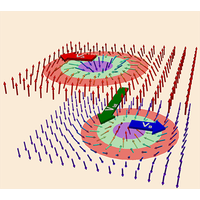
Magnetic skyrmions are topologically protected swirls in magnets. They behave like quasiparticles which, in ferromagnets, don’t exhibit inertial mass. In antiferromagnets, a skyrmion can be viewed as composed of two coupled ferromagnetic skyrmions of opposite orientation. Interestingly, antiferromagnetic skyrmions behave like classical particles, with finite inertial mass. Here, the authors trace this mass generation back to a small displacement between the sublattice skyrmions that arises when applying forces to the skyrmion. They further predict the velocity of a current-driven antiferromagnetic skyrmion.

Interfacial Dzyaloshinskii-Moriya interaction in nonmagnetic/noncollinear-antiferromagnetic bilayers

Yuta Yamane, Yasufumi Araki, and Shunsuke Fukami

Phys. Rev. B 111, 144412 (2025) - Published 11 April, 2025

Anisotropic modulations of superconductivity in an isolated superconducting layer of the iron-based superconductor KCa2Fe4As4F2

Zongyuan Zhang, Qing Wang, Lichuan Wang, Yu-bing Tu, Shuai Shao, Teng Wang, Fan Zhang, Jie Hou, Xing-yuan Hou, Gang Mu, Ning Hao, and Lei Shan

Phys. Rev. B 111, 144504 (2025) - Published 11 April, 2025

Extended Hubbard model on a honeycomb lattice

Welberth Kennedy, Sebastião dos Anjos Sousa-Júnior, Natanael C. Costa, and Raimundo R. dos Santos

Phys. Rev. B 111, 155118 (2025) - Published 11 April, 2025

Sign In to Your Journals Account

Filter

Recent Issues

Vol. 114, Iss. 24
15 October 2026
Vol. 114, Iss. 23
15 October 2026
Vol. 114, Iss. 22
15 October 2026
Vol. 114, Iss. 21
1 October 2026
Category
Article Type
Section

Filter

Article Lookup

Enter a citation