Recent Articles

Thermoelectric and specific heat characteristics of the charge density wave compounds RTe3 (R=Gd,Tb,Dy,Ho,andEr)

De-Lun Ma, Pallab Bag, Yung-Kang Kuo, Chia-Nung Kuo, and Chin Shan Lue

Phys. Rev. B 111, 165420 (2025) - Published 25 April, 2025

Unsupervised machine learning for detecting mutual independence among eigenstate regimes in interacting quasiperiodic chains

Colin Beveridge, Kathleen Hart, Cassio Rodrigo Cristani, Xiao Li, Enrico Barbierato, and Yi-Ting Hsu

Phys. Rev. B 111, L140202 (2025) - Published 25 April, 2025

Revealing the magnetic dimensional crossover in the Heisenberg ferromagnet CrSiTe3 through picosecond strain pulses

Anjan Kumar N M, Soumya Mukherjee, Abhirup Mukherjee, Ajinkya Punjal, Shubham Purwar, Thirupathaiah Setti, Shriganesh Prabhu S., Siddhartha Lal, and N. Kamaraju

Phys. Rev. B 111, L140414 (2025) - Published 25 April, 2025

Deciphering the origin of spin current in spintronic terahertz emitters and its imprint on their electromagnetic radiation via time-dependent density functional theory

Ali Kefayati, Yafei Ren, M. Benjamin Jungfleisch, Lars Gundlach, John Q. Xiao, and Branislav K. Nikolić

Phys. Rev. B 111, L140415 (2025) - Published 25 April, 2025

Anisotropic suppression of the phononic thermal conductivity by magnetic field in SmAlSi

Mujeeb Ahmad, Md Shahin Alam, Xiaohan Yao, Fazel Tafti, and Marcin Matusiak

Phys. Rev. B 111, L161121 (2025) - Published 25 April, 2025

Disorder enhanced thermalization in interacting many-particle system

Chakradhar Rangi, Herbert F. Fotso, Hanna Terletska, Juana Moreno, and Ka-Ming Tam

Phys. Rev. B 111, L161122 (2025) - Published 25 April, 2025

Obstruction of broken symmetries in topological flat bands

Penghao Zhu, Shi Feng, and Yuan-Ming Lu

Phys. Rev. B 111, L161411 (2025) - Published 25 April, 2025

Tunable Dirac nodal line in orthorhombic RuO2

Ece Uykur, Oleg Janson, Victoria A. Ginga, Marcus Schmidt, Nico Giordano, and Alexander A. Tsirlin

Phys. Rev. B 111, 134114 (2025) - Published 24 April, 2025

Hydrostatic pressure lowers the symmetry of RuO2 and controls the amount of orthorhombic strain in this material. The structural transformation upon compression is traced via single-crystal x-ray diffraction combined with ab initio calculations. It is shown that pressurized RuO2 does not become altermagnetic, but it retains the key feature of the parent tetragonal phase, the Dirac nodal line that can be shifted across the Fermi level by varying pressure.

Cooling and squeezing a microwave cavity state with magnons using an optomechanical-type coupling

Qin Xu and Gregory D. Fuchs

Phys. Rev. B 111, 134440 (2025) - Published 24 April, 2025

Skyrmion crystal phase on a magnetic domain wall in chiral magnets

Yuki Amari and Muneto Nitta

Phys. Rev. B 111, 134441 (2025) - Published 24 April, 2025

Phase diagram of the XXZ pyrochlore model from pseudo-Majorana functional renormalization group

Yannik Schaden, Matías G. Gonzalez, and Johannes Reuther

Phys. Rev. B 111, 134442 (2025) - Published 24 April, 2025

Pyrochlore materials exhibit exotic spin physics, which can be well described by a spin-½ nearest neighbor XXZ model. Here, the pseudo-Majorana functional renormalization group is used to compute the entire phase diagram as a function of the temperature and transverse coupling. The authors identify an extensive nonmagnetic regime accompanied by quantum order-by-disorder effects and the possibility of a lattice nematic ground state. In the spin ice phases, the method predicts structure factors with characteristic pinch points, broadened by thermal fluctuations.

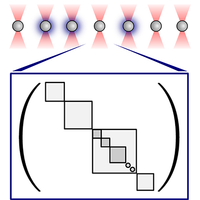
Probing Hilbert space fragmentation with strongly interacting Rydberg atoms

Fan Yang, Hadi Yarloo, Hua-Chen Zhang, Klaus Mølmer, and Anne E. B. Nielsen

Phys. Rev. B 111, 144313 (2025) - Published 24 April, 2025

Hilbert space fragmentation provides a novel route to ergodicity breaking in isolated quantum many-body systems. The authors present here a feasible scheme to systematically explore Hilbert space fragmentation in a Rydberg atom array. They show that asymmetric quasiparticle transport can be used to tune Krylov-subspace ergodicity, and that atomic position disorder can selectively induce a many-body localization transition. The proposed scheme is expected to be realized on state-of-the-art Rydberg quantum simulators.

Dynamically generated spin interactions and nutational spin inertia in normal metal–ferromagnet heterostructures

Christian Svingen Johnsen and Asle Sudbø

Phys. Rev. B 111, 144423 (2025) - Published 24 April, 2025

MPd5 kagome superconductors studied by density functional calculations

Dan Li, Zhengxuan Wang, Panshi Jing, Mehrdad Shiri, Kun Wang, Chunlan Ma, Shijing Gong, Chuanxi Zhao, Tianxing Wang, Xiao Dong, Lin Zhuang, Wuming Liu, and Yipeng An

Phys. Rev. B 111, 144511 (2025) - Published 24 April, 2025

DFT+DMFT investigation of the magnetic phase transition in the itinerant ferromagnet Fe3GaTe2

Yuanji Xu, Xintao Jin, Jiacheng Xiang, Huiyuan Zhang, and Fuyang Tian

Phys. Rev. B 111, 155142 (2025) - Published 24 April, 2025

Entanglement swapping in critical quantum spin chains

Masahiro Hoshino, Masaki Oshikawa, and Yuto Ashida

Phys. Rev. B 111, 155143 (2025) - Published 24 April, 2025

I-centered versus F-centered orthorhombic symmetry and negative thermal expansion of the charge density wave of EuAl2Ga2

Harshit Agarwal, Surya Rohith Kotla, Leila Noohinejad, Biplab Bag, Claudio Eisele, Sitaram Ramakrishnan, Martin Tolkiehn, Carsten Paulmann, Arumugam Thamizhavel, Srinivasan Ramakrishnan, and Sander van Smaalen

Phys. Rev. B 111, 155144 (2025) - Published 24 April, 2025

Ultraflat bands in twisted moiré superlattices under shallow potential wells

Qiqi Deng, Sheng-Yi Xie, Xian-Bin Li, and Ying Jiang

Phys. Rev. B 111, 155145 (2025) - Published 24 April, 2025

Phase coherence and electron-electron interactions in epitaxial strained SrTiO3 films on Si(001)

Ryan J. Cottier, Barry D. Koehne, John T. Miracle, Daniel A. Currie, Craig H. Swartz, and Nikoleta Theodoropoulou

Phys. Rev. B 111, 155307 (2025) - Published 24 April, 2025

Exact correlation functions at finite temperatures in a Tomonaga-Luttinger liquid with an open end

Naira Grigoryan and Piotr Chudzinski

Phys. Rev. B 111, 155439 (2025) - Published 24 April, 2025

The authors derive here exact analytic expressions for correlations in Tomonaga-Luttinger liquids with a boundary at finite temperature and discuss two distinct regimes: Coulomb and Hund metals. The difference between Coulomb and Hund is in the value of K. It is found that only the Hund metal has a peak in the single-particle density of states on its edge. Peak splitting due to coupling with plasmon polaritons is also studied. This shows how boundaries and external environmental coupling can shape the local density of states.

Sign In to Your Journals Account

Filter

Recent Issues

Vol. 114, Iss. 24
15 October 2026
Vol. 114, Iss. 23
15 October 2026
Vol. 114, Iss. 22
15 October 2026
Vol. 114, Iss. 21
1 October 2026
Category
Article Type
Section

Filter

Article Lookup

Enter a citation