Recent Articles

Multichannel Dyson equations for even- and odd-order Green's functions: Application to double excitations

Gabriele Riva, Théodore Fischer, Stefano Paggi, J. Arjan Berger, and Pina Romaniello

Phys. Rev. B 111, 195133 (2025) - Published 16 May, 2025

Electron-electron interactions in device simulation via nonequilibrium Green's functions and the GW approximation

Leonard Deuschle, Jiang Cao, Alexandros Nikolaos Ziogas, Anders Winka, Alexander Maeder, Nicolas Vetsch, and Mathieu Luisier

Phys. Rev. B 111, 195421 (2025) - Published 16 May, 2025

Defect liquids in a weakly imbalanced bilayer Wigner crystal

Zekun Zhuang and Ilya Esterlis

Phys. Rev. B 111, 205122 (2025) - Published 16 May, 2025

Anisotropic resonance energy transfer with strained phosphorene

J. Oliveira-Cony, C. Farina, P. P. Abrantes, and Tarik P. Cysne

Phys. Rev. B 111, 205422 (2025) - Published 16 May, 2025

Helium atom scattering investigation of the boson peak presence in amorphous and crystalline two-dimensional materials

Martin Tømterud, Sabrina D. Eder, Simen K. Hellner, Christin Büchner, Markus Heyde, Hans-Joachim Freund, Stiven Forti, Domenica Convertino, Camilla Coletti, Joseph R. Manson, and Bodil Holst

Phys. Rev. B 111, 205423 (2025) - Published 16 May, 2025

Braided Ising spin-tube physics in a purported kagome magnet

J. Nagl, D. Flavián, B. Duncan, S. Hayashida, O. Zaharko, E. Ressouche, J. Ollivier, Z. Yan, S. Gvasaliya, and A. Zheludev

Phys. Rev. B 111, L180406 (2025) - Published 16 May, 2025

Light-induced inverse spin Hall effect and field-induced circular photogalvanic effect in GaAs revealed by two-dimensional terahertz Fourier analysis

Tomohiro Fujimoto, Yuta Murotani, Tomohiro Tamaya, Takayuki Kurihara, Natsuki Kanda, Changsu Kim, Jun Yoshinobu, Hidefumi Akiyama, Takeo Kato, and Ryusuke Matsunaga

Phys. Rev. B 111, L201201 (2025) - Published 16 May, 2025

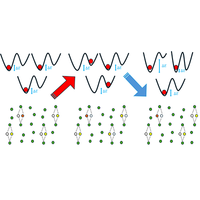
Thermal cycling: Evidence for a generalized tunneling model and a tool to distinguish noise sources in quantum circuits

Yigal Reiss and Moshe Schechter

Phys. Rev. B 111, L201403 (2025) - Published 16 May, 2025

The authors show here that the evolution of the excitation spectrum of tunneling structural two-level systems (TLSs) under thermal cycling reveals the generic existence of two types of TLSs, distinguished by a bimodal coupling to strain. These findings advance the understanding of low-temperature universality in amorphous solids, identify thermal cycling as a unique protocol for isolating TLS noise from other noise sources in quantum devices, and pave the way towards improved stability and scalability of quantum circuits.

Phase transition of ammonia quarterhydrate at high pressure

Mengqiong Pu, Xinyang Li, Xiaomei Yuan, Yanlei Geng, Yiping Ouyang, Chenlu Wang, Jiacheng Zhang, Liang Li, Fangfei Li, and Qiang Zhou

Phys. Rev. B 111, 174109 (2025) - Published 15 May, 2025

Strong-to-weak spontaneous symmetry breaking and average symmetry protected topological order in the doubled Hilbert space

Yoshihito Kuno, Takahiro Orito, and Ikuo Ichinose

Phys. Rev. B 111, 174110 (2025) - Published 15 May, 2025

There are two kinds of symmetries in quantum mixed states (QMSs) – called strong and weak symmetries– and studying their spontaneous symmetry breaking (SSB) pattern helps classify QMSs, which is an ongoing important issue. The authors study here a decohered cluster model with Z2⊗Z2 symmetry and uncover two kinds of symmetry-protected topological (SPT) mixed states. Using doubled Hilbert formalism, they demonstrate a transition between the two states, named strong and double average SPT states, where the latter features coexisting SPT and SSB.

Quantum simulation of the microscopic to macroscopic crossover using superconducting quantum impurities

Amir Burshtein and Moshe Goldstein

Phys. Rev. B 111, 174303 (2025) - Published 15 May, 2025

Controlled wave acceleration in PT-symmetric and inhomogeneous non-Hermitian lattices

Yehonatan Benisty, Sayan Jana, and Lea Sirota

Phys. Rev. B 111, 174304 (2025) - Published 15 May, 2025

Fragile unconventional magnetism in RuO2 by proximity to Landau-Pomeranchuk instability

Zhuang Qian, Yudi Yang, Shi Liu, and Congjun Wu

Phys. Rev. B 111, 174425 (2025) - Published 15 May, 2025

Continuous collapse of the spin cycloid in BiFeO3 thin films under an applied magnetic field probed by neutron scattering

Md. Firoz Pervez, Hongrui Zhang, Yen-Lin Huang, Lucas Caretta, Ramamoorthy Ramesh, and Clemens Ulrich

Phys. Rev. B 111, 174426 (2025) - Published 15 May, 2025

Tunnel-structured LiB5C5 with superhard and superconducting properties

Xiao Tang, Shuai Duan, Yangfan Cui, Yunxian Liu, Xin Chen, Yongsheng Zhang, and Xiaobing Liu

Phys. Rev. B 111, 174521 (2025) - Published 15 May, 2025

Doping dependence of the magnetic ground state in the frustrated magnets Ba2MTe1−xWxO6 (M = Mn, Co)

Chaoxin Huang, Lisi Li, Peiyue Ma, Xing Huang, Tao Xie, and Meng Wang

Phys. Rev. B 111, 184418 (2025) - Published 15 May, 2025

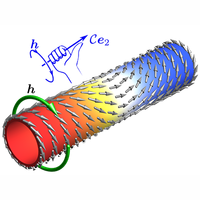
Chiral breakdown engineered by mesoscale Dzyaloshinskii-Moriya interaction in biaxial magnetic nanotubes

Kostiantyn V. Yershov, Svitlana Kondovych, and Denis D. Sheka

Phys. Rev. B 111, 184419 (2025) - Published 15 May, 2025

The authors analytically explore here domain wall statics and dynamics in biaxial magnetic nanotubes with intrinsic chiral Dzyaloshinskii–Moriya interaction (DMI) of different symmetries. The interplay between curvature, chiral, and dipolar interactions governs domain wall profiles and their response to external fields. While domain wall dynamics in nanotubes with bulk-type DMI is subject to chirality symmetry breaking, interfacial-type DMI primarily shifts the Walker breakdown field. These findings unlock new functionalities of chiral magnetization dynamics in curvilinear systems for advanced applications.

Substitution of Y, Ce, and Th for La in LaBeH8 as a path towards lower synthesis pressures of superconducting hydrides

Yuan Ma, Jie Luo, Sheng Meng, Xin Zhong, Guangtao Liu, Hanyu Liu, and Yanming Ma

Phys. Rev. B 111, 184512 (2025) - Published 15 May, 2025

Crystal symmetry selected pure spin photocurrent in altermagnetic insulators

Ruizhi Dong, Ranquan Cao, Dian Tan, and Ruixiang Fei

Phys. Rev. B 111, 195210 (2025) - Published 15 May, 2025

Spin current generation in altermagnets is a central focus in spintronics. While the time-reversal-odd spin Hall effect is significant in metallic systems, insulating behavior is more common in antiferromagnets. Here, the authors demonstrate that pure spin currents can be generated in altermagnetic insulators through nonlinear photogalvanic effects, specifically via shift and injection currents. Remarkably, these mechanisms remain effective in producing directional pure spin currents even with spin-orbit coupling, in contrast to previous findings in nonmagnetic and parity-time symmetric antiferromagnetic materials.

Prediction of polarization vortices, charge modulation, flat bands, and moiré magnetism in twisted oxide bilayers

Naafis Ahnaf Shahed, Kartik Samanta, Mohamed Elekhtiar, Kai Huang, Chang-Beom Eom, Mark S. Rzchowski, Kirill D. Belashchenko, and Evgeny Y. Tsymbal

Phys. Rev. B 111, 195420 (2025) - Published 15 May, 2025
Sign In to Your Journals Account

Filter

Recent Issues

Vol. 114, Iss. 24
15 October 2026
Vol. 114, Iss. 23
15 October 2026
Vol. 114, Iss. 22
15 October 2026
Vol. 114, Iss. 21
1 October 2026
Category
Article Type
Section

Filter

Article Lookup

Enter a citation