Recent Articles

Quasibound layer-breathing phonons inside perfect dislocations of lattice-relaxed twisted transition metal dichalcogenide bilayers

V. V. Enaldiev

Phys. Rev. B 112, 045404 (2025) - Published 7 July, 2025

Prediction of high-temperature half-quantum anomalous Hall effect in the semimagnetic topological insulator MnBi2Te4/Sb2Te3

M. U. Muzaffar, Kai-Zhi Bai, Wei Qin, Guohua Cao, Yutong Yang, Shunhong Zhang, Ping Cui, Shun-Qing Shen, and Zhenyu Zhang

Phys. Rev. B 112, 045405 (2025) - Published 7 July, 2025

Off-resonant light-induced topological phase transition and thermoelectric transport in semi-Dirac materials

Vassilios Vargiamidis, P. Vasilopoulos, and Neophytos Neophytou

Phys. Rev. B 112, 045406 (2025) - Published 7 July, 2025

Supersymmetry dynamics on Rydberg atom arrays

Shuo Liu, Zhengzhi Wu, Shi-Xin Zhang, and Hong Yao

Phys. Rev. B 112, L020301 (2025) - Published 7 July, 2025

Integrability is generic in homogeneous U(1)-invariant nearest-neighbor qubit circuits

Marko Žnidarič, Urban Duh, and Lenart Zadnik

Phys. Rev. B 112, L020302 (2025) - Published 7 July, 2025

The Aharonov-Casher phase is geometrical and not topological

Igor Kuzmenko, Y. B. Band, and Yshai Avishai

Phys. Rev. B 112, L020501 (2025) - Published 7 July, 2025

In the Aharonov-Casher effect (ACE), a particle with a magnetic moment moves along a closed path and is subject to an electric field. The spin-orbit term in the Hamiltonian affects the wave function phase. Consequently, the ACE is a purely quantum effect. The authors address here the question of whether this geometric phase depends on the details of the closed path (or not, as in the Aharonov-Bohm effect, wherein the phase is topological). By presenting a simple counterexample, it is shown that the phase depends on the details of the path. Therefore, it is not topological.

Pairing boost from enhanced spin-fermion coupling in the pseudogap regime

Yang Yu, Sergei Iskakov, Emanuel Gull, Karsten Held, and Friedrich Krien

Phys. Rev. B 112, L041105 (2025) - Published 7 July, 2025

LiV2O4: Hund-assisted orbital-selective Mottness

M. Grundner, F. B. Kugler, O. Parcollet, U. Schollwöck, A. Georges, and A. Hampel

Phys. Rev. B 112, L041106 (2025) - Published 7 July, 2025

Evidence for valence-bond pairing in a one-dimensional two-orbital system

M. Mierzejewski, E. Dagotto, and J. Herbrych

Phys. Rev. B 112, L041107 (2025) - Published 7 July, 2025

Layer skyrmions for ideal Chern bands in twisted graphene systems

Daniele Guerci, Jie Wang, and Christophe Mora

Phys. Rev. B 112, L041108 (2025) - Published 7 July, 2025

Importance of pure dephasing in the optical response of excitons in high-quality van der Waals heterostructures

Anabel Atash Kahlon, Matan Meshulam, Tomer Eini, Thomas Poirier, James H. Edgar, Seth Ariel Tongay, and Itai Epstein

Phys. Rev. B 112, L041402 (2025) - Published 7 July, 2025

Universal fluctuations of two localized interacting particles in one dimension

Sen Mu, Gabriel Lemarié, and Jiangbin Gong

Phys. Rev. B 112, 014201 (2025) - Published 2 July, 2025

Rashba spin-orbit coupling and magnetic inhomogeneity in La0.7Sr0.3MnO3/LaTiO3(δ)/SrTiO3(001) thin film heterostructures

Kishori Lal, Pramod Ghising, B. Samantaray, and Z. Hossain

Phys. Rev. B 112, 014405 (2025) - Published 2 July, 2025

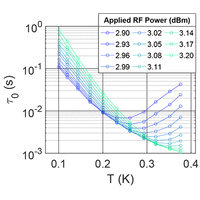
Noise-induced stabilization of dynamical states with broken time-reversal symmetry

T. F. Q. Larson, L. Zhao, E. G. Arnault, M. T. Wei, A. Seredinski, H. Li, K. Watanabe, T. Taniguchi, F. Amet, and G. Finkelstein

Phys. Rev. B 112, 014502 (2025) - Published 2 July, 2025

In the inverse Josephson effect, a junction exposed to microwaves develops quantized voltage steps (“Shapiro steps”). Coexisting steps at ±hf/2e lead to spontaneous time-reversal symmetry breaking as the phase ratchets in one direction. The authors study here switching between these states, which varies dramatically with small parameter changes. Unexpectedly, switching slows at high temperatures, showing noise-induced stabilization. This rare experimental observation, involving dynamic states and broken symmetry, highlights opportunities in stochastic physics and quantum thermodynamics using driven-dissipative systems.

Localization of Fe2+ and magnetocrystalline anisotropy of single crystals of La-substituted M-type strontium hexaferrites

Hiroaki Ueda, Haruka Morishita, and Chishiro Michioka

Phys. Rev. B 112, 024403 (2025) - Published 2 July, 2025

Short-range magnetic order and planar anisotropy in the topological ferrimagnet Mn3Si2Te6

Raju Baral, Andrew F. May, and Stuart Calder

Phys. Rev. B 112, 024405 (2025) - Published 2 July, 2025

Atomic and bond polarization causing strong screening of short-range Coulomb interactions and its effect in cuprate superconductors

Nassim Derriche and George Sawatzky

Phys. Rev. B 112, 024502 (2025) - Published 2 July, 2025

Effects of chemical disorder and spin-orbit coupling on the electronic-structure and Fermi-surface topology of YbSb-based monopnictides

Maxwell Eibert, Christopher Burgio, Tyler Del Rose, Prince Sharma, Yaroslav Mudryk, and Prashant Singh

Phys. Rev. B 112, 035106 (2025) - Published 2 July, 2025

Electric-field-enhanced electron-phonon coupling facilitating ultrafast charge transfer in two-dimensional g−C3N4/MoSi2N4 heterostructure

Yanqi Wang, Shangyong Yu, Chaochao Qin, Zhongpo Zhou, Shuhong Ma, and Zhaoyong Jiao

Phys. Rev. B 112, 035301 (2025) - Published 2 July, 2025

Broadband directional thermal emission with anisothermal microsources

F. Herz, R. Messina, and P. Ben-Abdallah

Phys. Rev. B 112, 035403 (2025) - Published 2 July, 2025

Sign In to Your Journals Account

Filter

Recent Issues

Vol. 114, Iss. 24
15 October 2026
Vol. 114, Iss. 23
15 October 2026
Vol. 114, Iss. 22
15 October 2026
Vol. 114, Iss. 21
1 October 2026
Category
Article Type
Section

Filter

Article Lookup

Enter a citation