Recent Articles

High-fidelity electronic structure and properties of InSb: G0W0 and Bayesian-optimized hybrid functionals and DFT+U approaches

Ritwik Das, Anne-Sophie Grimault-Jacquin, and Frédéric Aniel

Phys. Rev. B 112, 075136 (2025) - Published 18 August, 2025

Wannier functions dually localized in space and energy

Aaron Mahler, Jacob Z. Williams, Neil Qiang Su, and Weitao Yang

Phys. Rev. B 112, 075137 (2025) - Published 18 August, 2025

Dirac fermions in the altermagnet Ce4Sb3

Xue He and Shihao Zhang

Phys. Rev. B 112, 075138 (2025) - Published 18 August, 2025

Gate-tunable enhancement of supercurrent in hybrid planar Josephson junctions

Peng Yu, Han Fu, William F. Schiela, William Strickland, Bassel Heiba Elfeky, S. M. Farzaneh, Jacob Issokson, Enrico Rossi, and Javad Shabani

Phys. Rev. B 112, 075419 (2025) - Published 18 August, 2025

Engineering superconducting proximity effect can lead to major device functionalities as well as to the enhancement of the topological superconductivity gap. Here, the authors provide a new superconducting lead geometry that reshapes the Andreev bound states by creating gate-tunable patches within superconducting leads. The resulting supercurrent in the junction is remarkably different from that in standard plain superconducting leads. The authors attempt to understand these changes by creating a model that captures how constructive interference of Andreev bound states could lead to extra supercurrent in the Josephson junction.

Effective conformal field theory generated from pure and dephased Chern insulator

Abhijat Sarma, Yimu Bao, Nayan Myerson-Jain, Thomas Kiely, and Cenke Xu

Phys. Rev. B 112, 085130 (2025) - Published 18 August, 2025

Single-particle spectral function of the extended Peierls-Hubbard model at half-filling and quarter-filling

Ren-He Xu, Hantao Lu, Takami Tohyama, and Can Shao

Phys. Rev. B 112, 085131 (2025) - Published 18 August, 2025

Realizing topologically protected ghost surface polaritons by lattice transformation optics

Xianghong Kong, Chuanjie Hu, Xingsi Liu, Chunqi Zheng, Jianfeng Chen, Huanyang Chen, and Cheng-Wei Qiu

Phys. Rev. B 112, 085415 (2025) - Published 18 August, 2025

Antichiral edge states in diatomic square lattice and quantum transport properties

B. Ostahie and A. Aldea

Phys. Rev. B 112, 085416 (2025) - Published 18 August, 2025

Asymmetry engineering of spin-valley transport in bilayer silicene magnetic valves

Guangqin Xiong, Yiyi Lou, Xin Li, Tingting Wei, and Yu Wang

Phys. Rev. B 112, 085417 (2025) - Published 18 August, 2025

Electro-optically tunable second-harmonic generation in lithium niobate metasurfaces boosted by Brillouin zone folding induced bound states in the continuum

Huifu Qiu, Xu Tu, Meibao Qin, Feng Wu, Tingting Liu, and Shuyuan Xiao

Phys. Rev. B 112, 085418 (2025) - Published 18 August, 2025

Quasiaperiodic grain boundary phases of Σ5 tilt grain boundaries in refractory metals

Enze Chen and Timofey Frolov

Phys. Rev. B 112, L060101 (2025) - Published 18 August, 2025

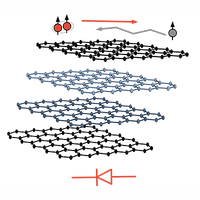
Intrinsic superconducting diode effect and nonreciprocal superconductivity in rhombohedral graphene multilayers

Yinqi Chen, Mathias S. Scheurer, and Constantin Schrade

Phys. Rev. B 112, L060505 (2025) - Published 18 August, 2025

Recent experiments found superconductivity in a four-layer graphene stack where electrons pair chirally in a single momentum-space valley. This spin- and valley-polarized pairing challenges conventional theory and suggests new superconducting orders. Here, the authors present a microscopic explanation for the emergence of such pairing. They show that the same broken symmetries produce an intrinsic superconducting diode effect with direction-dependent critical current. This nonreciprocity is inherent to the graphene stack, requiring no magnetic field. It offers a new platform for field-free, nonreciprocal superconducting transport.

Nature of magnetic phase transitions and spin-driven ferroelectricity in BaHoFeO4

N. T. Dang, D. P. Kozlenko, T. P. Hoang, A. V. Rutkauskas, T. N. Vershinina, S. E. Kichanov, D. T. Khan, L. T. P. Thao, T. L. Phan, N. Tran, E. V. Dyuzheva-Maltseva, C. Kadlec, F. Kadlec, T. Kmječ, J. Kohout, V. Chlan, and M. H. Phan

Phys. Rev. B 112, 054437 (2025) - Published 15 August, 2025

Nonlocal far-field modeling of multichannel metastructures

Peyman Abdipour and George V. Eleftheriades

Phys. Rev. B 112, 064205 (2025) - Published 15 August, 2025

Altermagnetic splitting of magnons in hematite α−Fe2O3

Rhea Hoyer, P. Peter Stavropoulos, Aleksandar Razpopov, Roser Valentí, Libor Šmejkal, and Alexander Mook

Phys. Rev. B 112, 064425 (2025) - Published 15 August, 2025

The authors investigate here the influence of spin-orbit coupling corrections on the magnon dispersion relation of the g-wave altermagnet candidate hematite (α-Fe2O3). They show that for both the easy-axis phase below and the weak ferromagnetic phase above the Morin transition temperature, the corrections are concentrated at the Brillouin zone center at low magnon energies, leaving intact the altermagnetic splitting of the magnon modes at higher energies and nonzero crystal momentum. The authors discuss implications for inelastic neutron scattering and magnon transport.

Valley-polarized quantum anomalous Hall and topological metal phase in a Rashba-induced pseudospin-1 lattice

Puspita Parui and Bheema Lingam Chittari

Phys. Rev. B 112, 075133 (2025) - Published 15 August, 2025

Landau-level composition of bound exciton states in magnetic field

Dinh Van Tuan and Hanan Dery

Phys. Rev. B 112, 085305 (2025) - Published 15 August, 2025

An exciton – a bound electron-hole pair – is inert to the Lorentz force due to its charge neutrality. As such, the motion of an exciton cannot be described by the same Landau quantization that characterizes the motion of a free electron or hole in magnetic field. This contrast raises the question: How can a bound exciton state in magnetic field be expressed through the Landau quantization of its electron and hole components? Here, the authors establish a scattering selection rule between the Landau levels {ne,nh} of the electron and hole components, and identify an elegant pairing law between these Landau levels, ne=nh+l. The pairing law provides information on the construction of a bound exciton state with magnetic quantum number l, and on the interaction of the exciton magnetic moment with magnetic field.

Reconstructing critical current density in Josephson junctions with phase nonlinearity

A. Kudriashov, R. A. Hovhannisyan, X. Zhou, L. Elesin, L. V. Yashina, K. S. Novoselov, and D. A. Bandurin

Phys. Rev. B 112, L060504 (2025) - Published 15 August, 2025

Specular Andreev reflection and Andreev interference in an Ising superconductor junction

Gaoyang Li, Sourabh Patil, Yanxia Xing, Wolfgang Belzig, and Gaomin Tang

Phys. Rev. B 112, L081407 (2025) - Published 15 August, 2025

Superspin renormalization and slow relaxation in random spin systems

Yi J. Zhao, Samuel J. Garratt, and Joel E. Moore

Phys. Rev. B 112, 054436 (2025) - Published 14 August, 2025

Many quantum simulation and computation platforms operate on microscopic degrees of freedom that are randomly or controllably positioned and interact across long distances. Here, the authors develop a theory that describes the dynamics of such systems and that allows for large-scale numerical simulations. This theory, based on the excited-state real-space renormalization group, describes dynamics in terms of emergent “superspins,” collective two-level degrees of freedom. The coherent dynamics of the superspins, which survive out to time scales many orders of magnitude larger than inverse microscopic energy scales, is a robust many-body interference effect.

Sign In to Your Journals Account

Filter

Recent Issues

Vol. 114, Iss. 24
15 October 2026
Vol. 114, Iss. 23
15 October 2026
Vol. 114, Iss. 22
15 October 2026
Vol. 114, Iss. 21
1 October 2026
Category
Article Type
Section

Filter

Article Lookup

Enter a citation