Recent Articles

Fermion sampling made more efficient

Haoran Sun, Jie Zou, and Xiaopeng Li

Phys. Rev. B 107, 035119 (2023) - Published 11 January, 2023

Flat optical conductivity in the topological kagome magnet TbMn6Sn6

R. S. Li, Tan Zhang, Wenlong Ma, S. X. Xu, Q. Wu, L. Yue, S. J. Zhang, Q. M. Liu, Z. X. Wang, T. C. Hu, X. Y. Zhou, D. Wu, T. Dong, Shuang Jia, Hongming Weng, and N. L. Wang

Phys. Rev. B 107, 045115 (2023) - Published 11 January, 2023

Spatial quantization of exciton-polariton condensates in optically induced traps

Ekaterina Aladinskaia, Roman Cherbunin, Evgeny Sedov, Alexey Liubomirov, Kirill Kavokin, Evgeny Khramtsov, Mikhail Petrov, P. G. Savvidis, and Alexey Kavokin

Phys. Rev. B 107, 045302 (2023) - Published 11 January, 2023

Giant electron-phonon interaction for a prototypical semiconductor interface: Sn/Ge(111)−(3×3)

M. N. Nair, I. Palacio, A. Mascaraque, E. G. Michel, A. Taleb-Ibrahimi, A. Tejeda, C. González, A. Martín-Rodero, J. Ortega, and F. Flores

Phys. Rev. B 107, 045303 (2023) - Published 11 January, 2023

Fractional second-order topological insulator from a three-dimensional coupled-wires construction

Katharina Laubscher, Pim Keizer, and Jelena Klinovaja

Phys. Rev. B 107, 045409 (2023) - Published 11 January, 2023

Emergent superconductivity and non-Fermi liquid transport in a doped valence bond solid insulator

Zi-Xiang Li, Steven G. Louie, and Dung-Hai Lee

Phys. Rev. B 107, L041103 (2023) - Published 11 January, 2023

Generation of modulated magnetic structures based on cluster multipole expansion: Application to α-Mn and CoM3S6

Yuki Yanagi, Hiroaki Kusunose, Takuya Nomoto, Ryotaro Arita, and Michi-To Suzuki

Phys. Rev. B 107, 014407 (2023) - Published 10 January, 2023

Experimental observation of interfacial Rashba-Edelstein magnetoresistance in Cr/YIG heterostructures

Zhendong Chen, Peng Chen, Yifei Wang, Wenqiang Wang, Zhe Zhang, Xianyang Lu, Ronghua Liu, Xiaolong Fan, Guoqiang Yu, and Fusheng Ma

Phys. Rev. B 107, 014408 (2023) - Published 10 January, 2023

Plasmons in three-dimensional superconductors

T. Repplinger, S. Klimin, M. Gélédan, J. Tempere, and H. Kurkjian

Phys. Rev. B 107, 014504 (2023) - Published 10 January, 2023

Degeneracy between even- and odd-parity superconductivity in the quasi-one-dimensional Hubbard model and implications for Sr2RuO4

Thomas Scaffidi

Phys. Rev. B 107, 014505 (2023) - Published 10 January, 2023

Real-time simulations of quantum spin chains: Density of states and reweighting approaches

Pavel Buividovich and Johann Ostmeyer

Phys. Rev. B 107, 024302 (2023) - Published 10 January, 2023

Cubic fixed point in three dimensions: Monte Carlo simulations of the ϕ4 model on the simple cubic lattice

Martin Hasenbusch

Phys. Rev. B 107, 024409 (2023) - Published 10 January, 2023

Lindblad master equation approach to the topological phase transition in the disordered Su-Schrieffer-Heeger model

Andrea Nava, Gabriele Campagnano, Pasquale Sodano, and Domenico Giuliano

Phys. Rev. B 107, 035113 (2023) - Published 10 January, 2023

Nonlinear optical responses in nodal line semimetals

Omid Tavakol and Yong Baek Kim

Phys. Rev. B 107, 035114 (2023) - Published 10 January, 2023

Persistent entanglement of valley exciton qubits in transition metal dichalcogenides integrated into a bimodal optical cavity

Halyne S. Borges, Celso A. N. Júnior, David S. Brandão, Fujun Liu, V. V. R. Pereira, S. J. Xie, Fanyao Qu, and A. M. Alcalde

Phys. Rev. B 107, 035404 (2023) - Published 10 January, 2023

Theory for polaritonic quantum tunneling

Kalle S. U. Kansanen

Phys. Rev. B 107, 035405 (2023) - Published 10 January, 2023

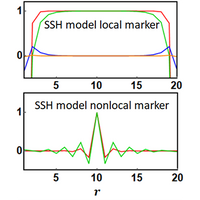
Universal topological marker

Wei Chen

Phys. Rev. B 107, 045111 (2023) - Published 10 January, 2023

The topological order of Dirac models in any dimension and symmetry class can be mapped to lattice sites by a universal topological marker. From the topological operator that extracts this marker, one can further define a nonlocal marker that detects topological phase transitions. Several prototype models such as the Su-Schrieffer-Heeger model, Majorana chain, Chern insulator, Bernevig-Hughes-Zhang model, chiral and helical p-wave superconductors, three-dimensional time-reversal symmetric topological insulators, among many others, are employed to demonstrate the ubiquity of these markers.

Dimensional crossover of charge order in IrTe2 with strong interlayer coupling

Hyoung Kug Kim, So Young Kim, C. J. Won, Sang-Wook Cheong, Jonghwan Kim, Jun Sung Kim, and Tae-Hwan Kim

Phys. Rev. B 107, 045112 (2023) - Published 10 January, 2023

Spin-dependent plasma frequency from all-electron ab initio calculations including spin-orbit coupling

Maria K. Pogodaeva, Sergey V. Levchenko, and Vladimir P. Drachev

Phys. Rev. B 107, 045113 (2023) - Published 10 January, 2023

Nature of visons in the perturbed ferromagnetic and antiferromagnetic Kitaev honeycomb models

Chuan Chen and Inti Sodemann Villadiego

Phys. Rev. B 107, 045114 (2023) - Published 10 January, 2023

The Kitaev honeycomb model features emergent anyons in the form of a Majorana fermion and a non-Abelian excitation known as the vison. While visons are static in the ideal model, certain perturbations can induce their motion. Here, it is demonstrated that the vison dynamics induced by Zeeman perturbations are sharply distinct in the ferromagnetic versus the antiferromagnetic model. Namely, in the ferromagnetic model the vison has a trivial translational symmetry and zero Berry curvature, whereas in the antiferromagnetic model it experiences a π flux per unit cell and has two bands with opposite Chern numbers, leading to an intrinsic contribution to the thermal Hall effect.

Sign In to Your Journals Account

Filter

Recent Issues

Vol. 114, Iss. 24
15 October 2026
Vol. 114, Iss. 23
15 October 2026
Vol. 114, Iss. 22
15 October 2026
Vol. 114, Iss. 21
1 October 2026
Category
Article Type
Section

Filter

Article Lookup

Enter a citation