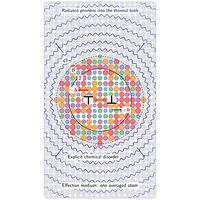
We develop a quantum statistical theory of phonon-mediated dislocation drag in chemically disordered alloys. Starting from a configuration-dependent harmonic Hamiltonian with Kanzaki coupling, we integrate out the lattice exactly via a Keldysh influence functional and obtain, for each disordered realization, a causal retarded memory kernel for the collective glide coordinate. The drag coefficient required by continuum mobility laws is the zero-frequency limit of this kernel, rather than an empirical input, while the full kernel provides a principled non-Markovian mobility law. To make the theory tractable for large disordered supercells with ab initio methods and machine-learned interatomic potentials, we introduce a hybrid embedding scheme that retains the disorder-sensitive Kanzaki vertex in an inner atomistic region and couples it to an outer effective medium description for far-field phonon radiation. We prove that any procedure which homogenizes the lattice before evaluating the quadratic dissipation functional produces a strict lower bound on the disorder-averaged drag, missing a non-negative variance contribution that is discarded by construction. Calculations for bcc , and for face-centered cubic systems show that this variance term is typically dominant: virtual crystal estimates underpredict drag by factors of 2 to 8 and suppress the screw versus edge hierarchy predicted by the full theory. The composition dependence is strongly nonmonotonic, demonstrating that chemical complexity alone is not a reliable proxy for drag and that extrapolations based on bulk elastic descriptors or Leibfried-type scaling can fail. Temperature dependence follows analytically from Bose reweighting of a single equilibrium spectral density, recovering the high-temperature linear regime with a slope set by an infrared-weighted spectral moment that remains sensitive to core-level chemistry. The resulting Stieltjes pole parameters provide a complete, passive, non-Markovian mobility input for mesoscale dislocation dynamics in concentrated alloys, with explicit configurational uncertainty quantification and without driven molecular dynamics, thereby providing a complete representation of dislocation mobility in disordered alloys without the need for costly molecular dynamics simulations.