Recent Articles

Non-Abelian line graph: A generalized approach to flat bands

Rui-Heng Liu and Xin Liu

Phys. Rev. B 111, 035134 (2025) - Published 15 January, 2025

Excitons in atomically thin transition metal dichalcogenides in electric and magnetic fields

Jack N. Engdahl, Harley D. Scammell, Dmitry K. Efimkin, and Oleg P. Sushkov

Phys. Rev. B 111, 035424 (2025) - Published 15 January, 2025

Dipole representation of composite fermions in graphene quantum Hall systems

Sonja Predin

Phys. Rev. B 111, 045132 (2025) - Published 15 January, 2025

Electronic and magnetic transitions in infinite-layer nickelates by strain-orbital engineering

Yajun Zhang, Xu He, Huadong Yong, Jie Wang, Xingyi Zhang, and Philippe Ghosez

Phys. Rev. B 111, 045133 (2025) - Published 15 January, 2025

Role of asymmetry in thermoelectric properties of a double quantum dot out of equilibrium

D. Perez Daroca, P. Roura-Bas, and A. A. Aligia

Phys. Rev. B 111, 045134 (2025) - Published 15 January, 2025

Engineering a Josephson junction chain for the simulation of the quantum clock model

Matteo M. Wauters, Lorenzo Maffi, and Michele Burrello

Phys. Rev. B 111, 045418 (2025) - Published 15 January, 2025

Autonomous demon exploiting heat and information at the trajectory level

Juliette Monsel, Matteo Acciai, Rafael Sánchez, and Janine Splettstoesser

Phys. Rev. B 111, 045419 (2025) - Published 15 January, 2025

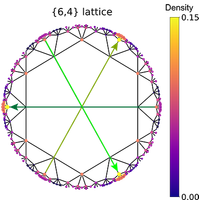
Non-Hermitian skin effect along hyperbolic geodesics

Ruizhe Shen, Wei Jie Chan, and Ching Hua Lee

Phys. Rev. B 111, 045420 (2025) - Published 15 January, 2025

Understanding the localization of the non-Hermitian skin effect (NHSE) becomes particularly difficult when the underlying lattice deviates from the traditional translation and periodicity, found in Euclidean lattices. Here, the authors found a way to locally circumvent this by studying the NHSE along the geodesics in hyperbolic space instead. Specifically, they develop a framework based on geodesic-periodic boundary conditions, revealing the distinctive spectral sensitivity induced by hyperbolic curvature. Furthermore, the scaling properties of hyperbolic lattices give rise to intriguing phenomena like hybrid skin modes and intrinsic boundary modes. This study provides valuable insights into the riches of non-Hermitian physics in curved spaces.

Global minimum structures and electronic properties variation of hydrogen adatoms on/in H-phase MX2 (M=Mo, W; X=S, Se, Te)

Ke-Xin Hou, Rui Yang, Nuo Xu, Xiao-Huan Lv, Mei-Yan Tian, Xing-Qiang Shi, and Jiang-Long Wang

Phys. Rev. B 111, 045421 (2025) - Published 15 January, 2025

Magnetization reversal of a ferromagnetic Pt/Co/Pt film by helicity dependent absorption of visible to near-infrared laser pulses

Kihiro T. Yamada, Carl S. Davies, Fuyuki Ando, Tian Li, Teruo Ono, Theo Rasing, Alexey V. Kimel, and Andrei Kirilyuk

Phys. Rev. B 111, L020406 (2025) - Published 15 January, 2025

Magnon spectrum of altermagnets beyond linear spin wave theory: Magnon-magnon interactions via time-dependent matrix product states versus atomistic spin dynamics

Federico Garcia-Gaitan, Ali Kefayati, John Q. Xiao, and Branislav K. Nikolić

Phys. Rev. B 111, L020407 (2025) - Published 15 January, 2025

Altermagnets, a newly classified type of collinear magnet, exhibit zero magnetization, akin to antiferromagnets, but have spin-split electronic bands, akin to ferromagnets. Their low-energy excitations are predicted to be magnons, but with linear energy-momentum dispersion, typical of antiferromagnets, and additional chiral splitting analogous to those of electronic bands. However, such predictions are made using linear spin wave theory, which considers infinitely long-lived noninteracting magnons. This study employs nonperturbative quantum many-body calculations, via tensor network algorithms, to find how a chiral magnon will acquire finite lifetime and how the bands will shift due to magnon-magnon interaction. Such corrections to noninteracting magnon bands could be detected by Raman scattering experiments, for which the recipe is provided. Although the same interaction effects are often described in magnetism by nonlinearity of the Landau-Lifshitz-Gilbert equation, direct comparison using altermagnetic magnons as the testbed, shows how such classical methods cannot fully reproduce the results of quantum many-body calculations.

Robustness of flat band superconductivity against disorder in a two-dimensional Lieb lattice model

G. Bouzerar and M. Thumin

Phys. Rev. B 111, L020506 (2025) - Published 15 January, 2025

The possibility of achieving high-temperature superconductivity in flat-band materials causes a great deal of excitement in the condensed matter community. As the synthesis of real materials inevitably leads to the presence of an unavoidable amount of defects, the authors explore the robustness of flat-band superconductivity in the face of disorder. They reveal in this letter that, unlike conventional intraband superconductivity for which disorder has a dramatic impact, flat-band superconductivity is surprisingly resilient to disorder-induced fluctuations and quasiparticle localization.

Optical resonators constitute a universal spin simulator

Wouter Verstraelen and Timothy C. H. Liew

Phys. Rev. B 111, 014307 (2025) - Published 14 January, 2025

Harmonic generation with topological edge states and electron-electron interaction

S. Pooyan and D. Bauer

Phys. Rev. B 111, 014308 (2025) - Published 14 January, 2025

Helical magnetic order in chiral PbMnTeO6

A. I. Kurbakov, A. N. Korshunov, and S. Nishimoto

Phys. Rev. B 111, 014418 (2025) - Published 14 January, 2025

Chirality detection through vortex bound states in a (d+id′)-wave superconductor

Soma Yoshida, Yukio Tanaka, Alexander A. Golubov, and Shu-Ichiro Suzuki

Phys. Rev. B 111, 014511 (2025) - Published 14 January, 2025

Magnetostatic effect on spin dynamics properties in the antiferromagnetic Van der Waals material CrSBr

Hongyue Xu, Nan Jiang, Haoran Chen, Yi Chen, Tong Wu, Yongwei Cui, Yunzhuo Wu, Zhiyuan Sheng, Zeyuan Sun, Jia Xu, Qixi Mi, Shiwei Wu, Weichao Yu, and Yizheng Wu

Phys. Rev. B 111, 024410 (2025) - Published 14 January, 2025

Odd-frequency superconducting pairing due to multiple Majorana edge modes in driven topological superconductors

Eslam Ahmed, Shun Tamura, Yukio Tanaka, and Jorge Cayao

Phys. Rev. B 111, 024507 (2025) - Published 14 January, 2025

Chiral spin liquid in a generalized Kitaev honeycomb model with Z4 1-form symmetry

Yu-Xin Yang, Meng Cheng, and Ji-Yao Chen

Phys. Rev. B 111, 035129 (2025) - Published 14 January, 2025

Nonlinear frequency-asymmetric optical response in chiral systems

Shuhei Kanda and Satoru Hayami

Phys. Rev. B 111, 035130 (2025) - Published 14 January, 2025

Sign In to Your Journals Account

Filter

Recent Issues

Vol. 114, Iss. 30
15 November 2026
Vol. 114, Iss. 29
15 November 2026
Vol. 114, Iss. 28
15 November 2026
Vol. 114, Iss. 27
1 November 2026
Category
Article Type
Section

Filter

Article Lookup

Enter a citation