Recent Articles

Scaling behavior and emergent conductance plateau with uniform conductance distribution in disordered topological insulators with a domain wall structure

Yuxiong Long, Miaomiao Wei, Fuming Xu, and Jian Wang

Phys. Rev. B 111, 035428 (2025) - Published 17 January, 2025

Stability of transport and quantum phase transitions with nonorthogonal orbitals

J. G. Santiago-García, R. A. Méndez-Sánchez, and E. Sadurní

Phys. Rev. B 111, 035429 (2025) - Published 17 January, 2025

Topological polarization singularities induced by non-Hermitian Dirac points

Jun Wang, Jie Liu, Peng Hu, Qiao Jiang, and Dezhuan Han

Phys. Rev. B 111, 035430 (2025) - Published 17 January, 2025

Nonlinear eigenvalue algorithm for GW quasiparticle equations

Dongming Li and Eric Polizzi

Phys. Rev. B 111, 045137 (2025) - Published 17 January, 2025

Hidden Kondo lattice physics in single-orbital Hubbard models

Philipp Werner and Sayed Ali Akbar Ghorashi

Phys. Rev. B 111, 045138 (2025) - Published 17 January, 2025

Yang-Lee zeros in quantum phase transitions: An entanglement perspective

Hongchao Li

Phys. Rev. B 111, 045139 (2025) - Published 17 January, 2025

Anomalous spin texture representation in quantum materials: Insights from density functional theory and analytical models

Manish Kumar Mohanta and Puru Jena

Phys. Rev. B 111, 045140 (2025) - Published 17 January, 2025

Implementation of a transverse Cooper-pair rectifier using an N-S junction

Pei-Hao Fu, Yong Xu, Jun-Feng Liu, Ching Hua Lee, and Yee Sin Ang

Phys. Rev. B 111, L020507 (2025) - Published 17 January, 2025

Unidirectional superconductivity and superconducting diode effect induced by dissipation

Akito Daido and Youichi Yanase

Phys. Rev. B 111, L020508 (2025) - Published 17 January, 2025

Electric current is generally prohibited in equilibrium. This prevents a zero-resistance state realized solely under a finite electric current, namely, unidirectional superconductivity. Here, the authors propose a setup to realize unidirectional superconductivity as a nonequilibrium steady state, focusing on the in-plane transport of thin-film superconductors which lack in-plane inversion symmetry. Introducing dissipation with the out-of-plane electric field and current, the system realizes unidirectional superconductivity as well as the superconducting diode effect, enabled by the effective time-reversal symmetry breaking by dissipation.

Origin of the unidentified color centers in 4H-SiC from first principles

Ruirong Bai, Dingrong Liu, Shiyou Chen, and Yu-Ning Wu

Phys. Rev. B 111, 014106 (2025) - Published 16 January, 2025

Kekulé-Kitaev model: Linear and nonlinear responses and the effect of magnetic fields

Mohammad-Kazem Negahdari and Abdollah Langari

Phys. Rev. B 111, 014419 (2025) - Published 16 January, 2025

Exchange bias and magnetization reversal in the compensated honeycomb ferrimagnet Ni4Nb2O9

I. Fita, R. Puzniak, C. Martin, A. Maignan, E. E. Zubov, and A. Wisniewski

Phys. Rev. B 111, 014420 (2025) - Published 16 January, 2025

Ab initio statistical mechanics of the Néel transition in monolayer FePS3

Shashank Chaturvedi and Umesh V. Waghmare

Phys. Rev. B 111, 024413 (2025) - Published 16 January, 2025

Discrete Lehmann representation of three-point functions

Dominik Kiese, Hugo U. R. Strand, Kun Chen, Nils Wentzell, Olivier Parcollet, and Jason Kaye

Phys. Rev. B 111, 035135 (2025) - Published 16 January, 2025

Self-supervised learning for denoising quasiparticle interference data

Ilse S. Kuijf, Willem O. Tromp, Tjerk Benschop, Niño Philip Ramones, Miguel Antonio Sulangi, Evert P. L. van Nieuwenburg, and Milan P. Allan

Phys. Rev. B 111, 035136 (2025) - Published 16 January, 2025

Interatomic spin-orbit coupling in atomic orbital based tight-binding models

Masaki Kato and Masao Ogata

Phys. Rev. B 111, 035137 (2025) - Published 16 January, 2025

Spin-dependent interatomic hopping gives rise to exotic phenomena such as topological insulators and cross-correlated effects. The authors systematically investigate interatomic spin-orbit coupling (SOC) and derive an explicit expression for the SOC hopping integrals. Using a multipole technique, they discuss how spin and orbital degrees of freedom couple in several specific tight-binding models on several distinct lattices. In particular, they reveal that the spin splitting, unique to chiral systems, is induced by the electric toroidal quadrupole.

Local rare-earth dopant structure in a complex-oxide/semiconductor heterojunction: Molecular beam epitaxy grown Yb-doped SrTiO3 on Si(001)

Scott A. Chambers, Enrique Ramirez, Deepa Guragain, Joseph H. Ngai, Peter V. Sushko, Krishna P. Koirala, Yingge Du, Niranjan Govind, Mark E. Bowden, Deepnarayan Biswas, Tien-Lin Lee, Conan Weiland, and Joseph C. Woicik

Phys. Rev. B 111, 035304 (2025) - Published 16 January, 2025

Accelerating the measurement of time-resolved emission line shapes with a denoising neural network

Oliver J. Tye, Jonah R. Horowitz, Weiwei Sun, Chantalle J. Krajewska, David B. Berkinsky, Andrew H. Proppe, and Moungi G. Bawendi

Phys. Rev. B 111, 035425 (2025) - Published 16 January, 2025

Multimode Coulomb blockade oscillations

D. B. Karki

Phys. Rev. B 111, 035426 (2025) - Published 16 January, 2025

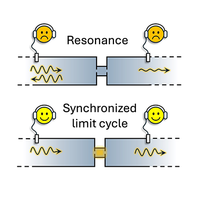
Cloaking obstacles using synchronization

Tiemo Pedergnana, Julia Kölliker, Leonardo Perniola, and Nicolas Noiray

Phys. Rev. B 111, 035427 (2025) - Published 16 January, 2025

Physical objects create reflections and shadows under incident waves, making them detectable and motivating research on cloaking devices. Here, the authors use the synchronization of a self-oscillating cavity mode with the incident waves to cancel backscattering and compensate transmission losses from a cavity. This cloak of invisibility concept only requires the addition of a saturable gain to the resonant scatterer. An acoustic experiment demonstrates this quasipassive concept in a one-dimensional waveguide, cloaking an obstacle by simply tuning the saturable gain.

Sign In to Your Journals Account

Filter

Recent Issues

Vol. 114, Iss. 30
15 November 2026
Vol. 114, Iss. 29
15 November 2026
Vol. 114, Iss. 28
15 November 2026
Vol. 114, Iss. 27
1 November 2026
Category
Article Type
Section

Filter

Article Lookup

Enter a citation