Recent Articles

Fragile spin liquid in three dimensions

Anna Fancelli, R. Flores-Calderón, Owen Benton, Bella Lake, Roderich Moessner, and Johannes Reuther

Phys. Rev. B 111, 134413 (2025) - Published 9 April, 2025

Unconventional superconductivity via charge fluctuations in the kagome metal CsV3Sb5

Yuan Tian and Sergey Y. Savrasov

Phys. Rev. B 111, 134507 (2025) - Published 9 April, 2025

Emergent pairing states and tunable symmetry in the anisotropic triangular lattice

Da-Fei Sun, Zuo-Dong Yu, Wei-Jian Li, Shun-Li Yu, and Yuan Zhou

Phys. Rev. B 111, 134508 (2025) - Published 9 April, 2025

Estimation of spin-orbit torques in the presence of current-induced magnon creation and annihilation

Paul Noel, Emir Karadža, Richard Schlitz, Pol Welter, Charles-Henri Lambert, Luca Nessi, Federico Binda, Christian L. Degen, and Pietro Gambardella

Phys. Rev. B 111, 144409 (2025) - Published 9 April, 2025

Current-induced spin-orbit torques (SOTs) are widely used to control magnetization in spintronic devices. However, the electrical injection of spin currents, which drives the SOTs, also generates and annihilates magnons, affecting both magnetization and magnetoresistance. This work demonstrates that neglecting magnonic effects can significantly overestimate the damping-like torque and misestimate the magnitude and sign of the field-like torque. By combining magneto-optical Kerr effect and magnetotransport measurements, the authors propose here a method for accurately assessing SOTs. These findings highlight the importance of considering magnon contributions to improve the reliability of SOT quantification across different material systems.

Bichromatic microwave manipulation of the NV center nuclear spin using transition not detectable via optically detected magnetic resonance

S. M. Drofa, V. V. Soshenko, I. S. Cojocaru, S. V. Bolshedvorskii, P. G. Vilyuzhanina, E. A. Primak, A. M. Kozodaev, A. Chernyavskiy, V. G. Vins, V. N. Sorokin, A. N. Smolyaninov, S. Ya. Kilin, and A. V. Akimov

Phys. Rev. B 111, 155114 (2025) - Published 9 April, 2025

Brightened emission of dark trions in transition metal dichalcogenide monolayers

V. Jindal, K. Mourzidis, A. Balocchi, C. Robert, P. Li, D. Van Tuan, L. Lombez, D. Lagarde, P. Renucci, T. Taniguchi, K. Watanabe, H. Dery, and X. Marie

Phys. Rev. B 111, 155409 (2025) - Published 9 April, 2025

Majorana bound states from cavity embedding in an interacting two-site Kitaev chain

Álvaro Gómez-León, Marco Schirò, and Olesia Dmytruk

Phys. Rev. B 111, 155410 (2025) - Published 9 April, 2025

Magnetic control of nonreciprocal charge transport

Xu Chen, Yuhao Fu, Xianjie Wang, Yu Sui, Hong Jian Zhao, and L. L. Tao

Phys. Rev. B 111, 155411 (2025) - Published 9 April, 2025

Al K-edge XANES of octahedral aluminum compounds: Similarities and differences via the analysis of excitonic properties

Newman Amoyaw, Abezu Agegnehu, Francesco Sottile, Matteo Gatti, and M. Laura Urquiza

Phys. Rev. B 111, 165112 (2025) - Published 9 April, 2025

Low-energy electrodynamics and a hidden Fermi liquid in the heavy-fermion compound CeCoIn5

L. Y. Shi, Zhenisbek Tagay, Jiahao Liang, Khoan Duong, Yi Wu, F. Ronning, Darrell G. Schlom, K. M. Shen, and N. P. Armitage

Phys. Rev. B 111, 165113 (2025) - Published 9 April, 2025

Geometric origin of self-intersection points in non-Hermitian energy spectra

Jinghui Pi, Chenyang Wang, Yong-Chun Liu, and Yangqian Yan

Phys. Rev. B 111, 165407 (2025) - Published 9 April, 2025

Evidence for reduced periodic lattice distortion within the Sb-terminated surface layer of the kagome metal CsV3Sb5

Felix Kurtz, Gevin von Witte, Lukas Jehn, Alp Akbiyik, Igor Vinograd, Matthieu Le Tacon, Amir A. Haghighirad, Dong Chen, Chandra Shekhar, Claudia Felser, and Claus Ropers

Phys. Rev. B 111, L140101 (2025) - Published 9 April, 2025

Ferroelectric control of spin and orbital Rashba effects at the Ni/HfO2 interface

Armando Pezo, Andrés Saul, Aurélien Manchon, and Rémi Arras

Phys. Rev. B 111, L140405 (2025) - Published 9 April, 2025

Coexistence of chiral Majorana edge states and Bogoliubov Fermi surfaces in two-dimensional nonsymmorphic Dirac semimetal/superconductor heterostructures

Yijie Mo, Xiao-Jiao Wang, Zheng-Yang Zhuang, and Zhongbo Yan

Phys. Rev. B 111, L140504 (2025) - Published 9 April, 2025

Antichiral surface states and Su-Schrieffer-Heeger physics in rutile altermagnets

Sopheak Sorn

Phys. Rev. B 111, L161109 (2025) - Published 9 April, 2025

Quantum skyrmion liquid

Dhiman Bhowmick, Andreas Haller, Deepak S. Kathyat, Thomas L. Schmidt, and Pinaki Sengupta

Phys. Rev. B 111, 134410 (2025) - Published 8 April, 2025

Transformer wave function for two dimensional frustrated magnets: Emergence of a spin-liquid phase in the Shastry-Sutherland model

Luciano Loris Viteritti, Riccardo Rende, Alberto Parola, Sebastian Goldt, and Federico Becca

Phys. Rev. B 111, 134411 (2025) - Published 8 April, 2025

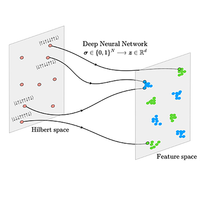
The authors propose here a variational ansatz based on the Transformer architecture to investigate frustrated quantum magnets. The key idea is based on constructing a map, parametrized with a Transformer, from the space of the physical spin configurations to an abstract space, where the determination of the properties of the system is simplified. This method achieves an exceptionally accurate description of the ground-state properties of the Shastry-Sutherland model, successfully identifying the presence of a gapless quantum spin liquid phase.

Simultaneous optimization of lattice and spin configurations in atomic scale simulation of magnetic materials

Zhengtao Huang, Teng Yang, Hanxing Liu, and Ben Xu

Phys. Rev. B 111, 134412 (2025) - Published 8 April, 2025

Detecting the topological winding of superconducting nodes via local density of states

Lena Engström, Pascal Simon, and Andrej Mesaros

Phys. Rev. B 111, 134505 (2025) - Published 8 April, 2025

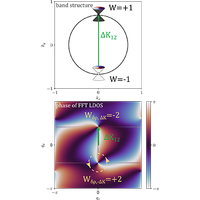
The authors propose here a method to use impurity scattering to detect interference effects between two superconducting nodes, each of which carries locally a winding number as a topological invariant. Steps are outlined for choosing an impurity and a tip for the scanning tunnelling microscope, such that the winding difference of the nodes becomes measurable via the local density of states around the impurity. The formalism is demonstrated on a model of a two-dimensional superconductor, but applies to any nodal system with chiral symmetry.

Quantum phase transition in small-size one- and two-dimensional Josephson junction arrays: Analysis of experiments within the interacting plasmons picture

Samuel Feldman and Andrey Rogachev

Phys. Rev. B 111, 134506 (2025) - Published 8 April, 2025

Sign In to Your Journals Account

Filter

Recent Issues

Vol. 114, Iss. 30
15 November 2026
Vol. 114, Iss. 29
15 November 2026
Vol. 114, Iss. 28
15 November 2026
Vol. 114, Iss. 27
1 November 2026
Category
Article Type
Section

Filter

Article Lookup

Enter a citation