Recent Articles

Quantum dot energy levels in bilayer graphene: Exact and approximate study

G. Giavaras

Phys. Rev. B 112, 115408 (2025) - Published 4 September, 2025

Thermo-optical tuning of nonmonotonic Casimir potentials arising from the thermal expansion of a liquid

Fangyuan Chen, Zonghuiyi Jiang, Yuquan Zhou, Zepu Kou, Haonan Guan, Wanlin Guo, and Xiaofei Liu

Phys. Rev. B 112, 115409 (2025) - Published 4 September, 2025

Constraints from antiunitary symmetries on phase diagrams of sign problem free models

Xu Zhang and Nick Bultinck

Phys. Rev. B 112, 125110 (2025) - Published 4 September, 2025

Arbitrarily high Chern numbers in spin-orbit coupled systems

Chang Qiao, Bin Zhou, and Chunyin Qiu

Phys. Rev. B 112, 125111 (2025) - Published 4 September, 2025

Estimates of the dynamic structure factor for the finite temperature electron liquid via analytic continuation of path integral Monte Carlo data

Thomas Chuna, Nicholas Barnfield, Jan Vorberger, Michael P. Friedlander, Tim Hoheisel, and Tobias Dornheim

Phys. Rev. B 112, 125112 (2025) - Published 4 September, 2025

High-throughput screening and theoretical analysis of charge-four Weyl materials

Yong-An Zhong, Lei Jin, Zining Hu, Yefeng Li, Ying Liu, Xuefang Dai, Hongshi Li, Hongli Gao, Xiaoming Zhang, and Guodong Liu

Phys. Rev. B 112, 125113 (2025) - Published 4 September, 2025

Charge-four Weyl points (C4-WPs), possessing the maximal topological charge, remain challenging to realize in real materials, and are largely confined to bosonic, artificial, or nonmagnetic systems. Here, the authors extend the study to ferromagnetic systems and systematically identify all nonmagnetic and ferromagnetic compounds hosting C4-WPs. Results reveal 13 space groups and 40 materials that can host C4-WPs. In the examples of Bi12PO20 and K2CuPbN6O12, four Fermi arcs are clearly observed. Uniaxial strain can also induce a topological phase transition from C4-WPs to C1-WPs.

First-principles computations of the Stark shift of a defect-bound exciton: The case of the T center in silicon

Louis Alaerts, Yihuang Xiong, Sinéad M. Griffin, and Geoffroy Hautier

Phys. Rev. B 112, 125114 (2025) - Published 4 September, 2025

The T center in silicon is a promising defect for quantum information science. Here, the authors use density functional theory to study the Stark shift of its zero-phonon line. Understanding Stark shift effects in quantum defects is important for their spectral diffusion. The work points to the technical challenge of dealing with bound exciton defects with DFT and stresses the importance of beyond first-order effects in these systems with delocalized wave functions.

Floquet-engineered diode performance of a topological Josephson junction composed of two Kitaev chains coupled via a quantum dot

Koustav Roy, Gourab Paul, Debika Debnath, Kuntal Bhattacharyya, and Saurabh Basu

Phys. Rev. B 112, 125407 (2025) - Published 4 September, 2025

Polaritonic Smith-Purcell radiations in van der Waals materials

Jiawei Wang, Zhiguo Sun, Weiwei Luo, Mengxin Ren, Wei Cai, and Jingjun Xu

Phys. Rev. B 112, 125408 (2025) - Published 4 September, 2025

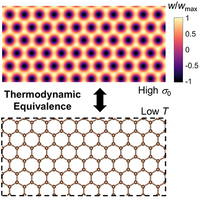
Elastically buckled film-substrate system as a two-dimensional crystal

Wenqing Zhu (朱文清)

Phys. Rev. B 112, L100101 (2025) - Published 4 September, 2025

Elastic buckling in soft matter is fundamental to applications from soft robotics to optical metasurfaces. Here, the authors demonstrate that the strain energy functional of a linear elastic film on a nonlinear elastic substrate can be mapped onto the density functional of phase-field crystal theory, with the film’s deflection field corresponding to the atomic density field. This equivalence reveals that the buckled film-substrate system under compression is mathematically analogous to a two-dimensional crystal formed upon cooling, bridging continuum mechanics and crystallization theory.

Finite-momentum mixed singlet-triplet pairing in chiral antiferromagnets induced by even-parity spin texture

Song-Bo Zhang and Lun-Hui Hu

Phys. Rev. B 112, L100501 (2025) - Published 4 September, 2025

Superconducting junctions with flat bands

P. Virtanen, R. P. S. Penttilä, P. Törmä, A. Díez-Carlón, D. K. Efetov, and T. T. Heikkilä

Phys. Rev. B 112, L100502 (2025) - Published 4 September, 2025

Materials where single electrons move slowly and form so-called flat electron bands, have been proposed to have theoretical promise in high-temperature superconductivity. Here, the authors predict how such materials would behave when used in superconducting junctions, which play a key role in quantum computers and other quantum technology applications. With flat-band materials, the current through the junction may increase as superconductivity becomes weaker. In extended junctions, quantum geometry of the flat electronic band is also important to allow current to flow through despite the slowness of the electron motion. The differences to conventional junctions are characteristic for the flat-band state, and understanding them is necessary for applications

Quantum Newman-Moore model in a longitudinal field

Konstantinos Sfairopoulos and Juan P. Garrahan

Phys. Rev. B 112, 094103 (2025) - Published 3 September, 2025

High-field NMR study of field-induced states in Pb(TiO)Cu4(PO4)4

Y. Ihara, T. Kanda, K. Matsui, K. Kindo, Y. Kohama, Y. Kato, Y. Motome, T. Kimura, and K. Kimura

Phys. Rev. B 112, 094405 (2025) - Published 3 September, 2025

Piezomagnetic effect on spin-orbit torque driven magnetization processes in Mn3Sn under epitaxial in-plane tensile strain: An atomistic spin modeling study

B. C. Choi, J. Qualter, and K. Bikouvaraki

Phys. Rev. B 112, 094406 (2025) - Published 3 September, 2025

Thermodynamics of the S=12 maple-leaf Heisenberg antiferromagnet

Taras Hutak

Phys. Rev. B 112, 104405 (2025) - Published 3 September, 2025

Spin waves in Na2Co2TeO6 studied by high-frequency/high-field ESR: Successes and failures of the triple-q model

Luca Bischof, Jan Arneth, Raju Kalaivanan, Raman Sankar, Kwang-Yong Choi, and Rüdiger Klingeler

Phys. Rev. B 112, 104406 (2025) - Published 3 September, 2025

Evolution of the pseudogap band structure in a system of electron-correlated lattice polarons

E. I. Shneyder, M. V. Zotova, A. V. Dudarev, S. V. Nikolaev, and S. G. Ovchinnikov

Phys. Rev. B 112, 115108 (2025) - Published 3 September, 2025

Role of on-site and intersite Coulomb interactions in KV3Sb5: A first-principles DFT+U+V study

Indukuru Ramesh Reddy, Sayandeep Ghosh, Bongjae Kim, and Chang-Jong Kang

Phys. Rev. B 112, 115109 (2025) - Published 3 September, 2025

Gauging quantum phases: A matrix product state approach

David Blanik, José Garre-Rubio, and Norbert Schuch

Phys. Rev. B 112, 115110 (2025) - Published 3 September, 2025

Sign In to Your Journals Account

Filter

Recent Issues

Vol. 114, Iss. 30
15 November 2026
Vol. 114, Iss. 29
15 November 2026
Vol. 114, Iss. 28
15 November 2026
Vol. 114, Iss. 27
1 November 2026
Category
Article Type
Section

Filter

Article Lookup

Enter a citation