Browse by Subject

Exceptional-point dynamics in photonic time crystals for enhanced optical sensing

Saurabh Mani Tripathi, Shalini Kumari, Krishnan Kundan, and Neha Ahlawat

Phys. Rev. Applied 25, 054054 (2026) - Published 21 May, 2026

Deep-learning-based design strategy for cladding-free and crosstalk-free photonic crystal waveguide systems

Guangyao Xu, Qianyi Guo, Yongxin Jing, Tongtong Song, and Yun Lai

Phys. Rev. Applied 25, 054051 (2026) - Published 20 May, 2026

Loss-driven gain enhancements driven by topological singularities in non-Hermitian photonic crystal defects

Daniel Cui and Aaswath P. Raman

Phys. Rev. Applied 25, 054044 (2026) - Published 18 May, 2026

Dammann grating–enabled spatial-temporal photonic Ising machine for large-scale combinatorial optimization problems

Jinmin Yang, Wenjia Zhang, Xin Ye, Zuyuan He, Junze Yao, and Junjie Yu

Phys. Rev. Applied 25, 054031 (2026) - Published 12 May, 2026

Practical countermeasure against attacks exploiting detection-efficiency mismatch in quantum key distribution

Ben J. Taylor, Peter R. Smith, James F. Dynes, Robert I. Woodward, Marco Lucamarini, R. Mark Stevenson, and Andrew J. Shields

Phys. Rev. Applied 25, 054029 (2026) - Published 12 May, 2026

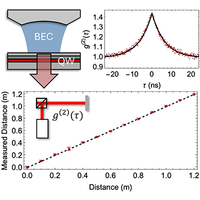
Semiconductor photon Bose-Einstein condensate as a practical light source for range finding

Ross C. Schofield, Daniel Lim, Nathan R. Gemmell, Edmund Clarke, Ian Farrer, Aristotelis Trapalis, Jon Heffernan, and Rupert F. Oulton

Phys. Rev. Applied 25, L051002 (2026) - Published 6 May, 2026

Photon Bose-Einstein condensates combine coherence, low threshold, and thermal photon statistics, making them promising optical sources and sensors. Here researchers show that a room-temperature semiconductor photon condensate can be used directly for thermal range finding by operating just above threshold, where bright continuous-wave single-mode emission still shows measurable photon bunching. The resulting second-order coherence peak provides a robust measure of optical delay, enabling millimeter-precision distance measurements and simultaneous extraction of multiple path delays. This work links many-body quantum optics with practical optical metrology.

Resource-efficient universal photonic processors based on time-multiplexed hybrid architectures

Jonas Lammers, Laura Ares, Federico Pegoraro, Philip Held, Benjamin Brecht, Jan Sperling, and Christine Silberhorn

Phys. Rev. Applied 25, 054011 (2026) - Published 5 May, 2026

Identifying bound states in the continuum by their boundary sensitivity

Vincent Laude and David Röhlig

Phys. Rev. Applied 25, 044086 (2026) - Published 29 April, 2026

Bound states in the continuum (BICs) are of interest for sensing applications, because their sensitivity can be made very sharp (with a quality factor that diverges, in principle), but their utility is held back because coupling to radiation loss is difficult to assess. This study makes progress by considering BIC sensitivity to the true boundary conditions, and clarifying the relation of BICs to the quasinormal modes of open systems. This insight is expected to impact the practical design of sensing solutions based on wave propagation.

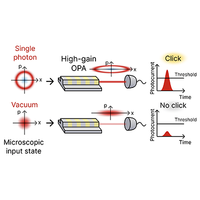
Ultrafast single-photon detector based on a nanophotonic parametric amplifier

Elina Sendonaris, James Williams, Rajveer Nehra, Robert Gray, Ryoto Sekine, Luis Ledezma, and Alireza Marandi

Phys. Rev. Applied 25, 044078 (2026) - Published 27 April, 2026

Single-photon detection is central to optical quantum communication and computation. Its speed and integrability into photonic chips are currently limited by the physical processes by which the photon is absorbed. This work shows that a nanophotonic optical parametric amplifier (OPA) can be used as an ultrafast single-photon detector, bypassing these absorption mechanisms in favor of optical amplification. In addition, a path for OPA-based single-photon detectors to reach state-of-the-art performance is discussed. This approach opens the door to integrated ultrafast single-photon detection, to enable ultrafast optical quantum information processing.

Quantum nanophotonic interface for tin-vacancy centers in thin-film diamond

Hope Lee, Hannah C. Kleidermacher, Abigail J.M. Stein, Hyunseok Oh, Lillian B. Hughes Wyatt, Casey K. Kim, Luca Basso, Andrew M. Mounce, Yongqiang Wang, Shei S. Su, Michael Titze, Ania C. Bleszynski Jayich, and Jelena Vučković

Phys. Rev. Applied 25, 044074 (2026) - Published 27 April, 2026

Strong coupling beyond the high-Q limit and linewidth narrowing in a multiexciton planar microcavity

E. A. Cerda-Mendez, Y. G. Rubo, K. Biermann, A. Camacho-Guardian, A. S. Kuznetsov, and P. V. Santos

Phys. Rev. Applied 25, 044067 (2026) - Published 23 April, 2026

Quantum-processing-assisted classical communication

Kelly Werker Smith, Don Boroson, Saikat Guha, and Johannes Borregaard

Phys. Rev. Applied 25, 044037 (2026) - Published 15 April, 2026

From heat capacity to coherence in ultranarrow-linewidth solid-state optical emitters at subkelvin temperatures

D. Serrano, T. Klein, C. Marcenat, P. Goldner, M.T. Hartman, B. Fang, Y. Le Coq, and S. Seidelin

Phys. Rev. Applied 25, 044032 (2026) - Published 13 April, 2026

Enhancement of vacuum-ultraviolet dispersive-wave emission using gas-filled tapered hollow-core fibers

Yinuo Zhao, Donghan Liu, Baoqi Shi, Zhiyuan Huang, Tiandao Chen, Jinyu Pan, Zhengzheng Liu, Xinglin Zeng, Wenbin He, Jiapeng Huang, Jinxin Zhan, Xin Jiang, Yuxin Leng, Junqiu Liu, and Meng Pang

Phys. Rev. Applied 25, L041001 (2026) - Published 1 April, 2026

Resonant dispersive wave emission in hollow-core optical fibers offers a promising route to the vacuum-ultraviolet (VUV) sources essential for 229Th nuclear clocks. Unfortunately, standard capillaries force a strict trade-off between the large core diameters needed for efficient input coupling and the high intensities required for efficient nonlinear conversion. The authors use a gas-filled tapered capillary fiber to avoid the trade-off, combining a large input aperture with adiabatic field concentration. This yields a widely tunable source with doubled efficiency specifically at the 148.38-nm isomer energy, in a scalable architecture for much-needed high-flux tabletop VUV tools.

Near-deterministic photon entanglement from a spin qudit in silicon using third quantization

Gözde Üstün, Samuel J Elman, Jarryd J. Pla, Andrew C Doherty, Andrea Morello, and Simon J. Devitt

Phys. Rev. Applied 25, 044002 (2026) - Published 1 April, 2026

Engineered Kerr nonlinearities for precise quantum control of Fock states

Gabriella G. Damas, Ciro Micheletti Diniz, Norton G. de Almeida, Celso J. Villas-Bôas, and G.D. de Moraes Neto

Phys. Rev. Applied 25, 034097 (2026) - Published 31 March, 2026

Complex vector gain-based annealer for minimizing XY Hamiltonians

James S. Cummins and Natalia G. Berloff

Phys. Rev. Applied 25, 034080 (2026) - Published 25 March, 2026

XY (planar-spin) Hamiltonians arise in phase synchronization and retrieval and analog formulations of hard optimization, which motivates fast, low-power physical solvers. However, gain-based XY systems that encode each spin with a single complex field can become trapped in metastable states. The authors introduce an annealer that represents each spin with two coupled complex components, and uses a graph-independent locking term that exploits the extra degree of freedom to bypass barriers. For challenging graph families, this higher-dimensional annealing improves ground-state recovery compared to one-component approaches, supporting more reliable photonic and analog XY optimization.

Effective programming of a photonic processor with complex interferometric structure

I.V. Kondratyev, K.N. Urusova, A.S. Argenchiev, N.S. Klushnikov, S.S. Kuzmin, N.N. Skryabin, A.D. Golikov, V.V. Kovalyuk, G.N. Goltsman, I.V. Dyakonov, S.S. Straupe, and S.P. Kulik

Phys. Rev. Applied 25, 034072 (2026) - Published 24 March, 2026

Sampling-driven training of deep belief networks using a coherent Ising machine with spiking neural network

Xing-Yu Wu, Chen-Rui Fan, Yusen Wu, and Chuan Wang

Phys. Rev. Applied 25, 034067 (2026) - Published 20 March, 2026

Self-seeded photon acceleration by electron-beam-driven transition radiation

Chaolu Ding, Xuesong Geng, and Liangliang Ji

Phys. Rev. Applied 25, 034034 (2026) - Published 10 March, 2026

Sign In to Your Journals Account

Filter

Filter

Article Lookup

Enter a citation