Highlights

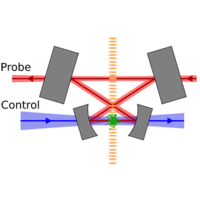
Observation and characterization of cavity Rydberg polaritons

Jia Ningyuan, Alexandros Georgakopoulos, Albert Ryou, Nathan Schine, Ariel Sommer, and Jonathan Simon

Phys. Rev. A 93, 041802(R) (2016) - Published 13 April, 2016

Rydberg polaritons are photonic quasiparticles that interface well with communication channels — as photons would — but can additionally experience strong interactions. This investigation provides an in-depth characterization of this system, including the exploration of dark-polariton physics in the multimode regime.

Robustness of asymmetry and coherence of quantum states

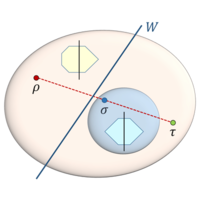
Marco Piani, Marco Cianciaruso, Thomas R. Bromley, Carmine Napoli, Nathaniel Johnston, and Gerardo Adesso

Phys. Rev. A 93, 042107 (2016) - Published 12 April, 2016

A general framework to witness and quantify the asymmetry of quantum states is developed. The concept is proven to be relevant for different applications, especially to the study of quantum coherence.

Slalom in complex time: Emergence of low-energy structures in tunnel ionization via complex-time contours

Emilio Pisanty and Misha Ivanov

Phys. Rev. A 93, 043408 (2016) - Published 12 April, 2016

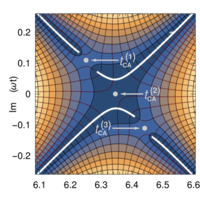
A first-principles, semiclassical theory is formulated in a complex space-time plane to investigate the quantum nature of electron motion in the strong-field ionization of atoms. This theory identifies a series of trajectories responsible for the zero- and low-energy structures in photoelectron spectra that has not been explained by the strong-field approximation.

Nondestructive probing of means, variances, and correlations of ultracold-atomic-system densities via qubit impurities

T. J. Elliott and T. H. Johnson

Phys. Rev. A 93, 043612 (2016) - Published 11 April, 2016

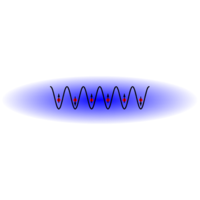
A method of probing densities of ultracold bosons confined in a one-dimensional lattice is proposed by employing measurements on the dephasing of qubits formed from impurity atoms, which may be further applied to detecting phase transitions in the Bose-Hubbard model.

Single-atom thermometer for ultracold gases

Michael Hohmann, Farina Kindermann, Tobias Lausch, Daniel Mayer, Felix Schmidt, and Artur Widera

Phys. Rev. A 93, 043607 (2016) - Published 8 April, 2016

The temperature of an ultracold, thermal Rb cloud is measured with a single Cs atom by comparing the release-recapture measurements of the atom to classical Monte Carlo simulations, which paves the way to use single atoms as nonperturbing probes of local temperatures of quantum gases.

Discrete photon statistics from continuous microwave measurements

Stéphane Virally, Jean Olivier Simoneau, Christian Lupien, and Bertrand Reulet

Phys. Rev. A 93, 043813 (2016) - Published 8 April, 2016

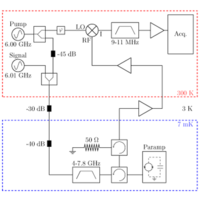
Moments of the photocount statistics are retrieved from measurements of field quadratures. The method makes use of cumulants to determine statistical properties of quantum-level microwave signals embedded in strong experimental noise.

Experimental observation of controllable kinetic constraints in a cold atomic gas

M. M. Valado, C. Simonelli, M. D. Hoogerland, I. Lesanovsky, J. P. Garrahan, E. Arimondo, D. Ciampini, and O. Morsch

Phys. Rev. A 93, 040701(R) (2016) - Published 4 April, 2016

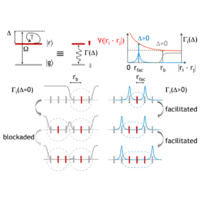
Nonequilibrium dynamics with controllable kinetic constraints are experimentally realized with cold interacting Rydberg gases. The blockade and facilitation constraints are shown to lead to strikingly different dynamical evolutions of the Rydberg excitations.

Ultimate capacity of a linear time-invariant bosonic channel

Bhaskar Roy Bardhan and Jeffrey H. Shapiro

Phys. Rev. A 93, 032342 (2016) - Published 31 March, 2016

Optical channels play an important role in the information era, in which establishing the ultimate rate for reliably transmitting  communication is paramount. Building on recent breakthroughs,  the authors derive  the capacity of quantum channels including realistic processes, providing a direct link to practical  broadband communications schemes.

Impact of third-harmonic generation on the filamentation process

J. Doussot, P. Béjot, and O. Faucher

Phys. Rev. A 93, 033857 (2016) - Published 30 March, 2016

The propagation of intense ultrashort pulses may cause ionization of the medium, leading to parasitic emission of radiation, in particular third-harmonic generation (THG). It is shown that, even if this influence is restricted to the level of a few percent, THG has an important impact on the dynamics of pulse propagation.

Multipartite concurrence for identical-fermion systems

A. P. Majtey, P. A. Bouvrie, A. Valdés-Hernández, and A. R. Plastino

Phys. Rev. A 93, 032335 (2016) - Published 23 March, 2016

The characterization of multipartite entanglement is tricky, but when the parts are fermions it might become even controversial. In this study a multipartite concurrence measure to detect entanglement in fermionic systems is proposed.

Towards highly multimode optical quantum memory for quantum repeaters

Pierre Jobez, Nuala Timoney, Cyril Laplane, Jean Etesse, Alban Ferrier, Philippe Goldner, Nicolas Gisin, and Mikael Afzelius

Phys. Rev. A 93, 032327 (2016) - Published 21 March, 2016

A technique to increase the capacity of a quantum memory is demonstrated. The method is based on shaping the profile of an optical pumping pulse, thus creating a high-resolution atomic comb structure that acts as a time-multiplexing optical storage device.

Radiative decay of a quantum emitter placed near a metal-dielectric lamellar nanostructure: Fundamental constraints

Vasily V. Klimov, Andrey A. Pavlov, Dmitry V. Guzatov, Ilya V. Zabkov, and Vitaly D. Savinov

Phys. Rev. A 93, 033831 (2016) - Published 16 March, 2016

Tailoring the environment for a quantum emitter with planar stratified metal-dielectric structures leads to a substantial enhancement of the spontaneous emission rate and could be a more effective alternative to approaches with plasmonic nanoparticles.

Fast graph operations in quantum computation

Liming Zhao, Carlos A. Pérez-Delgado, and Joseph F. Fitzsimons

Phys. Rev. A 93, 032314 (2016) - Published 10 March, 2016

Graphs, mathematical objects used as a ubiquitous representation of data structures, are commonly applied to better understand certain entangled states called graph states. In this insightful investigation, the authors take the inverse route, and show that quantum graph states provide an efficient way of representing and manipulating graphs better than any possible classical structure.

Attosecond lighthouses in gases: A theoretical and numerical study

T. Auguste, O. Gobert, T. Ruchon, and F. Quéré

Phys. Rev. A 93, 033825 (2016) - Published 10 March, 2016

The “attosecond lighthouse” is a recent approach to produce isolated attosecond pulses based on exploiting space-time couplings. In this detailed theoretical study, the method is further explored and made accessible to a broad community.

All-real spectra in optical systems with arbitrary gain-and-loss distributions

Sean Nixon and Jianke Yang

Phys. Rev. A 93, 031802(R) (2016) - Published 9 March, 2016

A general method to obtain complex potentials presenting all-real spectra, but without the need of parity-time (PT) symmetry, is proposed. By relaxing the stringent restriction set by PT symmetry, this study paves the way to new developments in non-Hermitian optics.

Inter- and intracycle interference effects in strong-field dissociative ionization

Lun Yue and Lars Bojer Madsen

Phys. Rev. A 93, 031401(R) (2016) - Published 8 March, 2016

The energy sharing between the electron and nuclei is studied in detail for strong-field dissociative ionization of H2+ molecular ions, where the fine-grained structures that appear to violate a simple energy conservation rule are now understood by inter- and intracycle interferences.

Conservation laws and symmetry transformations of the electromagnetic field with sources

Gerard Nienhuis

Phys. Rev. A 93, 023840 (2016) - Published 25 February, 2016

Light’s helicity and chirality are analyzed in the framework of continuity equations of a classical electromagnetic field in the presence of sources. The work brings a comprehensive physical understanding of the interaction of chiral light with matter.

Quantum acousto-optic transducer for superconducting qubits

Vitaly S. Shumeiko

Phys. Rev. A 93, 023838 (2016) - Published 24 February, 2016

It is theoretically shown how to coherently couple microwave photons to phonons via the mechanism of stimulated Brillouin scattering in an integrated acousto-optic resonator. Achieving efficient coupling is an important step towards long distance quantum communication based on circuit quantum electrodynamics architectures.

Multiparticle entanglement as an emergent phenomenon

Nikolai Miklin, Tobias Moroder, and Otfried Gühne

Phys. Rev. A 93, 020104(R) (2016) - Published 22 February, 2016

Genuine multipartite entangled states can be traced from separable marginals by an iterative method based on semidefinite programming. Viewed from another perspective, it is shown that localizable entanglement is not a precondition for genuine multiparticle entanglement.

Time-to-frequency mapping of optical pulses using accelerating quasi-phase-matching

Mor Konsens and Alon Bahabad

Phys. Rev. A 93, 023823 (2016) - Published 18 February, 2016
An alternative method to characterize the temporal profile of ultrafast pulses is proposed. The scheme, based on frequency conversion with tuned spatiotemporal coupling, does not require a retrieval algorithm and is single-shot based.

Sign In to Your Journals Account

Filter

Section

Filter

Article Lookup

Enter a citation