Recent Articles

Gaussian Conversion Protocols for Cubic Phase State Generation

Yu Zheng, Oliver Hahn, Pascal Stadler, Patric Holmvall, Fernando Quijandría, Alessandro Ferraro, and Giulia Ferrini

PRX Quantum 2, 010327 (2021) - Published 19 February, 2021

Cubic phase states, sought as a resource for universal computation, can be experimentally created using the recently produced trisqueezed states and simple Gaussian operations.

Error Correction of Quantum Reference Frame Information

Patrick Hayden, Sepehr Nezami, Sandu Popescu, and Grant Salton

PRX Quantum 2, 010326 (2021) - Published 18 February, 2021

An investigation of group covariant quantum error correction indicates that the Eastin-Knill theorem, a stumbling block on the path to fault-tolerant quantum computation, may be circumvented by using continuous variables.

Non-Gaussianity as a Signature of a Quantum Theory of Gravity

Richard Howl, Vlatko Vedral, Devang Naik, Marios Christodoulou, Carlo Rovelli, and Aditya Iyer

PRX Quantum 2, 010325 (2021) - Published 17 February, 2021

A new signature of quantum gravity, connected to a concept used in the area of quantum computation, may enable a table-top test of quantum gravity using just a single quantum system and without assumptions on locality.

Machine Learning of Noise-Resilient Quantum Circuits

Lukasz Cincio, Kenneth Rudinger, Mohan Sarovar, and Patrick J. Coles

PRX Quantum 2, 010324 (2021) - Published 15 February, 2021

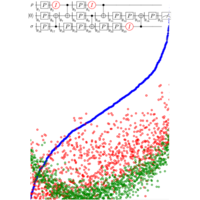
The impact of hardware noise on quantum circuits is circumvented using a machine learning strategy that outputs the best circuit design for optimizing the performance of a given algorithmic task under the noisy environment.

Faster Digital Quantum Simulation by Symmetry Protection

Minh C. Tran, Yuan Su, Daniel Carney, and Jacob M. Taylor

PRX Quantum 2, 010323 (2021) - Published 12 February, 2021

Error reduction of several orders of magnitude in a quantum simulation may be possible by using a technique that explores symmetry protection.

Fast Estimation of Sparse Quantum Noise

Robin Harper, Wenjun Yu, and Steven T. Flammia

PRX Quantum 2, 010322 (2021) - Published 10 February, 2021

An accurate and efficient way to estimate the noise on a quantum computer is devised, enabling the recovery of noise rates as small as 1 part in 10,000.

Few-Electron Single and Double Quantum Dots in an InAs Two-Dimensional Electron Gas

Christopher Mittag, Jonne V. Koski, Matija Karalic, Candice Thomas, Aymeric Tuaz, Anthony T. Hatke, Geoffrey C. Gardner, Michael J. Manfra, Jeroen Danon, Thomas Ihn, and Klaus Ensslin

PRX Quantum 2, 010321 (2021) - Published 9 February, 2021

Important challenges for successfully adopting indium arsenide quantum dots as a platform for quantum devices are solved, bringing in new competitive advantages to the realm of semiconductor technologies.

Computational Advantage from the Quantum Superposition of Multiple Temporal Orders of Photonic Gates

Márcio M. Taddei, Jaime Cariñe, Daniel Martínez, Tania García, Nayda Guerrero, Alastair A. Abbott, Mateus Araújo, Cyril Branciard, Esteban S. Gómez, Stephen P. Walborn, Leandro Aolita, and Gustavo Lima

PRX Quantum 2, 010320 (2021) - Published 8 February, 2021

Playing with causal orders leads to quadratic speed-up: An efficient algorithm is introduced and implemented in a scalable fiber-optic based experiment that achieves, for the first time, a quantum 4-switch gate.

Fully Quantum Scalable Description of Driven-Dissipative Lattice Models

Piotr Deuar, Alex Ferrier, Michał Matuszewski, Giuliano Orso, and Marzena H. Szymańska

PRX Quantum 2, 010319 (2021) - Published 5 February, 2021

The problem of modeling large driven dissipative quantum systems is tackled with a phase space method, opening the way to progress on a myriad of experimental platforms described by a Bose Hubbard model, including highly non-uniform systems with tens of thousands of sites.

Maximal Entropy Approach for Quantum State Tomography

Rishabh Gupta, Rongxin Xia, Raphael D. Levine, and Sabre Kais

PRX Quantum 2, 010318 (2021) - Published 2 February, 2021

An explicit scheme for the optimal approximation of a quantum state using a finite but incomplete set of observables is outlined.

Quantum Computation of Finite-Temperature Static and Dynamical Properties of Spin Systems Using Quantum Imaginary Time Evolution

Shi-Ning Sun, Mario Motta, Ruslan N. Tazhigulov, Adrian T.K. Tan, Garnet Kin-Lic Chan, and Austin J. Minnich

PRX Quantum 2, 010317 (2021) - Published 1 February, 2021

Simulations of the finite-temperature quantum dynamics of spin systems are performed on digital quantum computers, enhancing many capabilities that are critical to study realistic many-body physics on near-term quantum hardware.

Theory of Quantum System Certification

Martin Kliesch and Ingo Roth

PRX Quantum 2, 010201 (2021) - Published 29 January, 2021

Prominent protocols that allow certifying the proper functioning of quantum devices are thoroughly discussed, providing a high-level guide for newcomers.

Using Deep Learning to Understand and Mitigate the Qubit Noise Environment

David F. Wise, John J.L. Morton, and Siddharth Dhomkar

PRX Quantum 2, 010316 (2021) - Published 28 January, 2021

A neural network is constructed to learn the environment of an arbitrary qubit, allowing the underlying noise spectrum to be extracted in a manner that is more accurate and experimentally efficient than existing methods.

Complexity of Quantum State Verification in the Quantum Linear Systems Problem

Rolando D. Somma and Yiğit Subaşı

PRX Quantum 2, 010315 (2021) - Published 27 January, 2021

The prospects of quantum advantage using NISQ devices to solve linear algebra problems are shown to be fairly small.

Continuously Parametrized Quantum Simulation of Molecular Electron-Transfer Reactions

Frank Schlawin, Manuel Gessner, Andreas Buchleitner, Tobias Schätz, and Spiros S. Skourtis

PRX Quantum 2, 010314 (2021) - Published 25 January, 2021

A recipe to simulate chemistry at the single-molecule level in a trapped-ion platform is presented, enabling a high-precision investigation in previously unattainable regimes.

Uniqueness and Optimality of Dynamical Extensions of Divergences

Gilad Gour

PRX Quantum 2, 010313 (2021) - Published 22 January, 2021

An axiomatic approach to channel divergences, particularly dynamical relative entropies, based on an extension of the data processing inequality, is presented.

Universal Quantum Computing Using Electronuclear Wavefunctions of Rare-Earth Ions

Manuel Grimm, Adrian Beckert, Gabriel Aeppli, and Markus Müller

PRX Quantum 2, 010312 (2021) - Published 21 January, 2021

Rare-earth ions with nuclear spins in an insulating crystal constitute a promising quantum computing platform, with rapidly configurable two-qubit gates enabled by long-range magnetic dipolar interactions.

Probing the Coherence of Solid-State Qubits at Avoided Crossings

Mykyta Onizhuk, Kevin C. Miao, Joseph P. Blanton, He Ma, Christopher P. Anderson, Alexandre Bourassa, David D. Awschalom, and Giulia Galli

PRX Quantum 2, 010311 (2021) - Published 20 January, 2021

The dynamics of solid-state qubits coupled to a bath of nuclear spins at avoided crossings are investigated theoretically and experimentally, uncovering the nature of the decoherence process at clock transition.

Second Chern Number and Non-Abelian Berry Phase in Topological Superconducting Systems

H. Weisbrich, R.L. Klees, G. Rastelli, and W. Belzig

PRX Quantum 2, 010310 (2021) - Published 19 January, 2021

A hybrid network structure of superconductors and quantum dots is theoretically shown to represent a rich platform for exploring nontrivial non-Abelian 4D topology.

Quantifying the Efficiency of State Preparation via Quantum Variational Eigensolvers

Gabriel Matos, Sonika Johri, and Zlatko Papić

PRX Quantum 2, 010309 (2021) - Published 15 January, 2021

The reason why quantum approximate optimization algorithms work to prepare some quantum states but not others is addressed, shining light into its capabilities and limitations.

Sign In to Your Journals Account

Filter

Recent Issues

Vol. 7, Iss. 4
October - December 2026
Vol. 7, Iss. 3
July - September 2026
Vol. 7, Iss. 2
April - June 2026
Vol. 7, Iss. 1
January - March 2026
Category
Article Type

Filter

Article Lookup

Enter a citation