Recent Articles

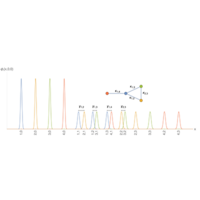
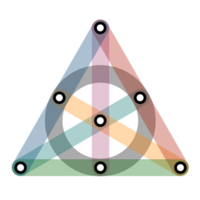
Many-Body Quantum Magic

Zi-Wen Liu and Andreas Winter

PRX Quantum 3, 020333 (2022) - Published 12 May, 2022

As with many good things, of the quantum computational resource of magic one can have either too little or too much, and to be useful it has to be consumed in moderation.

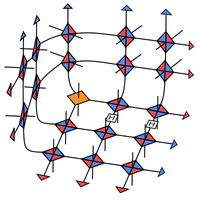
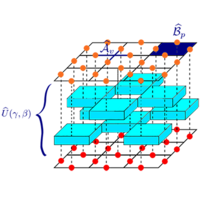
Quantum Lego: Building Quantum Error Correction Codes from Tensor Networks

ChunJun Cao and Brad Lackey

PRX Quantum 3, 020332 (2022) - Published 11 May, 2022

A graphically intuitive framework is introduced to construct complex quantum error correction codes, enabling a wealth of designing features and capabilities.

Simulation of Quantum Many-Body Dynamics with Tensor Processing Units: Floquet Prethermalization

Alan Morningstar, Markus Hauru, Jackson Beall, Martin Ganahl, Adam G.M. Lewis, Vedika Khemani, and Guifre Vidal

PRX Quantum 3, 020331 (2022) - Published 11 May, 2022

A recent technological advancement powering state-of-the-art machine learning applications is repurposed to accelerate and scale classical simulations of quantum many-body dynamics.

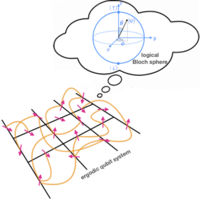
Symmetry-Protected Infinite-Temperature Quantum Memory from Subsystem Codes

Julia Wildeboer, Thomas Iadecola, and Dominic J. Williamson

PRX Quantum 3, 020330 (2022) - Published 10 May, 2022

The structure of subsystem codes is harnessed to construct non-integrable models exhibiting unconventional conserved quantities that can be used to build a quantum memory at infinite temperature.

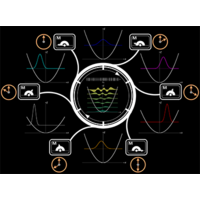
Autonomous Dissipative Maxwell’s Demon in a Diamond Spin Qutrit

S. Hernández-Gómez, S. Gherardini, N. Staudenmaier, F. Poggiali, M. Campisi, A. Trombettoni, F.S. Cataliotti, P. Cappellaro, and N. Fabbri

PRX Quantum 3, 020329 (2022) - Published 9 May, 2022

The quantum (non-thermal) energy fluctuations and the extractable energy of a spin system, driven by an autonomous dissipative feedback mechanism, are experimentally characterized using NV centers in diamond.

Fermion Sampling: A Robust Quantum Computational Advantage Scheme Using Fermionic Linear Optics and Magic Input States

Michał Oszmaniec, Ninnat Dangniam, Mauro E.S. Morales, and Zoltán Zimborás

PRX Quantum 3, 020328 (2022) - Published 9 May, 2022

Demonstrating quantum computational advantage with strong hardness guarantees is shown to be possible using fermionic linear optics with magic input states, and an experimentally feasible setup is proposed.

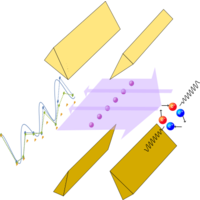
Coherent Light Shift on Alkaline-Earth Rydberg Atoms from Isolated Core Excitation without Autoionization

Ky-Luc Pham, Thomas F. Gallagher, Pierre Pillet, Steven Lepoutre, and Patrick Cheinet

PRX Quantum 3, 020327 (2022) - Published 6 May, 2022

Mastering alkaline-earth atoms for quantum simulations: A new approach to control a core electron without disturbing the Rydberg one.

Controlling Rydberg Excitations Using Ion-Core Transitions in Alkaline-Earth Atom-Tweezer Arrays

Alex P. Burgers, Shuo Ma, Sam Saskin, Jack Wilson, Miguel A. Alarcón, Chris H. Greene, and Jeff D. Thompson

PRX Quantum 3, 020326 (2022) - Published 6 May, 2022

A method to improve the local control of Rydberg atom arrays is experimentally demonstrated, leading to significantly reduced photon scattering errors from light shifts.

Site-Dependent Properties of Quantum Emitters in Nanostructured Silicon Carbide

Tamanna Joshi and Pratibha Dev

PRX Quantum 3, 020325 (2022) - Published 5 May, 2022

A density functional theory investigation of structural, electronic, spin and optical properties of defects in nanostructured silicon carbide is presented, aiming at the optimized generation of quantum emitters.

Digital Quantum Simulation of the Schwinger Model and Symmetry Protection with Trapped Ions

Nhung H. Nguyen, Minh C. Tran, Yingyue Zhu, Alaina M. Green, C. Huerta Alderete, Zohreh Davoudi, and Norbert M. Linke

PRX Quantum 3, 020324 (2022) - Published 4 May, 2022

Combining experimental and algorithmic advances in quantum simulation improves the investigation of gauge field theories: pair creation is simulated for longer times using less computational resources.

Real-Time Evolution for Ultracompact Hamiltonian Eigenstates on Quantum Hardware

Katherine Klymko, Carlos Mejuto-Zaera, Stephen J. Cotton, Filip Wudarski, Miroslav Urbanek, Diptarka Hait, Martin Head-Gordon, K. Birgitta Whaley, Jonathan Moussa, Nathan Wiebe, Wibe A. de Jong, and Norm M. Tubman

PRX Quantum 3, 020323 (2022) - Published 3 May, 2022

VQPE: A combination of variational methods and quantum phase estimation is put together to develop an approach for computing ground and excited states that is fast and efficient.

Intractability of Electronic Structure in a Fixed Basis

Bryan O’Gorman, Sandy Irani, James Whitfield, and Bill Fefferman

PRX Quantum 3, 020322 (2022) - Published 2 May, 2022

The computational complexity of electronic ground-state energy calculations remains hard even by fixing the number of electrons or restricting the problem to a fixed single-particle basis.

Path Integral Framework for Characterizing and Controlling Decoherence Induced by Nonstationary Environments on a Quantum Probe

Martin Kuffer, Analia Zwick, and Gonzalo A. Álvarez

PRX Quantum 3, 020321 (2022) - Published 29 April, 2022

A framework to characterize and control the influence of out-of-equilibrium environments on a quantum device is presented: A methodology inspired by field theory with relevance to quantum technologies.

Two-Dimensional Z2 Lattice Gauge Theory on a Near-Term Quantum Simulator: Variational Quantum Optimization, Confinement, and Topological Order

Luca Lumia, Pietro Torta, Glen B. Mbeng, Giuseppe E. Santoro, Elisa Ercolessi, Michele Burrello, and Matteo M. Wauters

PRX Quantum 3, 020320 (2022) - Published 28 April, 2022

Quantum approximate optimization algorithms can efficiently initialize the ground states of two-dimensional lattice gauge theory in different phases, showing signatures of topological order in systems sizes comparable to modern quantum computing platforms.

Speed Limits for Macroscopic Transitions

Ryusuke Hamazaki

PRX Quantum 3, 020319 (2022) - Published 27 April, 2022

By mapping general systems onto graphs, speed limits qualitatively tighter than conventional ones are derived for macroscopic transitions.

Thermodynamic Constraints on Quantum Information Gain and Error Correction: A Triple Trade-Off

Arshag Danageozian, Mark M. Wilde, and Francesco Buscemi

PRX Quantum 3, 020318 (2022) - Published 26 April, 2022

Trade-off relations linking quantum error correction–viewed as a heat engine–and quantum measurements used for error identification are established, helping to understand how thermodynamics can inform, or limit, our ability to reach fault-tolerance.

Programmable Quantum Annealers as Noisy Gibbs Samplers

Marc Vuffray, Carleton Coffrin, Yaroslav A. Kharkov, and Andrey Y. Lokhov

PRX Quantum 3, 020317 (2022) - Published 25 April, 2022

Physical realizations of quantum annealers behave as samplers from Gibbs distributions with parameters that fluctuate due to noise, leading to spurious interactions between qubits in the output distributions.

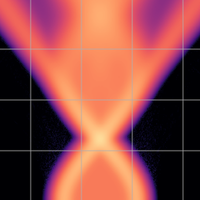
Collisions of False-Vacuum Bubble Walls in a Quantum Spin Chain

Ashley Milsted, Junyu Liu, John Preskill, and Guifre Vidal

PRX Quantum 3, 020316 (2022) - Published 22 April, 2022

The limits of classical computing and the possibility of quantum advantage are explored by simulating the quantum dynamics of particle production in false-vacuum bubble wall collisions.

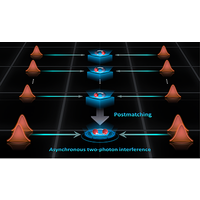
Breaking the Rate-Loss Bound of Quantum Key Distribution with Asynchronous Two-Photon Interference

Yuan-Mei Xie, Yu-Shuo Lu, Chen-Xun Weng, Xiao-Yu Cao, Zhao-Ying Jia, Yu Bao, Yang Wang, Yao Fu, Hua-Lei Yin, and Zeng-Bing Chen

PRX Quantum 3, 020315 (2022) - Published 21 April, 2022

An asynchronous version of measurement-device-independent quantum key distribution protocol promises to boost intercity quantum communication rates by tens of thousands through multiplexing.

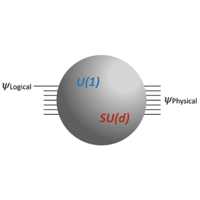
Near-Optimal Covariant Quantum Error-Correcting Codes from Random Unitaries with Symmetries

Linghang Kong and Zi-Wen Liu

PRX Quantum 3, 020314 (2022) - Published 20 April, 2022

A systematic investigation of the symmetry-constrained quantum error-correcting codes through a natural and near-optimal new model is thoroughly presented, including an extensive discussion of the expected impact of the results.

Sign In to Your Journals Account

Filter

Recent Issues

Vol. 7, Iss. 4
October - December 2026
Vol. 7, Iss. 3
July - September 2026
Vol. 7, Iss. 2
April - June 2026
Vol. 7, Iss. 1
January - March 2026
Category
Article Type

Filter

Article Lookup

Enter a citation