The complexity of learning quantum states and evolutions is related to the complexity of creating them.
Learning Quantum States and Unitaries of Bounded Gate Complexity
Haimeng Zhao, Laura Lewis, Ishaan Kannan, Yihui Quek, Hsin-Yuan Huang, and Matthias C. Caro
PRX Quantum 5, 040306 (2024)
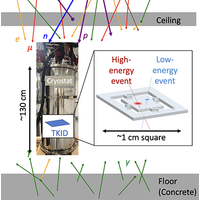
Joseph W. Fowler, Paul Szypryt, Raymond Bunker, Ellen R. Edwards, Ian Fogarty Florang, Jiansong Gao, Andrea Giachero, Shannon F. Hoogerheide, Ben Loer, H. Pieter Mumm, Nathan Nakamura, Galen C. O’Neil, John L. Orrell, Elizabeth M. Scott, Jason Stevens, Daniel S. Swetz, Brent A. VanDevender, Michael Vissers, and Joel N. Ullom
PRX Quantum 5, 040323 (2024) - Published 12 November, 2024
New superconducting thermal detectors characterize the radiation environment of qubits, making it possible to determine and reduce sources of decoherence.
Francesca Orsi, Nick Sauerwein, Rohit Prasad Bhatt, Jonas Faltinath, Ekaterina Fedotova, Nicola Reiter, Tigrane Cantat-Moltrecht, and Jean-Philippe Brantut
PRX Quantum 5, 040333 (2024) - Published 2 December, 2024
This novel cavity microscope combines the enhanced sensitivity of cavity quantum electrodynamics with the manipulation of atom-light interactions at high-spatial resolution.
Henning Schlömer, Hannah Lange, Titus Franz, Thomas Chalopin, Petar Bojović, Si Wang, Immanuel Bloch, Timon A. Hilker, Fabian Grusdt, and Annabelle Bohrdt
PRX Quantum 5, 040341 (2024) - Published 12 December, 2024
Researchers demonstrate how local control and bilayer optical lattices can simulate nickelate and cuprate high-temperature superconductors, enabling the study of long-range superconducting order and -wave pairing physics.
Robbie King, Kianna Wan, and Jarrod R. McClean
PRX Quantum 5, 040301 (2024) - Published 2 October, 2024
Proof that the complex conjugate quantum state is a resource that can lead to massive sample advantages over classical computation has wide implications and applications across quantum technologies.
Eric Sabo, Lane G. Gunderman, Benjamin Ide, Michael Vasmer, and Guillaume Dauphinais
PRX Quantum 5, 040302 (2024) - Published 4 October, 2024
A simple weight-reduction method that preserves the number of logical qubits and often increases the code distance is proposed for small-to-medium-sized quantum low-density parity-check codes.
Christophe Piveteau, Christopher T. Chubb, and Joseph M. Renes
PRX Quantum 5, 040303 (2024) - Published 8 October, 2024
By expanding tensor-network decoding capabilities to 3D codes, highly accurate decoders that outperform the state of the art are demonstrated for quantum error correction.
Yifan Zhang, Sarang Gopalakrishnan, and Georgios Styliaris
PRX Quantum 5, 040304 (2024) - Published 10 October, 2024
Constant-depth local circuits with a single round of measurement and feedback can be used to prepare long-range entangled states, revealing new insights into tensor symmetries.
Andrew Pocklington and Aashish A. Clerk
PRX Quantum 5, 040305 (2024) - Published 15 October, 2024
Rigorous bounds provide a novel link between steady-state entanglement and relaxation times in Markovian open systems.
Haimeng Zhao, Laura Lewis, Ishaan Kannan, Yihui Quek, Hsin-Yuan Huang, and Matthias C. Caro
PRX Quantum 5, 040306 (2024) - Published 16 October, 2024
The complexity of learning quantum states and evolutions is related to the complexity of creating them.
Iivari Pietikäinen, Ondřej Černotík, Alec Eickbusch, Aniket Maiti, John W.O. Garmon, Radim Filip, and Steven M. Girvin
PRX Quantum 5, 040307 (2024) - Published 17 October, 2024
A precise evaluation of the trade-offs in controlling ultra-high-quality microwave cavities advances their use as quantum memory for superconducting qubits.
Hiroyuki Harada, Kaito Wada, and Naoki Yamamoto
PRX Quantum 5, 040308 (2024) - Published 18 October, 2024
A novel approach based on an optimal wire-cutting method for quantum circuit decomposition is shown to achieve minimal sampling overhead and channel count without using ancilla qubits.
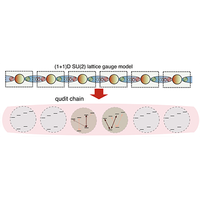
Giuseppe Calajó, Giuseppe Magnifico, Claire Edmunds, Martin Ringbauer, Simone Montangero, and Pietro Silvi
PRX Quantum 5, 040309 (2024) - Published 21 October, 2024
An efficient method to simulate non-Abelian lattice gauge theories with trapped-ion qudits opens a new avenue in quantum simulation.
Guo-Xian Su, Jesse J. Osborne, and Jad C. Halimeh
PRX Quantum 5, 040310 (2024) - Published 22 October, 2024
A new proposal to quantum simulate particle collisions in a U(1) lattice gauge theory using cold atoms.
Marko Ljubotina, Elena Petrova, Norbert Schuch, and Maksym Serbyn
PRX Quantum 5, 040311 (2024) - Published 23 October, 2024
A new framework for preparing matrix product states via continuous unitary evolution provides a path to state control in quantum many-body systems and insights into Floquet scars.
Javier Martínez-Cifuentes, Hubert de Guise, and Nicolás Quesada
PRX Quantum 5, 040312 (2024) - Published 24 October, 2024
A validation strategy based on linear cross-entropy provides a figure of merit that certifies quantum advantage and prevents classical spoofing.
Finn Eckstein, Bo Han, Simon Trebst, and Guo-Yi Zhu
PRX Quantum 5, 040313 (2024) - Published 25 October, 2024
Teleportation of surface codes with minimal entanglement resources can be enhanced using an electric-magnetic self-duality, charting a way to experimental realizations of robust many-qubit teleportation.
Matthew Thibodeau, Angela Kou, and Bryan K. Clark
PRX Quantum 5, 040314 (2024) - Published 28 October, 2024
A superconducting qubit using Floquet drives is expected to provide state-of-the-art logical coherence with low bit- and phase-flip errors and fast high-fidelity gates.
Shlok Nahar, Devashish Tupkary, Yuming Zhao, Norbert Lütkenhaus, and Ernest Y.-Z. Tan
PRX Quantum 5, 040315 (2024) - Published 29 October, 2024
An experimentally relevant quantum key distribution security proof via a reduction to IID attacks is presented.
Jacob Watkins, Nathan Wiebe, Alessandro Roggero, and Dean Lee
PRX Quantum 5, 040316 (2024) - Published 31 October, 2024
A qubitization-based framework is introduced for simulating time-dependent quantum Hamiltonians, eliminating time ordering via a “clock” degree of freedom and proposing a multiproduct algorithm for efficient simulation.
Emma L. Rosenfeld, Connor T. Hann, David I. Schuster, Matthew H. Matheny, and Aashish A. Clerk
PRX Quantum 5, 040317 (2024) - Published 1 November, 2024
Resonator-based two-qubit gates between fluxonium qubits could offer scalability and state-of-the-art fidelity.
Raymond A. Mencia, Wei-Ju Lin, Hyunheung Cho, Maxim G. Vavilov, and Vladimir E. Manucharyan
PRX Quantum 5, 040318 (2024) - Published 4 November, 2024
Tuning the fluxonium magnetic flux bias to integer values (including zero) instead of the conventional half values yields superconducting qubits with high fidelity, high coherence time, and frequencies similar to transmons.
David Theidel, Viviane Cotte, René Sondenheimer, Viktoriia Shiriaeva, Marie Froidevaux, Vladislav Severin, Adam Merdji-Larue, Philip Mosel, Sven Fröhlich, Kim-Alessandro Weber, Uwe Morgner, Milutin Kovacev, Jens Biegert, and Hamed Merdji
PRX Quantum 5, 040319 (2024) - Published 5 November, 2024
Experimental evidence shows that high-harmonic generation in semiconductors produces nonclassical states of light, including multimode squeezing and entanglement, opening pathways for quantum technologies.
Alexander Miessen, Daniel J. Egger, Ivano Tavernelli, and Guglielmo Mazzola
PRX Quantum 5, 040320 (2024) - Published 6 November, 2024
A scalable, transferable, and simple set of benchmarks for quantum computers based on reproducing known universal scaling laws of condensed-matter systems eliminates the need for intractable classical simulation.
J. Schuhmann, L. Lazzari, M. Morassi, A. Lemaître, I. Sagnes, G. Beaudoin, M.I. Amanti, F. Boeuf, F. Raineri, F. Baboux, and S. Ducci
PRX Quantum 5, 040321 (2024) - Published 7 November, 2024
On-chip generation and manipulation of quantum states is experimentally demonstrated on a hybrid photonic platform, with properties that enable a variety of quantum information applications.
Merritt P. Losert, Max Oberländer, Julian D. Teske, Mats Volmer, Lars R. Schreiber, Hendrik Bluhm, S.N. Coppersmith, and Mark Friesen
PRX Quantum 5, 040322 (2024) - Published 8 November, 2024
By combining tuning strategies to avoid the guaranteed regions where energy gaps in quantum dots are small and therefore prone to leakage, shuttling infidelities can be dramatically reduced.
Joseph W. Fowler, Paul Szypryt, Raymond Bunker, Ellen R. Edwards, Ian Fogarty Florang, Jiansong Gao, Andrea Giachero, Shannon F. Hoogerheide, Ben Loer, H. Pieter Mumm, Nathan Nakamura, Galen C. O’Neil, John L. Orrell, Elizabeth M. Scott, Jason Stevens, Daniel S. Swetz, Brent A. VanDevender, Michael Vissers, and Joel N. Ullom
PRX Quantum 5, 040323 (2024) - Published 12 November, 2024
New superconducting thermal detectors characterize the radiation environment of qubits, making it possible to determine and reduce sources of decoherence.
Maxime Allemand, Raphael Jannin, Géraud Dupuy, Jan-Philipp Bureik, Luca Pezzè, Denis Boiron, and David Clément
PRX Quantum 5, 040324 (2024) - Published 13 November, 2024
A new detector tomography approach experimentally demonstrates highly accurate and robust characterization by exploiting the spatial resolution of a single-particle detector.
Kaito Kobayashi, Keisuke Fujii, and Naoki Yamamoto
PRX Quantum 5, 040325 (2024) - Published 14 November, 2024
A method to avoid interrupting a quantum process during measurements could boost the real-time processing of time-series data.
François Swiadek, Ross Shillito, Paul Magnard, Ants Remm, Christoph Hellings, Nathan Lacroix, Quentin Ficheux, Dante Colao Zanuz, Graham J. Norris, Alexandre Blais, Sebastian Krinner, and Andreas Wallraff
PRX Quantum 5, 040326 (2024) - Published 20 November, 2024
dynamic control of the dispersive shift allows for faster- and higher-fidelity qubit readout.
Oscar Higgott and Nikolas P. Breuckmann
PRX Quantum 5, 040327 (2024) - Published 22 November, 2024
New construction of Floquet quantum error-correction codes derived from the tiling of hyperbolic surfaces can be up to 100 times more efficient than surface codes.
Adam Siegel, Armands Strikis, and Michael Fogarty
PRX Quantum 5, 040328 (2024) - Published 25 November, 2024
Error correction on highly constrained architectures equipped with shuttling is not only possible but is powerful enough to support fault tolerance.
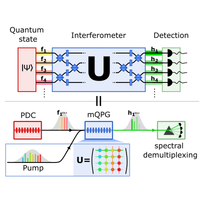
Patrick Folge, Michael Stefszky, Benjamin Brecht, and Christine Silberhorn
PRX Quantum 5, 040329 (2024) - Published 26 November, 2024
Single-spatial-mode interferometers are made through the design of nonlinear processes, enabling resource-efficient linear quantum networks.
Sanjay Moudgalya and Olexei I. Motrunich
PRX Quantum 5, 040330 (2024) - Published 27 November, 2024
A systematic link between conventional and unconventional symmetries and their corresponding hydrodynamic modes is established by interpreting symmetry operators as ground states of local superoperators.
Shirin Afzal, Tyler J. Zimmerling, Mahdi Rizvandi, Majid Taghavi, Leili Esmaeilifar, Taras Hrushevskyi, Manpreet Kaur, Vien Van, and Shabir Barzanjeh
PRX Quantum 5, 040331 (2024) - Published 27 November, 2024
A high entangled-pair generation rate is made possible by a topological resonance, providing protection against fabrication imperfections.
Mariano Bonifacio, Francesco Piazza, and Tobias Donner
PRX Quantum 5, 040332 (2024) - Published 2 December, 2024
A method for creating fully tunable and highly controlled atom-atom interactions in quantum gases enables new investigations of materials properties and applications in quantum simulation.
Francesca Orsi, Nick Sauerwein, Rohit Prasad Bhatt, Jonas Faltinath, Ekaterina Fedotova, Nicola Reiter, Tigrane Cantat-Moltrecht, and Jean-Philippe Brantut
PRX Quantum 5, 040333 (2024) - Published 2 December, 2024
This novel cavity microscope combines the enhanced sensitivity of cavity quantum electrodynamics with the manipulation of atom-light interactions at high-spatial resolution.
Bence Hetényi and James R. Wootton
PRX Quantum 5, 040334 (2024) - Published 3 December, 2024
By interleaving two error-correction codes with each other, logical qubits are entangled using only local entangling gates on quantum hardware with restricted connectivity.
Sanaa Agarwal, Edwin Chaparro, Diego Barberena, A. Piñeiro Orioli, G. Ferioli, S. Pancaldi, I. Ferrier-Barbut, A. Browaeys, and A.M. Rey
PRX Quantum 5, 040335 (2024) - Published 3 December, 2024
For dense, disordered gases with strong excitations, new insight based on mean-field approximation captures emergent properties and is validated in experiments.
Amin Moharramipour, Leonardo A. Lessa, Chong Wang, Timothy H. Hsieh, and Subhayan Sahu
PRX Quantum 5, 040336 (2024) - Published 4 December, 2024
New results show that in strongly symmetric quantum channels, the maximally mixed steady state can attain logarithmically scaling entanglement in the presence of non-Abelian continuous symmetries.
Christophe H. Valahu, Tomas Navickas, Michael J. Biercuk, and Ting Rei Tan
PRX Quantum 5, 040337 (2024) - Published 5 December, 2024
An efficient, cross-platform method for benchmarking bosonic modes by applying randomized displacements can identify underlying noise using few measurements.
Victor Bradley, Kamal Sharma, Mohammad Hafezi, and Wade DeGottardi
PRX Quantum 5, 040338 (2024) - Published 6 December, 2024
The generation of many-body entanglement from repeated emission of photons leads to superradiance in one-dimensional electron gases.
Stepan Fomichev, Kasra Hejazi, Modjtaba Shokrian Zini, Matthew Kiser, Joana Fraxanet, Pablo Antonio Moreno Casares, Alain Delgado, Joonsuk Huh, Arne-Christian Voigt, Jonathan E. Mueller, and Juan Miguel Arrazola
PRX Quantum 5, 040339 (2024) - Published 9 December, 2024
A novel, cost-efficient method for preparing good initial states for ground-state energy estimation is used to suggest the most promising ground-state problems for exhibiting quantum advantage.
Benjamin Anker and Milad Marvian
PRX Quantum 5, 040340 (2024) - Published 10 December, 2024
A novel framework to design flag gadgets broadly applicable to many quantum codes is used to perform fault-tolerant syndrome extraction using exponentially fewer qubits than conventional methods.
Henning Schlömer, Hannah Lange, Titus Franz, Thomas Chalopin, Petar Bojović, Si Wang, Immanuel Bloch, Timon A. Hilker, Fabian Grusdt, and Annabelle Bohrdt
PRX Quantum 5, 040341 (2024) - Published 12 December, 2024
Researchers demonstrate how local control and bilayer optical lattices can simulate nickelate and cuprate high-temperature superconductors, enabling the study of long-range superconducting order and -wave pairing physics.
David A. Rower, Leon Ding, Helin Zhang, Max Hays, Junyoung An, Patrick M. Harrington, Ilan T. Rosen, Jeffrey M. Gertler, Thomas M. Hazard, Bethany M. Niedzielski, Mollie E. Schwartz, Simon Gustavsson, Kyle Serniak, Jeffrey A. Grover, and William D. Oliver
PRX Quantum 5, 040342 (2024) - Published 13 December, 2024
Two methods that combat counterrotating effects in fast Rabi-based gates are deployed in experiment to yield reliably high fidelity.
Matthew N. H. Chow, Vikas Buchemmavari, Sivaprasad Omanakuttan, Bethany J. Little, Saurabh Pandey, Ivan H. Deutsch, and Yuan-Yu Jau
PRX Quantum 5, 040343 (2024) - Published 16 December, 2024
Atom loss is detected during computation without disturbing the quantum state, an important task for long computations with neutral atoms.
Daniel Belkin, James Allen, Soumik Ghosh, Christopher Kang, Sophia Lin, James Sud, Frederic T. Chong, Bill Fefferman, and Bryan K. Clark
PRX Quantum 5, 040344 (2024) - Published 17 December, 2024
Random circuits with general architectures scramble information at least linearly as circuit depth increases.
Sahil Pontula, Yannick Salamin, Charles Roques-Carmes, and Marin Soljačić
PRX Quantum 5, 040345 (2024) - Published 18 December, 2024
Dissipation engineering in multimode nonlinear cavities enables bright squeezing across discrete frequency modes, with applications in quantum sensing, communication, and topological photonics.
Modesto Orozco-Ruiz, Nguyen H. Le, and Florian Mintert
PRX Quantum 5, 040346 (2024) - Published 20 December, 2024
An implicit approach for quantum control in terms of operators helps overcome the exponential scaling in a special class of quantum many-body systems.
Mason L. Rhodes, Michael Kreshchuk, and Shivesh Pathak
PRX Quantum 5, 040347 (2024) - Published 23 December, 2024
Algorithmic advances have cut lattice gauge theory simulation costs to levels comparable with quantum chemistry calculations.
Manthan Badbaria, Nicola Pancotti, Rajeev Singh, Jamir Marino, and Riccardo J. Valencia-Tortora
PRX Quantum 5, 040348 (2024) - Published 24 December, 2024
Kinetically constrained models display a mobility edge that depends on initial conditions, opening novel routes toward quantum advantage in nonergodic systems.
Zimu Li, Han Zheng, Junyu Liu, Liang Jiang, and Zi-Wen Liu
PRX Quantum 5, 040349 (2024) - Published 26 December, 2024
Unique strategies to generate pseudorandom quantum distributions using local ensembles under continuous symmetry constraints that impose fundamental challenges are proposed.
Kobra Mahdavipour, Farzam Nosrati, Stefania Sciara, Roberto Morandotti, and Rosario Lo Franco
PRX Quantum 5, 040350 (2024) - Published 27 December, 2024
A new scheme employs the indistinguishability of identical particles together with a graph-based representation to enable the controlled generation of various multipartite entangled states.
Francesco Atzori, Salvatore Virzì, Enrico Rebufello, Alessio Avella, Fabrizio Piacentini, Iris Cusini, Henri Haka, Federica Villa, Marco Gramegna, Eliahu Cohen, Ivo Pietro Degiovanni, and Marco Genovese
PRX Quantum 5, 040351 (2024) - Published 30 December, 2024
A bound on quantum correlations, which stems from the locality of generalized uncertainty relations and rules out stronger-than-quantum correlations, is experimentally demonstrated via nonprojective measurements, providing insights regarding the interplay between local and nonlocal correlations.
Bálint Koczor
PRX Quantum 5, 040352 (2024) - Published 31 December, 2024
A general framework that implements ideal quantum operations by taking linear combinations of nonideal operations is proposed and applied to a broad spectrum of practical applications.
Philippe Lewalle, Yipei Zhang, and K. Birgitta Whaley
PRX Quantum 5, 040901 (2024) - Published 30 October, 2024