Browse by Subject

Quantum Coding with Low-Depth Random Circuits

Michael J. Gullans, Stefan Krastanov, David A. Huse, Liang Jiang, and Steven T. Flammia

Phys. Rev. X 11, 031066 (2021) - Published 24 September, 2021

Quantum error-correction codes generated by random circuits can offer robust performance with low circuit depth, suggesting that practical error correction is within reach on near-term quantum devices.

Scaling Regimes of Active Turbulence with External Dissipation

Berta Martínez-Prat, Ricard Alert, Fanlong Meng, Jordi Ignés-Mullol, Jean-François Joanny, Jaume Casademunt, Ramin Golestanian, and Francesc Sagués

Phys. Rev. X 11, 031065 (2021) - Published 23 September, 2021

The energy spectrum of an active liquid-crystal film exhibits three scaling regimes with universal exponents—two predicted and one new—verifying long-held analogies of active turbulence to classical turbulence.

Stochastic Thermodynamics of Nonlinear Electronic Circuits: A Realistic Framework for Computing Around kT

Nahuel Freitas, Jean-Charles Delvenne, and Massimiliano Esposito

Phys. Rev. X 11, 031064 (2021) - Published 22 September, 2021

A new general thermodynamic theory of electronic circuits provides tools to construct practical circuits that make the most of thermal fluctuations.

Inertia Drives a Flocking Phase Transition in Viscous Active Fluids

Rayan Chatterjee, Navdeep Rana, R. Aditi Simha, Prasad Perlekar, and Sriram Ramaswamy

Phys. Rev. X 11, 031063 (2021) - Published 21 September, 2021

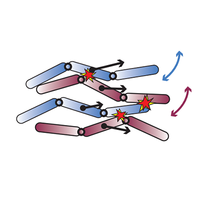
The motion of an ensemble of self-propelled swimmers has three fates—turbulent, noisy but ordered, and coordinated—depending on how their speed relates to the growth of viscous instabilities in the group.

Signatures of Quantum Phase Transitions after Quenches in Quantum Chaotic One-Dimensional Systems

Asmi Haldar, Krishnanand Mallayya, Markus Heyl, Frank Pollmann, Marcos Rigol, and Arnab Das

Phys. Rev. X 11, 031062 (2021) - Published 20 September, 2021

Locating quantum phase transitions is key to understanding drastic changes in the behavior of low-temperature matter. A new nonequilibrium protocol promises an easier way to do so.

Coherent Optical Creation of a Single Molecule

Yichao Yu, Kenneth Wang, Jonathan D. Hood, Lewis R. B. Picard, Jessie T. Zhang, William B. Cairncross, Jeremy M. Hutson, Rosario Gonzalez-Ferez, Till Rosenband, and Kang-Kuen Ni

Phys. Rev. X 11, 031061 (2021) - Published 17 September, 2021

The use of optical tweezers to create an NaCs molecule from its constituent atoms demonstrates a flexible platform for building molecular species one atom at a time.

Fiber Tracking Velocimetry for Two-Point Statistics of Turbulence

Stefano Brizzolara, Marco Edoardo Rosti, Stefano Olivieri, Luca Brandt, Markus Holzner, and Andrea Mazzino

Phys. Rev. X 11, 031060 (2021) - Published 17 September, 2021

A new technique to probe turbulence overcomes many limitations of traditional methods by relying on rigid fibers of various lengths, rather than tracer particles, suspended in a fluid.

Statistical Mechanics of Deep Linear Neural Networks: The Backpropagating Kernel Renormalization

Qianyi Li and Haim Sompolinsky

Phys. Rev. X 11, 031059 (2021) - Published 16 September, 2021

A new theory of linear deep neural networks allows for the first statistical study of their “weight space,” providing insight into the features that allow such networks to generalize so well.

Games in Rigged Economies

Luís F. Seoane

Phys. Rev. X 11, 031058 (2021) - Published 15 September, 2021

A game-theoretical model of a rigged economy predicts the emergence of cartels followed by a risk of instability as the economy becomes more complex.

Exponential Error Suppression for Near-Term Quantum Devices

Bálint Koczor

Phys. Rev. X 11, 031057 (2021) - Published 15 September, 2021

A new scheme could offer a technologically viable solution for remedying computational errors in near-term quantum devices.

Enantiomer Superpositions from Matter-Wave Interference of Chiral Molecules

Benjamin A. Stickler, Mira Diekmann, Robert Berger, and Daqing Wang

Phys. Rev. X 11, 031056 (2021) - Published 14 September, 2021

Matter-wave diffraction can put chiral molecules into superpositions of left- and right-handed forms, enabling new studies of how the two states interact with their environment

Self-Assembly of Informational Polymers by Templated Ligation

Joachim H. Rosenberger, Tobias Göppel, Patrick W. Kudella, Dieter Braun, Ulrich Gerland, and Bernhard Altaner

Phys. Rev. X 11, 031055 (2021) - Published 13 September, 2021

Competition of timescales in RNA self-assembly leads to two distinct length scales, one of which may act as building blocks for strands that grow into functional catalyzers, a key insight for origins-of-life research.

Josephson-Anderson Relation and the Classical D’Alembert Paradox

Gregory L. Eyink

Phys. Rev. X 11, 031054 (2021) - Published 10 September, 2021

A quantum-inspired model explains why objects moving in a fluid experience drag even at high speeds where viscosity should be negligible.

Dynamical Backaction Magnomechanics

C. A. Potts, E. Varga, V. A. S. V. Bittencourt, S. Viola Kusminskiy, and J. P. Davis

Phys. Rev. X 11, 031053 (2021) - Published 9 September, 2021

New experiments reveal all the ways that light impacts mechanics in cavity magnomechanics, where photons, phonons, and magnons couple in a versatile platform for exploring proposals quantum applications.

Dissipation Reduction and Information-to-Measurement Conversion in DNA Pulling Experiments with Feedback Protocols

M. Rico-Pasto, R. K. Schmitt, M. Ribezzi-Crivellari, J. M. R. Parrondo, H. Linke, J. Johansson, and F. Ritort

Phys. Rev. X 11, 031052 (2021) - Published 8 September, 2021

A novel protocol for applying feedback when pulling on a folded DNA strand minimizes dissipation, a demonstration of how feedback can be used to reduce dissipation in small out-of-equilibrium systems.

Collective Synchronization of Undulatory Movement through Contact

Wei Zhou, Zhuonan Hao, and Nick Gravish

Phys. Rev. X 11, 031051 (2021) - Published 7 September, 2021

Physical contact among simple robots with undulatory gaits leads to rich collective dynamics including synchronization, thus showing how some populations in nature sync their movements when in close proximity.

Observation of Unconventional Charge Density Wave without Acoustic Phonon Anomaly in Kagome Superconductors AV3Sb5 (A=Rb, Cs)

Haoxiang Li, T. T. Zhang, T. Yilmaz, Y. Y. Pai, C. E. Marvinney, A. Said, Q. W. Yin, C. S. Gong, Z. J. Tu, E. Vescovo, C. S. Nelson, R. G. Moore, S. Murakami, H. C. Lei, H. N. Lee, B. J. Lawrie, and H. Miao

Phys. Rev. X 11, 031050 (2021) - Published 3 September, 2021

New experiments explore a previously reported charge-density wave in a kagome metal and reveal its electronic excitations and interactions with the underlying lattice motions.

Cross-Verification of Independent Quantum Devices

C. Greganti, T. F. Demarie, M. Ringbauer, J. A. Jones, V. Saggio, I. Alonso Calafell, L. A. Rozema, A. Erhard, M. Meth, L. Postler, R. Stricker, P. Schindler, R. Blatt, T. Monz, P. Walther, and J. F. Fitzsimons

Phys. Rev. X 11, 031049 (2021) - Published 2 September, 2021

A technique for verifying that a quantum computation is correct checks one device against another, a method that does not rely on classical computers and could be used on next-generation quantum devices.

Correlation-Driven Transient Hole Dynamics Resolved in Space and Time in the Isopropanol Molecule

T. Barillot et al.

Phys. Rev. X 11, 031048 (2021) - Published 1 September, 2021

A new experimental technique uses an x-ray free-electron laser to reveal charge dynamics within a molecule following removal of an electron, paving the way for a broader understanding of molecular charge transfer.

Magnetic Field Effect on Topological Spin Excitations in CrI3

Lebing Chen, Jae-Ho Chung, Matthew B. Stone, Alexander I. Kolesnikov, Barry Winn, V. Ovidiu Garlea, Douglas L. Abernathy, Bin Gao, Mathias Augustin, Elton J. G. Santos, and Pengcheng Dai

Phys. Rev. X 11, 031047 (2021) - Published 31 August, 2021

Neutron-scattering experiments reveal the microscopic origin of an antiferromagnetic order seen in thin layers of the van der Waals magnetic material CrI3.

Sign In to Your Journals Account

Filter

Subject

Filter

Article Lookup

Enter a citation