Browse by Subject

Erratum: Spin-Group Symmetry in Magnetic Materials with Negligible Spin-Orbit Coupling [Phys. Rev. X 12, 021016 (2022)]

Pengfei Liu, Jiayu Li, Jingzhi Han, Xiangang Wan, and Qihang Liu

Phys. Rev. X 14, 049901 (2024) - Published 14 November, 2024

Understanding and Controlling the Formation of Nonradiative Defects in Blue Organic Triplet Emitters

Haonan Zhao, Boning Qu, and Stephen R. Forrest

Phys. Rev. X 14, 041044 (2024) - Published 14 November, 2024

A new theoretical understanding of what shortens the lifetime of blue phosphorescent organic LEDs paves the way for improving those lifetimes and enabling widespread adoption in digital displays.

Broad Instantaneous Bandwidth Microwave Spectrum Analyzer with a Microfabricated Atomic Vapor Cell

Yongqi Shi (石永麒), Thomas Ruster, Melvyn Ho, Sylvain Karlen, Jacques Haesler, and Philipp Treutlein

Phys. Rev. X 14, 041043 (2024) - Published 13 November, 2024

A novel type of real-time microwave spectrum analyzer, using atoms as microscopic antennas, has the potential to achieve a much higher bandwidth than current analyzers.

Bell Test of Quantum Entanglement in Attosecond Photoionization

Marco Ruberti, Vitali Averbukh, and Florian Mintert

Phys. Rev. X 14, 041042 (2024) - Published 13 November, 2024

A proposed test of quantum entanglement in photoionization experiments offers a way to directly detect this overlooked yet crucial aspect of attosecond physics.

Spectral Signatures of Nontrivial Topology in a Superconducting Circuit

L. Peyruchat, R. H. Rodriguez, J.-L. Smirr, R. Leone, and Ç. Ö. Girit

Phys. Rev. X 14, 041041 (2024) - Published 12 November, 2024

Spectroscopy reveals remarkable topological properties of a superconducting circuit that could inspire the design of more robust qubits.

Parent Berry Curvature and the Ideal Anomalous Hall Crystal

Tixuan Tan and Trithep Devakul

Phys. Rev. X 14, 041040 (2024) - Published 12 November, 2024

Certain geometric features in the electronic structure of a material hosting a 2D system of strongly interacting electrons can lead to a crystal-like pattern—an anomalous Hall crystal—that insulates in its bulk but conducts along its edges.

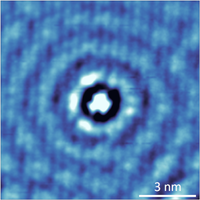
Revealing the Microscopic Mechanism of Elementary Vortex Pinning in Superconductors

C. Chen, Y. Liu, Y. Chen, Y. N. Hu, T. Z. Zhang, D. Li, X. Wang, C. X. Wang, Z. Y. W. Lu, Y. H. Zhang, Q. L. Zhang, X. L. Dong, R. Wang, D. L. Feng, and T. Zhang

Phys. Rev. X 14, 041039 (2024) - Published 8 November, 2024

Atomic-scale investigations of how vortices get pinned to defects in superconductors offers new insights into enabling new superconductor-based applications.

Information Arbitrage in Bipartite Heat Engines

Matthew P. Leighton, Jannik Ehrich, and David A. Sivak

Phys. Rev. X 14, 041038 (2024) - Published 8 November, 2024

A theoretical model shows that exchange of information plays a key role in the molecular machines found in biological cells.

Evidence of Zero-Field Wigner Solids in Ultrathin Films of Cadmium Arsenide

Simon Munyan, Sina Ahadi, Binghao Guo, Arman Rashidi, and Susanne Stemmer

Phys. Rev. X 14, 041037 (2024) - Published 7 November, 2024

Wigner crystals, frozen 2D arrangements of electrons, generally require strong magnetic fields. The formation of such phases in Cd3As2 without a magnetic field point to an unconventional means for their formation.

Emergent Properties of the Periodic Anderson Model: A High-Resolution, Real-Frequency Study of Heavy-Fermion Quantum Criticality

Andreas Gleis, Seung-Sup B. Lee, Gabriel Kotliar, and Jan von Delft

Phys. Rev. X 14, 041036 (2024) - Published 7 November, 2024

A theoretical study of the Kondo breakdown transition—a sudden localization of f electrons in heavy-fermion metals—provides new insights into what drives both the localization and the concurrent emergence of strange-metal behavior.

Lifted TASEP: A Solvable Paradigm for Speeding up Many-Particle Markov Chains

Fabian H. L. Essler and Werner Krauth

Phys. Rev. X 14, 041035 (2024) - Published 6 November, 2024

Nonreversible Markov-chain Monte Carlo algorithms have great potential for sampling probability distributions but are difficult to conceive and analyze. An exactly solvable many-particle paradigm features astonishingly fast dynamics.

Anomalous Long-Ranged Influence of an Inclusion in Momentum-Conserving Active Fluids

Thibaut Arnoulx de Pirey, Yariv Kafri, and Sriram Ramaswamy

Phys. Rev. X 14, 041034 (2024) - Published 6 November, 2024

An obstacle placed in a suspension of active, swimming particles leads to unexpected modulations in particle density far from the obstacle, highlighting the complex ways in which microswimmers interact with their environment.

CFTD from TQFTD+1 via Holographic Tensor Network, and Precision Discretization of CFT2

Lin Chen, Kaixin Ji, Haochen Zhang, Ce Shen, Ruoshui Wang, Xiangdong Zeng, and Ling-Yan Hung

Phys. Rev. X 14, 041033 (2024) - Published 5 November, 2024

A framework for simulating a continuous theory of spacetime as a discrete network provides a way to make such simulations more tractable and deepens insights into how symmetries interact with continuous and discrete spacetime.

Optical Time-Domain Quantum State Tomography on a Subcycle Scale

Emanuel Hubenschmid, Thiago L. M. Guedes, and Guido Burkard

Phys. Rev. X 14, 041032 (2024) - Published 5 November, 2024

A proposed optical tomography scheme can dynamically sample a broadband quantum state using an ultrabroadband probe pulse, opening a new paradigm for time-domain quantum tomography with subcycle resolution.

Defining Stable Phases of Open Quantum Systems

Tibor Rakovszky, Sarang Gopalakrishnan, and Curt von Keyserlingk

Phys. Rev. X 14, 041031 (2024) - Published 4 November, 2024

A condition called uniformity—in which the steady states of a perturbed quantum channel relax to those of an unperturbed one—may be common to many open phases of matter, narrowing the search for new examples.

Modular Quantum Processor with an All-to-All Reconfigurable Router

Xuntao Wu, Haoxiong Yan, Gustav Andersson, Alexander Anferov, Ming-Han Chou, Christopher R. Conner, Joel Grebel, Yash J. Joshi, Shiheng Li, Jacob M. Miller, Rhys G. Povey, Hong Qiao, and Andrew N. Cleland

Phys. Rev. X 14, 041030 (2024) - Published 4 November, 2024

A new concept for computational quantum networks can connect arbitrary qubit pairs, offering greater flexibility than current architectures without sacrificing performance.

Opening the Black Box inside Grover’s Algorithm

E. M. Stoudenmire and Xavier Waintal

Phys. Rev. X 14, 041029 (2024) - Published 1 November, 2024

Grover’s algorithm has no proven quantum advantage as soon as the same input is given to classical and quantum computers. In a best-case scenario, it speeds up problems that would take thousands of years to solve on a quantum computer.

Scalable Multispecies Ion Transport in a Grid-Based Surface-Electrode Trap

Robert D. Delaney, Lucas R. Sletten, Matthew J. Cich, Brian Estey, Maya I. Fabrikant, David Hayes, Ian M. Hoffman, James Hostetter, Christopher Langer, Steven A. Moses, Abigail R. Perry, Timothy A. Peterson, Andrew Schaffer, Curtis Volin, Grahame Vittorini, and William Cody Burton

Phys. Rev. X 14, 041028 (2024) - Published 1 November, 2024

A scheme that moves electromagnetically trapped ions around a 2D array of sites could aid development of scaled-up ion-based quantum computing.

First Principles Numerical Demonstration of Emergent Decoherent Histories

Philipp Strasberg, Teresa E. Reinhard, and Joseph Schindler

Phys. Rev. X 14, 041027 (2024) - Published 30 October, 2024

Simulations deliver hints on how the multiverse produced according to the many-worlds interpretation of quantum mechanics might be compatible with our stable, classical Universe.

Imaging Quantum Interference in a Monolayer Kitaev Quantum Spin Liquid Candidate

Y. Kohsaka, S. Akutagawa, S. Omachi, Y. Iwamichi, T. Ono, I. Tanaka, S. Tateishi, H. Murayama, S. Suetsugu, K. Hashimoto, T. Shibauchi, M. O. Takahashi, S. Nikolaev, T. Mizushima, S. Fujimoto, T. Terashima, T. Asaba, Y. Kasahara, and Y. Matsuda

Phys. Rev. X 14, 041026 (2024) - Published 25 October, 2024

Imaging of never-before-seen concentric patterns around atomic-scale defects in the quantum spin liquid candidate α-RuCl3 opens a new avenue for probing the electronic behavior of this exotic quantum state.

Sign In to Your Journals Account

Filter

Subject

Filter

Article Lookup

Enter a citation