Browse by Subject

Deep-Learning Generation of High-Resolution Images of Live Cells in Culture Using Tri-Frequency Acoustic Images

Natsumi Fujiwara, Midori Uno, Hiroki Fukuda, Akira Nagakubo, Shao Ying Tan, Masahiro Kino-oka, and Hirotsugu Ogi

Phys. Rev. X 15, 021015 (2025) - Published 15 April, 2025

A new method for obtaining high-resolution images of cells from low-resolution ultrasound data enables longer, noninvasive monitoring of organisms.

From Existing and New Nuclear and Astrophysical Constraints to Stringent Limits on the Equation of State of Neutron-Rich Dense Matter

Hauke Koehn, Henrik Rose, Peter T. H. Pang, Rahul Somasundaram, Brendan T. Reed, Ingo Tews, Adrian Abac, Oleg Komoltsev, Nina Kunert, Aleksi Kurkela, Michael W. Coughlin, Brian F. Healy, and Tim Dietrich

Phys. Rev. X 15, 021014 (2025) - Published 14 April, 2025

For neutron stars, a combination of nuclear experiments, astrophysical data, and gravitational waves narrows the uncertainty of radii measurements to 0.5 km and predicts a maximum mass of about 2.3 solar masses.

Classification of Joint Quantum Measurements Based on Entanglement Cost of Localization

Jef Pauwels, Alejandro Pozas-Kerstjens, Flavio Del Santo, and Nicolas Gisin

Phys. Rev. X 15, 021013 (2025) - Published 14 April, 2025

A powerful framework allows scientists to understand and classify joint quantum measurements—procedures essential for many quantum technologies.

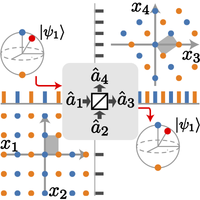
Digital Discovery of Interferometric Gravitational Wave Detectors

Mario Krenn, Yehonathan Drori, and Rana X Adhikari

Phys. Rev. X 15, 021012 (2025) - Published 11 April, 2025

AI-driven design of gravitational wave detectors uncovers approaches that surpass current plans, potentially boosting sensitivity more than tenfold.

Control of Solid-State Nuclear Spin Qubits Using an Electron Spin-1/2

Hans K. C. Beukers, Christopher Waas, Matteo Pasini, Hendrik B. van Ommen, Zarije Ademi, Mariagrazia Iuliano, Nina Codreanu, Julia M. Brevoord, Tim Turan, Tim H. Taminiau, and Ronald Hanson

Phys. Rev. X 15, 021011 (2025) - Published 11 April, 2025

Improved methods for using electron spins to sense and control nuclear spins could benefit many quantum technologies.

Spin-Stripe Order Tied to the Pseudogap Phase in La1.8−xEu0.2SrxCuO4

Anne Missiaen, Hadrien Mayaffre, Steffen Krämer, Dan Zhao, Yanbing Zhou, Tao Wu, Xianhui Chen, Sunseng Pyon, Tomohiro Takayama, Hidenori Takagi, David LeBoeuf, and Marc-Henri Julien

Phys. Rev. X 15, 021010 (2025) - Published 10 April, 2025

Stripe order of spins and charges in cuprates is linked to the pseudogap, as both phenomena are confined below the same critical electronic density. This raises new questions about the strange metal phase found above this critical density.

Synthetic High Angular Momentum Spin Dynamics in a Microwave Oscillator

Saswata Roy, Alen Senanian, Christopher S. Wang, Owen C. Wetherbee, Luojia Zhang, B. Cole, C. P. Larson, E. Yelton, Kartikeya Arora, Peter L. McMahon, B. L. T. Plourde, Baptiste Royer, and Valla Fatemi

Phys. Rev. X 15, 021009 (2025) - Published 8 April, 2025

A new control scheme simplifies quantum harmonic oscillator manipulation, linking control parameters to quantum behavior. It enables spin-like behavior for novel quantum information processing.

Bulk Superconductivity in Pressurized Trilayer Nickelate Pr4Ni3O10 Single Crystals

Enkang Zhang, Di Peng, Yinghao Zhu, Lixing Chen, Bingkun Cui, Xingya Wang, Wenbin Wang, Qiaoshi Zeng, and Jun Zhao

Phys. Rev. X 15, 021008 (2025) - Published 8 April, 2025

The discovery of bulk superconductivity in pressurized single crystals of Pr₄Ni₃O₁₀ establishes trilayer nickelates as genuine bulk high-temperature superconductors.

Confinement Determines Transport of a Reaction-Diffusion Active Matter Front

Nicolas Lobato-Dauzier, Ananyo Maitra, André Estevez-Torres, and Jean-Christophe Galas

Phys. Rev. X 15, 021007 (2025) - Published 7 April, 2025

Confinement of active flows influences chemical signal transport, changing speed by up to a factor of 8, offering insights on biochemical signaling in processes like embryogenesis.

Sticking without Contact: Elastohydrodynamic Adhesion

Vincent Bertin, Alexandros Oratis, and Jacco H. Snoeijer

Phys. Rev. X 15, 021006 (2025) - Published 7 April, 2025

Wet adhesion in soft materials follows a two-phase process: a fluid-trapped sticking phase and a sudden snapping phase. This behavior has implications for biology, adhesives, and soft robotics.

Superconductivity in Trilayer Nickelate La4Ni3O10 under Pressure

Mingxin Zhang et al.

Phys. Rev. X 15, 021005 (2025) - Published 4 April, 2025

The emergence of superconductivity in the Ruddlesden-Popper phase nickelate La4Ni3O10 around 25 K under high pressure opens new search avenues for unconventional superconductivity in bulk materials.

Tuning the Coherent Interaction of an Electron Qubit and a Nuclear Magnon

Noah Shofer, Leon Zaporski, Martin Hayhurst Appel, Santanu Manna, Saimon Covre da Silva, Alexander Ghorbal, Urs Haeusler, Armando Rastelli, Claire Le Gall, Michał Gawełczyk, Mete Atatüre, and Dorian A. Gangloff

Phys. Rev. X 15, 021004 (2025) - Published 4 April, 2025

A method to fine-tune electron-nuclear spin interactions in quantum dots enables dynamic control of quantum information exchange, advancing spin-based quantum memories, computing, and secure communication.

Passive Environment-Assisted Quantum Communication with GKP States

Zhaoyou Wang and Liang Jiang

Phys. Rev. X 15, 021003 (2025) - Published 3 April, 2025

Specially structured quantum states enable direct quantum communication through highly lossy channels, overcoming conventional limits. This approach could enhance quantum networks and transduction efficiency.

ac Stark Spectroscopy of Interactions between Moiré Excitons and Polarons

B. Evrard, H. S. Adlong, A. A. Ghita, T. Uto, L. Ciorciaro, K. Watanabe, T. Taniguchi, M. Kroner, and A. İmamoğlu

Phys. Rev. X 15, 021002 (2025) - Published 1 April, 2025

Nonlinear optical measurements reveal drastic modification of excitonic interactions in semiconductor moiré materials. In stark contrast to monolayers, the interaction between excitons dressed by moiré localized electrons is suppressed.

Revealing the Electron-Spin Fluctuation Coupling by Photoemission in CaKFe4As4

Peng Li, Yuzhe Wang, Yabin Liu, Jianghao Yao, Zhisheng Zhao, Zhengtai Liu, Dawei Shen, Huiqian Luo, Guanghan Cao, Juan Jiang, and Donglai Feng

Phys. Rev. X 15, 021001 (2025) - Published 1 April, 2025

High-resolution spectroscopy of CaKFe₄As₄ reveals that spin fluctuations, not phonons, drive its superconductivity, a result that lays a path for unifying theories of iron-based superconductors.

Multiobjective Optimization for Targeted Self-Assembly among Competing Polymorphs

Sambarta Chatterjee and William M. Jacobs

Phys. Rev. X 15, 011075 (2025) - Published 31 March, 2025

A machine-learning-guided active learning framework to optimize material design balances stability and self-assembly kinetics to reveal insights into crystallization tradeoffs.

Emergence of Sound in a Tunable Fermi Fluid

Songtao Huang, Yunpeng Ji, Thomas Repplinger, Gabriel G. T. Assumpção, Jianyi Chen, Grant L. Schumacher, Franklin J. Vivanco, Hadrien Kurkjian, and Nir Navon

Phys. Rev. X 15, 011074 (2025) - Published 31 March, 2025

Ultracold atomic Fermi gases provide a precise platform for testing Fermi liquid theory. Measurements of density responses and quasiparticle distributions confirm the theory’s validity across different interaction regimes.

Precision Reconstruction of Rational Conformal Field Theory from Exact Fixed-Point Tensor Network

Gong Cheng, Lin Chen, Zheng-Cheng Gu, and Ling-Yan Hung

Phys. Rev. X 15, 011073 (2025) - Published 28 March, 2025

An exact fixed-point structure for entanglement renormalization in critical systems links it to conformal field theory, revealing surprising ties to topological quantum field theory.

Exact Quantization of Nonreciprocal Quasilumped Electrical Networks

A. Parra-Rodriguez and I. L. Egusquiza

Phys. Rev. X 15, 011072 (2025) - Published 28 March, 2025

A geometric framework combined with functional analysis expands classical electrical theory to model complex superconducting and nonreciprocal quantum networks, enabling scalable quantum processors.

Spin-Photon Entanglement of a Single Er3+ Ion in the Telecom Band

Mehmet T. Uysal, Łukasz Dusanowski, Haitong Xu, Sebastian P. Horvath, Salim Ourari, Robert J. Cava, Nathalie P. de Leon, and Jeff D. Thompson

Phys. Rev. X 15, 011071 (2025) - Published 26 March, 2025

Experiments with erbium ions show that they can be used to create entangled photons in the telecom band—an important step in building quantum repeaters.

Sign In to Your Journals Account

Filter

Subject

Filter

Article Lookup

Enter a citation