Browse by Subject

Dynamical Conductivity across the Disorder-Tuned Superconductor-Insulator Transition

Mason Swanson, Yen Lee Loh, Mohit Randeria, and Nandini Trivedi

Phys. Rev. X 4, 021007 (2014) - Published 9 April, 2014

State-of-the-art quantum Monte Carlo simulations of the electrodynamic properties of disordered superconductors lead to many new insights about the disorder-driven superconductor-insulator transition.

Frequency-Comb-Assisted Terahertz Quantum Cascade Laser Spectroscopy

S. Bartalini, L. Consolino, P. Cancio, P. De Natale, P. Bartolini, A. Taschin, M. De Pas, H. Beere, D. Ritchie, M. S. Vitiello, and R. Torre

Phys. Rev. X 4, 021006 (2014) - Published 9 April, 2014

The spectral purity of quantum cascade lasers (QCL) suggests their use in high-precision metrology applications at terahertz wavelengths. By combining a QCL with a THz frequency comb, scientists have been able to measure the frequency of a rotational transition of a gas (methanol) with a record-breaking precision of four parts in one billion.

Electronic Predetermination of Ethylene Fragmentation Dynamics

Xinhua Xie, Stefan Roither, Markus Schöffler, Erik Lötstedt, Daniil Kartashov, Li Zhang, Gerhard G. Paulus, Atsushi Iwasaki, Andrius Baltuška, Kaoru Yamanouchi, and Markus Kitzler

Phys. Rev. X 4, 021005 (2014) - Published 7 April, 2014

Removing electrons in a polyatomic molecule from their orbitals can split the molecule into two ionic fragments. The precise fragmentation pathway taken depends on the molecular orbitals. Scientists show that selective fragmentation can be achieved by controlling the intensity and duration of the laser pulses used to remove the electrons.

Cavity-Enhanced Real-Time Monitoring of Single-Charge Jumps at the Microsecond Time Scale

C. Arnold, V. Loo, A. Lemaître, I. Sagnes, O. Krebs, P. Voisin, P. Senellart, and L. Lanco

Phys. Rev. X 4, 021004 (2014) - Published 4 April, 2014

Highly sensitive, high-speed control and detection of light–quantum-state interactions in nanoscale quantum devices such as quantum dots is key in quantum technology. Scientists achieve real-time detection of single-charge jumps in a quantum dot by amplifying its interaction with photons using a micropillar optical cavity and measuring the interaction with a high-speed technique.

Magnetic Localized Surface Plasmons

Paloma A. Huidobro, Xiaopeng Shen, J. Cuerda, Esteban Moreno, L. Martin-Moreno, F. J. Garcia-Vidal, Tie Jun Cui, and J. B. Pendry

Phys. Rev. X 4, 021003 (2014) - Published 3 April, 2014

Surface plasmons, electromagnetic fields generated by the charge oscillations at the surface of a light-illuminated metallic nanoparticle, are typically described in terms of effective electric dipoles and their dynamics. Scientists discover that adding periodic grooves to the surface of subwavelength metallic disks creates localized surface plasmons of magnetic character in addition to the typical electric ones.

Sensing Viruses by Mechanical Tension of DNA in Responsive Hydrogels

Jaeoh Shin, Andrey G. Cherstvy, and Ralf Metzler

Phys. Rev. X 4, 021002 (2014) - Published 3 April, 2014

Could blowing your nose into a “smart tissue” help detect a viral infection? Theorists say “yes” with a proposal for such a smart tissue: a hydrogel film with embedded prestretched DNA molecules.

Polaronic Transport Induced by Competing Interfacial Magnetic Order in a La0.7Ca0.3MnO3/BiFeO3 Heterostructure

Y. M. Sheu, S. A. Trugman, L. Yan, J. Qi, Q. X. Jia, A. J. Taylor, and R. P. Prasankumar

Phys. Rev. X 4, 021001 (2014) - Published 2 April, 2014

Composite thin films composed of ferromagnetic metallic manganite La0.7Ca0.3MnO3 (LCMO) and multiferroic BiFeO3 (BFO) host a novel magnetotransport phenomenon at the interface that can be controlled by switching the ferroelectric polarization in BFO. A new experiment reveals that suppression by BFO of the polaronic coupling between electrons and Mn ions in LCMO frees the electron and enables the transport.

Deterministic Electrical Charge-State Initialization of Single Nitrogen-Vacancy Center in Diamond

Y. Doi, T. Makino, H. Kato, D. Takeuchi, M. Ogura, H. Okushi, H. Morishita, T. Tashima, S. Miwa, S. Yamasaki, P. Neumann, J. Wrachtrup, Y. Suzuki, and N. Mizuochi

Phys. Rev. X 4, 011057 (2014) - Published 31 March, 2014

Use of nitrogen-vacancy (NV) centers in diamond for quantum applications requires fast switching between their two different charge states. Using a diamond diode, scientists now demonstrate for the first time deterministic, purely electrical, and room-temperature charge-state control of single NV centers on the time scale of a microsecond.

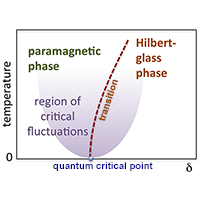
Hilbert-Glass Transition: New Universality of Temperature-Tuned Many-Body Dynamical Quantum Criticality

David Pekker, Gil Refael, Ehud Altman, Eugene Demler, and Vadim Oganesyan

Phys. Rev. X 4, 011052 (2014) - Published 31 March, 2014

Conventional phase transitions are usually characterized by a change in a fundamental thermodynamic observable, e.g., in density when liquid changes to vapor. A theoretical study of a one-dimensional disordered quantum spin chain reveals a new class of quantum phase transitions that leave no such signatures and pins down their origin.

Strain-Induced Enhancement of the Electron Energy Relaxation in Strongly Correlated Superconductors

C. Gadermaier, V. V. Kabanov, A. S. Alexandrov, L. Stojchevska, T. Mertelj, C. Manzoni, G. Cerullo, N. D. Zhigadlo, J. Karpinski, Y. Q. Cai, X. Yao, Y. Toda, M. Oda, S. Sugai, and D. Mihailovic

Phys. Rev. X 4, 011056 (2014) - Published 28 March, 2014

A new ultrafast optical spectroscopy experiment establishes, for both cuprates and pnictides, a remarkable systematic, nonmonotonic variation of their highest superconducting critical temperature with the strength of the electron-phonon interaction in them.

Decay-Assisted Laser Spectroscopy of Neutron-Deficient Francium

K. M. Lynch, J. Billowes, M. L. Bissell, I. Budinčević, T. E. Cocolios, R. P. De Groote, S. De Schepper, V. N. Fedosseev, K. T. Flanagan, S. Franchoo, R. F. Garcia Ruiz, H. Heylen, B. A. Marsh, G. Neyens, T. J. Procter, R. E. Rossel, S. Rothe, I. Strashnov, H. H. Stroke, and K. D. A. Wendt

Phys. Rev. X 4, 011055 (2014) - Published 28 March, 2014

In the quest to understand atomic nuclei, laser spectroscopy is a valuable tool. Combining laser excitation and ionization of atoms with tracking and analysis of the associated alpha decay, a novel technique demonstrates its capability to probe with high sensitivity the hyperfine structure of exotic nuclear isotopes and determine their fundamental nuclear observables.

Fermi-Pasta-Ulam Recurrence in Nonlinear Fiber Optics: The Role of Reversible and Irreversible Losses

Arnaud Mussot, Alexandre Kudlinski, Maxime Droques, Pascal Szriftgiser, and Nail Akhmediev

Phys. Rev. X 4, 011054 (2014) - Published 28 March, 2014

The celebrated Fermi-Pasta-Ulam recurrence phenomenon in nonlinear dynamics was first demonstrated experimentally in optical fibers 50 years after its theoretical discovery. But it was expected to be suppressed when the so-called third-third-order dispersion (TOD) became relevant. A new optical-fiber experiment shows that it not only survives in the presence of TOD, but disappears and reappears several times as the optical pump frequency is varied.

Statistical Physics of Neural Systems with Nonadditive Dendritic Coupling

David Breuer, Marc Timme, and Raoul-Martin Memmesheimer

Phys. Rev. X 4, 011053 (2014) - Published 28 March, 2014

Each dendrite in a biological neuron has long been thought to process the multiple inputs it receives in a simple additive fashion. Recent experiments, however, have demonstrated occurrences of nonadditive dendritic input processing. Theorists find that such single-neuron nonlinearity makes memory retrieval in a network of neurons more resilient to noise.

Error Correction for Non-Abelian Topological Quantum Computation

James R. Wootton, Jan Burri, Sofyan Iblisdir, and Daniel Loss

Phys. Rev. X 4, 011051 (2014) - Published 28 March, 2014

Topological quantum computation using non-Abelian anyons—exotic particlelike excitations that are neither bosons nor fermions—as qubits has been thought to be in no need of error correction. Theorists now show that active error correction is in fact necessary and offer a method for performing it.

Soliton Attenuation and Emergent Hydrodynamics in Fragile Matter

N. Upadhyaya, L. R. Gómez, and V. Vitelli

Phys. Rev. X 4, 011045 (2014) - Published 26 March, 2014

A system of loosely packed little solid balls is an intriguing sonic material in which sound travels always as shock waves. A new theoretical investigation reveals a number of interesting findings about the inner workings of such shock waves, including the emergence of a fluidlike state in the wake of a shock wave.

Robust Extraction of Tomographic Information via Randomized Benchmarking

Shelby Kimmel, Marcus P. da Silva, Colm A. Ryan, Blake R. Johnson, and Thomas Ohki

Phys. Rev. X 4, 011050 (2014) - Published 25 March, 2014

Quantum processing tomography typically reconstructs an unknown quantum dynamical operation by measuring its effects on known states of a quantum device. Taking a different approach of comparing the operation of interest to a set of finite and easily implementable reference operations, a new method can reconstruct any quantum operation reliably.

Quantum Spectroscopy of Plasmonic Nanostructures

Dmitry A. Kalashnikov, Zhenying Pan, Arseniy I. Kuznetsov, and Leonid A. Krivitsky

Phys. Rev. X 4, 011049 (2014) - Published 25 March, 2014

Ultrasensitive optical sensing based on surface plasmons requires nonintrusive weak light and a large signal-to-noise ratio. Using quantum mechanically entangled photon pairs, experimentalists exploit the quantum entanglement for noise cancellation and achieve sensing at the single-photon scale and in the presence of a noise level 70 times higher than the signal.

Spin Polarization Oscillations without Spin Precession: Spin-Orbit Entangled Resonances in Quasi-One-Dimensional Spin Transport

D. H. Berman, M. Khodas, and M. E. Flatté

Phys. Rev. X 4, 011048 (2014) - Published 25 March, 2014

“Ballistic spin resonance” refers to the counterintuitive phenomenon in which spin-polarized electrons moving down a conducting wire lose their collective spin polarization at special values of an applied magnetic field. A quantum-mechanical treatment shows that electron spin-orbit coupling and quantum confinement are at the root of the phenomenon.

Hierarchical Block Structures and High-Resolution Model Selection in Large Networks

Tiago P. Peixoto

Phys. Rev. X 4, 011047 (2014) - Published 24 March, 2014

Social, technological, and biological networks are known to organize into modules or “communities.” Characterizing and identifying modules is highly nontrivial and still an outstanding problem in networks research. A new approach uses both the concept of modular hierarchy for network construction and the methods of statistical inference to address this problem, succeeding where the existing approaches see difficulties.

Photoemission of Bi2Se3 with Circularly Polarized Light: Probe of Spin Polarization or Means for Spin Manipulation?

J. Sánchez-Barriga, A. Varykhalov, J. Braun, S.-Y. Xu, N. Alidoust, O. Kornilov, J. Minár, K. Hummer, G. Springholz, G. Bauer, R. Schumann, L. V. Yashina, H. Ebert, M. Z. Hasan, and O. Rader

Phys. Rev. X 4, 011046 (2014) - Published 24 March, 2014

Do photoelectrons, excited, and then liberated from a solid, by ultraviolet or x-ray light, change their spin orientations? Earlier work reported that they always did if the light used was circularly polarized. A new combined experimental and theoretical study reveals that the answer actually depends on the full symmetry properties of the states the photoelectrons are first excited to.

Sign In to Your Journals Account

Filter

Subject

Filter

Article Lookup

Enter a citation