Browse by Subject

Quantum Nondemolition Measurement of a Nonclassical State of a Massive Object

F. Lecocq, J. B. Clark, R. W. Simmonds, J. Aumentado, and J. D. Teufel

Phys. Rev. X 5, 041037 (2015) - Published 7 December, 2015

The act of a quantum measurement reduces the uncertainty in the motion of a vibrating membrane below the fundamental quantum limit.

Nanophotonic Optical Isolator Controlled by the Internal State of Cold Atoms

Clément Sayrin, Christian Junge, Rudolf Mitsch, Bernhard Albrecht, Danny O’Shea, Philipp Schneeweiss, Jürgen Volz, and Arno Rauschenbeutel

Phys. Rev. X 5, 041036 (2015) - Published 4 December, 2015

A proof-of-principle experiment allows single photons to travel in only one direction through an optical fiber.

Phase Diagram and Quantum Order by Disorder in the Kitaev K1−K2 Honeycomb Magnet

Ioannis Rousochatzakis, Johannes Reuther, Ronny Thomale, Stephan Rachel, and N. B. Perkins

Phys. Rev. X 5, 041035 (2015) - Published 1 December, 2015

Theorists studying unexpected quantum states of matter show that the second-neighbor Kitaev can explain materials that are in close proximity to a spin-liquid state.

Towards Gauging Time-Reversal Symmetry: A Tensor Network Approach

Xie Chen and Ashvin Vishwanath

Phys. Rev. X 5, 041034 (2015) - Published 30 November, 2015

Time-reversal symmetry is fundamental to condensed matter physics, and now researchers show how time reversal can be applied locally, using a tensor network representation, and how time-reversal twists can be used to detect topological order.

Discontinuous Shear Modulus Determines the Glass Transition Temperature

Christian L. Klix, Georg Maret, and Peter Keim

Phys. Rev. X 5, 041033 (2015) - Published 25 November, 2015

Glasses remain a poorly understood material despite their widespread use. A study of the macroscopic elastic properties of a colloidal-glass former during vitrification offers new insights.

Imaginary-Time Matrix Product State Impurity Solver for Dynamical Mean-Field Theory

F. Alexander Wolf, Ara Go, Ian P. McCulloch, Andrew J. Millis, and Ulrich Schollwöck

Phys. Rev. X 5, 041032 (2015) - Published 24 November, 2015

Researchers use ideas generated in the study of quantum entanglement to guide the construction of new impurity solvers, enabling analysis of substantially more complex and realistic problems within the cluster dynamical mean-field-theory framework.

Dual Dirac Liquid on the Surface of the Electron Topological Insulator

Chong Wang and T. Senthil

Phys. Rev. X 5, 041031 (2015) - Published 20 November, 2015

Topological insulators possess properties of both conductors and insulators. A theoretical study demonstrates that the surface state of a Fu-Kane-Mele topological insulator can access all of the other surface states of the material.

Transition to Chaos in Random Neuronal Networks

Jonathan Kadmon and Haim Sompolinsky

Phys. Rev. X 5, 041030 (2015) - Published 19 November, 2015

Cortical neural circuits have been hypothesized to operate in a regime termed the “edge of chaos.” A new theoretical study puts this regime in a more biologically plausible perspective.

Emergence of Chaotic Scattering in Ultracold Er and Dy

T. Maier, H. Kadau, M. Schmitt, M. Wenzel, I. Ferrier-Barbut, T. Pfau, A. Frisch, S. Baier, K. Aikawa, L. Chomaz, M. J. Mark, F. Ferlaino, C. Makrides, E. Tiesinga, A. Petrov, and S. Kotochigova

Phys. Rev. X 5, 041029 (2015) - Published 19 November, 2015

Chaos is a fundamental aspect of many fields of nuclear and atomic physics. Scientists use collisions among magnetic rare-earth atoms to investigate quantum chaos.

Nonequilibrium Phase Transition in a Two-Dimensional Driven Open Quantum System

G. Dagvadorj, J. M. Fellows, S. Matyjaśkiewicz, F. M. Marchetti, I. Carusotto, and M. H. Szymańska

Phys. Rev. X 5, 041028 (2015) - Published 17 November, 2015

The transition between a superfluid and a normal fluid in two dimensions can be understood in terms of the proliferation of topological defects. Now, scientists theoretically analyze such phase transitions in the far-from-equilibrium context of a quantum fluid of exciton polaritons.

Widely Tunable Terahertz Phase Modulation with Gate-Controlled Graphene Metasurfaces

Ziqi Miao, Qiong Wu, Xin Li, Qiong He, Kun Ding, Zhenghua An, Yuanbo Zhang, and Lei Zhou

Phys. Rev. X 5, 041027 (2015) - Published 16 November, 2015

Modulating the phase of electromagnetic waves has many applications in photonic research. A new mechanism allows a thin graphene metasurface to reliably achieve an extremely large phase modulation in THz radiation.

Superregular Breathers in Optics and Hydrodynamics: Omnipresent Modulation Instability beyond Simple Periodicity

B. Kibler, A. Chabchoub, A. Gelash, N. Akhmediev, and V. E. Zakharov

Phys. Rev. X 5, 041026 (2015) - Published 13 November, 2015

Water, plasmas, and laser light can all exhibit instabilities. Experiments in two different areas of wave physics are used to investigate the creation and annihilation dynamics of superregular breather waves, which combine to form an instability.

Bekenstein-Hawking Entropy and Strange Metals

Subir Sachdev

Phys. Rev. X 5, 041025 (2015) - Published 13 November, 2015

Black hole horizons have been shown to have characteristic entropies and temperatures. A new investigation shows similarities between the entropy of a black hole and a metallic state of high-temperature superconductors.

Position-Squared Coupling in a Tunable Photonic Crystal Optomechanical Cavity

Taofiq K. Paraïso, Mahmoud Kalaee, Leyun Zang, Hannes Pfeifer, Florian Marquardt, and Oskar Painter

Phys. Rev. X 5, 041024 (2015) - Published 12 November, 2015

Coupling the frequency of an electromagnetic cavity to the square of mechanical displacement of the cavity structure has been proposed for realizing quantum nondemolition measurements. Such measurement systems are now one step closer with the realization of a tunable microscale photonic crystal cavity with coupling that is some 5 orders of magnitude larger than in conventional Fabry-Pérot resonators.

Origin of the Magnetoresistance in Oxide Tunnel Junctions Determined through Electric Polarization Control of the Interface

Hisashi Inoue, Adrian G. Swartz, Nicholas J. Harmon, Takashi Tachikawa, Yasuyuki Hikita, Michael E. Flatté, and Harold Y. Hwang

Phys. Rev. X 5, 041023 (2015) - Published 11 November, 2015

Spintronics devices often use the accumulation of spins, probed by magnetoresistance, to convey information, and now researchers identify the origin of junction magnetoresistance in artificially engineered oxide heterostructures.

Cavity-Induced Modifications of Molecular Structure in the Strong-Coupling Regime

Javier Galego, Francisco J. Garcia-Vidal, and Johannes Feist

Phys. Rev. X 5, 041022 (2015) - Published 9 November, 2015

Interactions between molecules and light modes can alter the chemical structures of molecules. By examining strong coupling from a microscopic perspective it is possible to predict the modifications that molecules will undergo.

Intrinsic Paramagnetic Meissner Effect Due to s-Wave Odd-Frequency Superconductivity

A. Di Bernardo, Z. Salman, X. L. Wang, M. Amado, M. Egilmez, M. G. Flokstra, A. Suter, S. L. Lee, J. H. Zhao, T. Prokscha, E. Morenzoni, M. G. Blamire, J. Linder, and J. W. A. Robinson

Phys. Rev. X 5, 041021 (2015) - Published 6 November, 2015

The Meissner effect, which explains the levitation of magnetic objects, involves the expulsion of external magnetic flux from a superconductor. Now, researchers show that the inverse effect can also occur in which external magnetic flux is amplified.

Reconfigurable Josephson Circulator/Directional Amplifier

K. M. Sliwa, M. Hatridge, A. Narla, S. Shankar, L. Frunzio, R. J. Schoelkopf, and M. H. Devoret

Phys. Rev. X 5, 041020 (2015) - Published 5 November, 2015

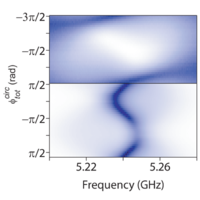
Superconducting qubit experiments cannot be conducted without nonreciprocal devices such as circulators and directional amplifiers. Researchers show that both of these kinds of devices can be realized using a single Josephson circuit.

Near-Complete Photon Spin Selectivity in a Metasurface of Anisotropic Plasmonic Antennas

Robin Ogier, Yurui Fang, Mikael Käll, and Mikael Svedendahl

Phys. Rev. X 5, 041019 (2015) - Published 4 November, 2015

Many of tomorrow’s photonic devices, including optical biosensors, may rely on light signals with highly particular polarization properties. A new experiment shows that an ultrathin layer of gold particles can selectively absorb or reflect a light beam depending on its polarization handedness.

Electron-Doped Sr2IrO4: An Analogue of Hole-Doped Cuprate Superconductors Demonstrated by Scanning Tunneling Microscopy

Y. J. Yan, M. Q. Ren, H. C. Xu, B. P. Xie, R. Tao, H. Y. Choi, N. Lee, Y. J. Choi, T. Zhang, and D. L. Feng

Phys. Rev. X 5, 041018 (2015) - Published 4 November, 2015

Superconducting cuprates are of great interest in condensed-matter physics, and now a new study shows that another transition-metal oxide, Sr2IrO4, may be analogous to cuprates in its high-temperature superconductivity.

Sign In to Your Journals Account

Filter

Subject

Filter

Article Lookup

Enter a citation