

- Open Access
Sensing and Control of Single Trapped Electrons above 1 K
Phys. Rev. X 15, 041002 – Published 2 October, 2025
DOI: https://doi.org/10.1103/vcl7-73ms
Abstract
Electrons trapped on the surface of cryogenic substrates (liquid helium, solid neon, or hydrogen) are an emerging platform for quantum information processing made attractive by the inherent purity of the electron environment, the scalability of trapping devices, and the predicted long lifetime of electron spin states. Here we demonstrate the spatial control and detection of single electrons above the surface of liquid helium at temperatures above 1 K. A superconducting coplanar waveguide resonator is used to read out the charge state of an electron trap defined by gate electrodes beneath the helium surface. Dispersive frequency shifts are observed as the trap is loaded with electrons, from several tens down to single electrons. These frequency shifts are in good agreement with our theoretical model that treats each electron as a classical oscillator coupled to the cavity field. This sensitive charge readout scheme can aid efforts to develop large-scale quantum processors that require the high cooling powers available in cryostats operating above 1 K.
Physics Subject Headings (PhySH)
- Quantum circuits
- Quantum engineering
- Low-temperature superconductors
- Quantum dots
- Quantum fluids & solids
- Single-electron devices
- Superconducting devices
- Two-dimensional electron system
- Cavity resonators
- Evaporation
- Film deposition
- Finite-element method
- Liquid helium cooling
- Lithography
- Microwave techniques
- Plasma etching
- Radiofrequency reflectometry
- Superconducting RF
Popular Summary
Scaling quantum computers requires platforms for quantum bits, or qubits, that remain well isolated while operating at practical temperatures. Electrons trapped above the surface of superfluid helium are promising in this regard, because they can serve as mobile charge or spin qubits with exceptionally long coherence. While previous single-electron control and readout experiments on helium have been limited to millikelvin temperatures, we demonstrate detection of single electrons above 1 K. Using a microwave-frequency coplanar waveguide resonator coupled to an integrated electron trap, we achieve coupling strengths more than twice those in earlier helium-based circuit quantum electrodynamics experiments, even in a significantly warmer and noisier environment.
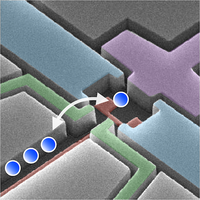
Our device features patterned niobium electrodes that define microchannels filled with superfluid helium and an isolated trap connected to a separate electron reservoir. By tuning gate voltages, we can deterministically load or unload electrons into the trap. The trapped electrons interact with the resonator’s microwave field, altering its response and producing measurable resonance frequency shifts. We design the trap using finite-element modeling and interpret the data with a classical model of collective many-electron motion coupled to the cavity field. Despite operating at temperatures where thermal energy far exceeds the electron motional frequency, we observe clear, reproducible single-electron frequency shifts that match our model’s predictions.
These results establish that single-electron control and readout on helium is feasible at temperatures above 1 K, enabling integration with higher-power cryogenic systems. This capability paves the way for scalable quantum processors based on electrons on helium and related noble gas substrates, and for studying spin properties in conditions more compatible with large-scale quantum hardware.
Article Text
References (61)
- P. Platzman and M. Dykman, Quantum computing with electrons floating on liquid helium, Science 284, 1967 (1999).
- S. Lyon, Spin-based quantum computing using electrons on liquid helium, Phys. Rev. A 74, 052338 (2006).
- D. I. Schuster, A. Fragner, M. I. Dykman, S. A. Lyon, and R. J. Schoelkopf, Proposal for manipulating and detecting spin and orbital states of trapped electrons on helium using cavity quantum electrodynamics, Phys. Rev. Lett. 105, 040503 (2010).
- D. G. Rees, I. Kuroda, C. A. Marrache-Kikuchi, M. Höfer, P. Leiderer, and K. Kono, Point-contact transport properties of strongly correlated electrons on liquid helium, Phys. Rev. Lett. 106, 026803 (2011).
- M. F. Gonzalez-Zalba, S. de Franceschi, E. Charbon, T. Meunier, M. Vinet, and A. S. Dzurak, Scaling silicon-based quantum computing using CMOS technology, National electronics review 4, 872 (2021).
- A. Zwerver, T. Krähenmann, T. Watson, L. Lampert, H. C. George, R. Pillarisetty, S. Bojarski, P. Amin, S. Amitonov, J. Boter et al., Qubits made by advanced semiconductor manufacturing, National electronics review 5, 184 (2022).
- F. R. Bradbury, M. Takita, T. M. Gurrieri, K. J. Wilkel, K. Eng, M. S. Carroll, and S. A. Lyon, Efficient clocked electron transfer on superfluid helium, Phys. Rev. Lett. 107, 266803 (2011).
- M. Takita, F. Bradbury, T. Gurrieri, K. Wilkel, K. Eng, M. Carroll, and S. A. Lyon, Spatial distribution of electrons on a superfluid helium charge-coupled device, J. Phys. Conf. Ser. 400, 042059 (2012).
- W. Ha, S. D. Ha, M. D. Choi, Y. Tang, A. E. Schmitz, M. P. Levendorf, K. Lee, J. M. Chappell, T. S. Adams, D. R. Hulbert et al., A flexible design platform for exchange-only qubits with low disorder, Nano Lett. 22, 1443 (2021).
- J. M. Hornibrook, J. I. Colless, I. D. Conway Lamb, S. J. Pauka, H. Lu, A. C. Gossard, J. D. Watson, G. C. Gardner, S. Fallahi, M. J. Manfra, and D. J. Reilly, Cryogenic control architecture for large-scale quantum computing, Phys. Rev. Appl. 3, 024010 (2015).
- C. G. Almudever, L. Lao, X. Fu, N. Khammassi, I. Ashraf, D. Iorga, S. Varsamopoulos, C. Eichler, A. Wallraff, L. Geck et al., The engineering challenges in quantum computing, in Design, Automation and Test in Europe Conference and Exhibition, 2017 (IEEE, New York, 2017), pp. 836–845, https://ieeexplore.ieee.org/abstract/document/7927104.
- S. Krinner, S. Storz, P. Kurpiers, P. Magnard, J. Heinsoo, R. Keller, J. Luetolf, C. Eichler, and A. Wallraff, Engineering cryogenic setups for 100-qubit scale superconducting circuit systems, Eur. Phys. J. Quantum Technol. 6, 2 (2019).
- M. Kjaergaard, M. E. Schwartz, J. Braumüller, P. Krantz, J. I.-J. Wang, S. Gustavsson, and W. D. Oliver, Superconducting qubits: Current state of play, Annu. Rev. Condens. Matter Phys. 11, 369 (2020).
- A. Clerk, K. Lehnert, P. Bertet, J. Petta, and Y. Nakamura, Hybrid quantum systems with circuit quantum electrodynamics, Nat. Phys. 16, 257 (2020).
- A. Anferov, S. P. Harvey, F. Wan, J. Simon, and D. I. Schuster, Superconducting qubits above 20 GHz operating over 200 mk, PRX Quantum 5, 030347 (2024).
- C. H. Yang, R. Leon, J. Hwang, A. Saraiva, T. Tanttu, W. Huang, J. Camirand Lemyre, K. W. Chan, K. Tan, F. E. Hudson et al., Operation of a silicon quantum processor unit cell above one kelvin, Nature (London) 580, 350 (2020).
- J. Y. Huang, R. Y. Su, W. H. Lim, M. Feng, B. van Straaten, B. Severin, W. Gilbert, N. Dumoulin Stuyck, T. Tanttu, S. Serrano et al., High-fidelity spin qubit operation and algorithmic initialization above 1K, Nature (London) 627, 772 (2024).
- F. M. Piegsa, B. Van den Brandt, and K. Kirch, High-power closed-cycle cryostat with top-loading sample exchange, Cryogenics 87, 24 (2017).
- C. Wang, T. Hanrahan, and M. Johnson, High capacity closed-cycle 1K cryocooler, Cryogenics 95, 64 (2018).
- Y. Monarkha and K. Kono, Two-Dimensional Coulomb Liquids and Solids (Springer Science & Business Media, New York, 2013), Vol. 142.
- M. I. Dykman, O. Asban, Q. Chen, D. Jin, and S. A. Lyon, Spin dynamics in quantum dots on liquid helium, Phys. Rev. B 107, 035437 (2023).
- G. Papageorgiou, P. Glasson, K. Harrabi, V. Antonov, E. Collin, P. Fozooni, P. Frayne, M. Lea, D. Rees, and Y. Mukharsky, Counting individual trapped electrons on liquid helium, Appl. Phys. Lett. 86 (2005).
- E. Rousseau, Y. Mukharsky, D. Ponarine, O. Avenel, and E. Varoquaux, Trapping electrons in electrostatic traps over the surface of , J. Low Temp. Phys. 148, 193 (2007).
- G. Koolstra, G. Yang, and D. I. Schuster, Coupling a single electron on superfluid helium to a superconducting resonator, Nat. Commun. 10, 5323 (2019).
- A. E. Seedhouse, T. Tanttu, R. C. C. Leon, R. Zhao, K. Y. Tan, B. Hensen, F. E. Hudson, K. M. Itoh, J. Yoneda, C. H. Yang, A. Morello, A. Laucht, S. N. Coppersmith, A. Saraiva, and A. S. Dzurak, Pauli blockade in silicon quantum dots with spin-orbit control, PRX Quantum 2, 010303 (2021).
- A. Jennings, X. Zhou, I. Grytsenko, and E. Kawakami, Quantum computing using floating electrons on cryogenic substrates: Potential and challenges, Appl. Phys. Lett. 124 (2024).
- N. Daniilidis, D. J. Gorman, L. Tian, and H. Häffner, Quantum information processing with trapped electrons and superconducting electronics, New J. Phys. 15, 073017 (2013).
- G. Burkard, M. J. Gullans, X. Mi, and J. R. Petta, Superconductor–semiconductor hybrid-circuit quantum electrodynamics, Nat. Rev. Phys. 2, 129 (2020).
- P. Glasson, V. Dotsenko, P. Fozooni, M. J. Lea, W. Bailey, G. Papageorgiou, S. E. Andresen, and A. Kristensen, Observation of dynamical ordering in a confined Wigner crystal, Phys. Rev. Lett. 87, 176802 (2001).
- D. G. Rees, N. R. Beysengulov, Y. Teranishi, C.-S. Tsao, S.-S. Yeh, S.-P. Chiu, Y.-H. Lin, D. A. Tayurskii, J.-J. Lin, and K. Kono, Structural order and melting of a quasi-one-dimensional electron system, Phys. Rev. B 94, 045139 (2016).
- N. R. Beysengulov, ZeroHeliumKit, https://github.com/eeroqlab/zeroheliumkit, 2024.
- F. Hecht, New development in freefem++, J. Numer. Math. 20, 251 (2012).
- G. Yang, A. Fragner, G. Koolstra, L. Ocola, D. A. Czaplewski, R. J. Schoelkopf, and D. I. Schuster, Coupling an ensemble of electrons on superfluid helium to a superconducting circuit, Phys. Rev. X 6, 011031 (2016).
- G. Koolstra, E. O. Glen, N. R. Beysengulov, H. Byeon, K. E. Castoria, M. Sammon, B. Dizdar, C. S. Wang, D. I. Schuster, S. A. Lyon, J. Pollanen, and D. G. Rees, High-impedance resonators for strong coupling to an electron on helium, Phys. Rev. Appl. 23, 024001 (2025).
- G. Koolstra, Quantum electron, https://github.com/gkoolstra/quantum_electron, 2024.
- F. Vigneau, F. Fedele, A. Chatterjee, D. Reilly, F. Kuemmeth, M. F. Gonzalez-Zalba, E. Laird, and N. Ares, Probing quantum devices with radio-frequency reflectometry, Appl. Phys. Rev. 10 (2023).
- S. Park, C. Metzger, L. Tosi, M. F. Goffman, C. Urbina, H. Pothier, and A. L. Yeyati, From adiabatic to dispersive readout of quantum circuits, Phys. Rev. Lett. 125, 077701 (2020).
- E. Kawakami, A. Elarabi, and D. Konstantinov, Image-charge detection of the Rydberg states of surface electrons on liquid helium, Phys. Rev. Lett. 123, 086801 (2019).
- M. Gonzalez-Zalba, S. Barraud, A. Ferguson, and A. Betz, Probing the limits of gate-based charge sensing, Nat. Commun. 6, 1 (2015).
- J. I. Colless, A. C. Mahoney, J. M. Hornibrook, A. C. Doherty, H. Lu, A. C. Gossard, and D. J. Reilly, Dispersive readout of a few-electron double quantum dot with fast rf gate sensors, Phys. Rev. Lett. 110, 046805 (2013).
- E. Kawakami, J. Chen, M. Benito, and D. Konstantinov, Blueprint for quantum computing using electrons on helium, Phys. Rev. Appl. 20, 054022 (2023).
- M. Belianchikov, J. A. Kraus, and D. Konstantinov, Cryogenic resonant amplifier for electron-on-helium image charge readout, J. Low Temp. Phys. 215, 312 (2024).
- N. R. Beysengulov, Ø. S. Schøyen, S. D. Bilek, J. B. Flaten, O. Leinonen, M. Hjorth-Jensen, J. Pollanen, H. E. Kristiansen, Z. J. Stewart, J. D. Weidman et al., Coulomb interaction-driven entanglement of electrons on helium, PRX Quantum 5, 030324 (2024).
- R. Mehrotra, C. J. Guo, Y. Z. Ruan, D. B. Mast, and A. J. Dahm, Density-dependent mobility of a two-dimensional electron fluid, Phys. Rev. B 29, 5239 (1984).
- E. Kawakami, A. Elarabi, and D. Konstantinov, Relaxation of the excited Rydberg states of surface electrons on liquid helium, Phys. Rev. Lett. 126, 106802 (2021).
- M. Saitoh, Warm electrons on the liquid surface, J. Phys. Soc. Jpn. 42, 201 (1977).
- R. H. Dicke, Coherence in spontaneous radiation processes, Phys. Rev. 93, 99 (1954).
- J. Hopfield, Theory of the contribution of excitons to the complex dielectric constant of crystals, Phys. Rev. 112, 1555 (1958).
- A. Frisk Kockum, A. Miranowicz, S. De Liberato, S. Savasta, and F. Nori, Ultrastrong coupling between light and matter, Nat. Rev. Phys. 1, 19 (2019).
- V. Rokaj, M. Ruggenthaler, F. G. Eich, and A. Rubio, Free electron gas in cavity quantum electrodynamics, Phys. Rev. Res. 4, 013012 (2022).
- X. Zhou, G. Koolstra, X. Zhang, G. Yang, X. Han, B. Dizdar, X. Li, R. Divan, W. Guo, K. W. Murch et al., Single electrons on solid neon as a solid-state qubit platform, Nature (London) 605, 46 (2022).
- X. Zhou, X. Li, Q. Chen, G. Koolstra, G. Yang, B. Dizdar, Y. Huang, C. S. Wang, X. Han, X. Zhang et al., Electron charge qubit with 0.1 millisecond coherence time, Nat. Phys. 20, 116 (2024).
- A. Troyanovskiĭ, A. Volodin, and M. Khaĭkin, Electron localization over the surface of crystalline hydrogen and neon, JETP Lett. 29, 421 (1979), http://jetpletters.ru/ps/1447/article_22021.shtml.
- K. Kajita and W. Sasaki, Two-dimensional electrons on the helium film—solid neon system, Surf. Sci. 113, 419 (1982).
- Z. Chen, A. Megrant, J. Kelly, R. Barends, J. Bochmann, Y. Chen, B. Chiaro, A. Dunsworth, E. Jeffrey, J. Mutus et al., Fabrication and characterization of aluminum airbridges for superconducting microwave circuits, Appl. Phys. Lett. 104 (2014).
- W. Sommer and D. J. Tanner, Mobility of electrons on the surface of liquid , Phys. Rev. Lett. 27, 1345 (1971).
- H. How, A. Widom, and C. Vittoria, Lagrangian formulation of a linear microstrip resonator: Theory and experiment, IEEE Trans. Microwave Theory Tech. 39, 660 (1991).
- U. Vool and M. Devoret, Introduction to quantum electromagnetic circuits, Int. J. Circuit Theory Appl. 45, 897 (2017).
- M. Göppl, A. Fragner, M. Baur, R. Bianchetti, S. Filipp, JM. Fink, PJ. Leek, G. Puebla, L. Steffen, and A. Wallraff, Coplanar waveguide resonators for circuit quantum electrodynamics, J. Appl. Phys. 104, 113904 (2008).
- D. Rieger, S. Günzler, M. Spiecker, A. Nambisan, W. Wernsdorfer, and I. M. Pop, Fano interference in microwave resonator measurements, Phys. Rev. Appl. 20, 014059 (2023).
- J. Leppäkangas, J. D. Brehm, P. Yang, L. Guo, M. Marthaler, A. V. Ustinov, and M. Weides, Resonance inversion in a superconducting cavity coupled to artificial atoms and a microwave background, Phys. Rev. A 99, 063804 (2019).

