

- Open Access
Complexity-Theoretic Foundations of BosonSampling with a Linear Number of Modes
Phys. Rev. X 16, 021059 – Published 24 June, 2026
DOI: https://doi.org/10.1103/xc7b-sjm5
Abstract
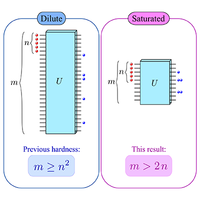
BosonSampling is the leading candidate for demonstrating quantum computational advantage in photonic systems. While we have recently seen many impressive experimental demonstrations, there is still a formidable distance between the complexity-theoretic hardness arguments and current experiments. One of the largest gaps involves the ratio of particles to modes—all current hardness evidence assumes a “dilute” regime in which the number of linear optical modes scales at least quadratically in the number of particles. By contrast, current experiments operate in a “saturated” regime with a linear number of modes. In this paper, we bridge this gap, bringing the hardness evidence for experiments in the saturated regime to the same level as had been previously established for the dilute regime. This involves proving a worst-to-average-case reduction for computing the permanent, which is robust both to large numbers of row repetitions and also to distributions over matrices with correlated entries. We also apply similar arguments to give evidence for hardness of Gaussian BosonSampling in the saturated regime.
Physics Subject Headings (PhySH)
Popular Summary
Classical simulation of photonic quantum systems remains a significant challenge, particularly for experiments operating in the “saturated” regime where the number of particles is comparable to the number of optical modes. We bridge the gap between complexity theory and current experiments by proving that BosonSampling in this linear-mode regime is just as hard to simulate classically as the previously established “dilute” regime. This was achieved by developing a new worst-to-average-case reduction for the permanent function that remains robust despite photon collisions and correlated matrix entries. We identify that the number of detector clicks, rather than total photons, serves as the primary measure of computational hardness in these systems. These results reinforce the theoretical foundations for achieving quantum computational advantage and provide realistic benchmarks for scaling up photonic processors in the presence of optical losses.
Article Text
References (48)
- S. Aaronson and A. Arkhipov, The computational complexity of linear optics, Theory Comput. 9, 143 (2013).
- Aaron W. Young, Shawn Geller, William J. Eckner, Nathan Schine, Scott Glancy, Emanuel Knill, and Adam M. Kaufman, An atomic boson sampler, Nature (London) 629, 311 (2024).
- Hui Wang, Jian Qin, Xing Ding, Ming-Cheng Chen, Si Chen, Xiang You, Yu-Ming He, Xiao Jiang, L. You, Z. Wang et al., Boson sampling with 20 input photons and a 60-mode interferometer in a -dimensional Hilbert space, Phys. Rev. Lett. 123, 250503 (2019).
- Lars S. Madsen, Fabian Laudenbach, Mohsen Falamarzi. Askarani, Fabien Rortais, Trevor Vincent, Jacob F. F. Bulmer, Filippo M. Miatto, Leonhard Neuhaus, Lukas G. Helt, Matthew J. Collins, Adriana E. Lita, Thomas Gerrits, Sae Woo Nam, Varun D. Vaidya, Matteo Menotti, Ish Dhand, Zachary Vernon, Nicolás Quesada, and Jonathan Lavoie, Quantum computational advantage with a programmable photonic processor, Nature (London) 606, 75 (2022).
- Han-Sen Zhong, Yu-Hao Deng, Jian Qin, Hui Wang, Ming-Cheng Chen, Li-Chao Peng, Yi-Han Luo, Dian Wu, Si-Qiu Gong, Hao Su et al., Phase-programmable Gaussian boson sampling using stimulated squeezed light, Phys. Rev. Lett. 127, 180502 (2021).
- Han-Sen Zhong, Hui Wang, Yu-Hao Deng, Ming-Cheng Chen, Li-Chao Peng, Yi-Han Luo, Jian Qin, Dian Wu, Xing Ding, Yi Hu et al., Quantum computational advantage using photons, Science 370, 1460 (2020).
- L. Chakhmakhchyan and N. J. Cerf, Boson sampling with Gaussian measurements, Phys. Rev. A 96, 032326 (2017).
- Abhinav Deshpande, Arthur Mehta, Trevor Vincent, Nicolás Quesada, Marcel Hinsche, Marios Ioannou, Lars Madsen, Jonathan Lavoie, Haoyu Qi, Jens Eisert, Dominik Hangleiter, Bill Fefferman, and Ish Dhand, Quantum computational advantage via high-dimensional Gaussian boson sampling, Sci. Adv. 8, eabi7894 (2022).
- Daniel Grier, Daniel J. Brod, Juan Miguel Arrazola, Marcos Benicio de Andrade Alonso, and Nicolás Quesada, The complexity of bipartite Gaussian boson sampling, Quantum 6, 863 (2022).
- C. S. Hamilton, R. Kruse, L. Sansoni, S. Barkhofen, C. Silberhorn, and I. Jex, Gaussian boson sampling, Phys. Rev. Lett. 119, 170501 (2017).
- Yu-Hao Deng et al., Gaussian boson sampling with pseudo-photon-number-resolving detectors and quantum computational advantage, Phys. Rev. Lett. 131, 150601 (2023).
- P. Clifford and R. Clifford, Proceedings of the Twenty-Ninth Annual ACM-SIAM Symposium on Discrete Algorithms (SODA) (2018), p. 146, 10.1137/1.9781611975031.10.
- P. Clifford and R. Clifford, Faster classical boson sampling, Phys. Scr. 99, 065121 (2020).
- Gregory Morse, Tomasz Rybotycki, Ágoston Kaposi, Zoltán Kolarovszki, Uros Stojic, Tamás Kozsik, Oskar Mencer, Michał Oszmaniec, Zoltán Zimborás, and Péter Rakyta, High performance boson sampling simulation via data-flow engines, New J. Phys. 26, 033033 (2024).
- Emanuel Knill, Raymond Laflamme, and Gerald J. Milburn, A scheme for efficient quantum computation with linear optics, Nature (London) 409, 46 (2001).
- Alex Arkhipov and Greg Kuperberg, The bosonic birthday paradox, Geom. Topol. Monogr. 18, 1 (2012).
- Tiefeng Jiang, How many entries of a typical orthogonal matrix can be approximated by independent normals?, Ann. Probab. 34, 1497 (2006).
- Daniel Jost Brod and Michał Oszmaniec, Classical simulation of linear optics subject to nonuniform losses, Quantum 4, 267 (2020).
- Raúl García-Patrón, Jelmer J. Renema, and Valery Shchesnovich, Simulating boson sampling in lossy architectures, Quantum 3, 169 (2019).
- Michał Oszmaniec and Daniel J. Brod, Classical simulation of photonic linear optics with lost particles, New J. Phys. 20, 092002 (2018).
- Changhun Oh, Minzhao Liu, Yuri Alexeev, Bill Fefferman, and Liang Jiang, Classical algorithm for simulating experimental Gaussian boson sampling, Nat. Phys. 20, 1461 (2024).
- H. Qi, D. J. Brod, N. Quesada, and R. García-Patrón, Regimes of classical simulability for noisy Gaussian boson sampling, Phys. Rev. Lett. 124, 100502 (2020).
- P. I. Sund, R. Uppu, S. Paesani, and P. Lodahl, Hardware requirements for realizing a quantum advantage with deterministic single-photon sources, Phys. Rev. A 109, 042613 (2024).
- S. Scheel, Permanents in linear optical networks, Acta Phys. Slovaca 58, 675 (2008); arXiv:quant-ph/0406127.
- Adam Bouland, Bill Fefferman, Chinmay Nirkhe, and Umesh Vazirani, On the complexity and verification of quantum random circuit sampling, Nat. Phys. 15, 159 (2019).
- Michael J. Bremner, Ashley Montanaro, and Dan J. Shepherd, Average-case complexity versus approximate simulation of commuting quantum computations, Phys. Rev. Lett. 117, 080501 (2016).
- Michał Oszmaniec, Ninnat Dangniam, Mauro E. S. Morales, and Zoltán Zimborás, Fermion sampling: A robust quantum computational advantage scheme using fermionic linear optics and magic input states, PRX Quantum 3, 020328 (2022).
- Larry Stockmeyer, The complexity of approximate counting, in Proceedings of the Fifteenth Annual ACM Symposium on Theory of Computing, STOC ’83 (Association for Computing Machinery, New York, 1983), pp. 118–126.
- Adam Bouland, Bill Fefferman, Zeph Landau, and Yunchao Liu, Noise and the frontier of quantum supremacy, in Proceedings of the 2021 IEEE 62nd Annual Symposium on Foundations of Computer Science (FOCS) (2022), arXiv:2102.01738.
- Richard J. Lipton, New directions in testing, in Distributed Computing and Cryptography, edited by Joan Feigenbaum and Michael J. Merritt (American Mathematical Society, Oxford, 1991), Vol. 2, pp. 191–202.
- Benoît Collins, Intégrales matricielles et probabilités non-commutatives, Ph.D. thesis, Université Pierre et Marie Curie-Paris VI, 2003.
- Júlia Réffy, Asymptotics of random unitaries, Ph.D. thesis, BUTE Institute of Mathematics, 2005.
- Sepehr Nezami, Permanent of random matrices from representation theory: Moments, numerics, concentration, and comments on hardness of boson-sampling, arXiv:2104.06423.
- J. C. Napp, R. L. La Placa, A. M. Dalzell, F. G. S. L. Brandao, and A. W. Harrow, Efficient classical simulation of random shallow 2D quantum circuits, Phys. Rev. X 12, 021021 (2022).
- Daniel J. Brod, Ernesto F. Galvão, Andrea Crespi, Roberto Osellame, Nicolò Spagnolo, and Fabio Sciarrino, Photonic implementation of boson sampling: A review, Adv. Opt. Photonics 1, 034001 (2019).
- Alexander I. Barvinok, Two algorithmic results for the traveling salesman problem, Math. Oper. Res. 21, 65 (1996).
- D. A. Ivanov and L. Gurvits, Complexity of full counting statistics of free quantum particles in product states, Phys. Rev. A 101, 012303 (2020).
- Seungbeom Chin and Joonsuk Huh, Generalized concurrence in boson sampling, Sci. Rep. 8, 6101 (2018).
- V. Chvátal, The tail of the hypergeometric distribution, Discrete Math. 25, 285 (1979).
- L. G. Valiant, The complexity of computing the permanent, Theor. Comput. Sci. 8, 189 (1979).
- Elwyn R. Berlekamp and Lloyd R. Welch, Error correction for algebraic block codes, US Patent No. 4,633,470, 1986.
- Tanmay Singal, Filip B. Maciejewski, and Michał Oszmaniec, Implementation of quantum measurements using classical resources and only a single ancillary qubit, npj Quantum Inf. 8, 82 (2022).
- Ramis Movassagh, The hardness of random quantum circuits, Nat. Phys. 19, 1719 (2023).
- Ramis Movassagh, Quantum supremacy and random circuits, arXiv:1909.06210.
- Ramamohan Paturi, On the degree of polynomials that approximate symmetric Boolean functions, in Proceedings of the Twenty-Fourth Annual ACM Symposium on Theory of Computing, STOC ’92 (Association for Computing Machinery, New York, USA, 1992), pp. 468–474.
- Boaz Barak, Chi-Ning Chou, and Xun Gao, Spoofing linear cross-entropy benchmarking in shallow quantum circuits, arXiv:2005.02421.
- R. Kruse, C. S. Hamilton, L. Sansoni, S. Barkhofen, C. Silberhorn, and I. Jex, Detailed study of Gaussian boson sampling, Phys. Rev. A 100, 032326 (2019).
- A. Bouland, I. Datta, B. Fefferman, and F. Hernández, Exponential improvements to the average-case hardness of BosonSampling, 2025 IEEE 66th Annual Symposium on Foundations of Computer Science (FOCS) (2024), pp. 912–933, 10.1109/FOCS63196.2025.00047.

