

- Open Access
Engineering 2D Square Lattice Hubbard Models in 90° Twisted (, Se) Moiré Superlattices
Phys. Rev. X 15, 041049 – Published 15 December, 2025
DOI: https://doi.org/10.1103/wcbz-lbr1
Abstract
Because of the large-period superlattices emerging in moiré two-dimensional (2D) materials, electronic states in such systems exhibit low energy flat bands that can be used to simulate strongly correlated physics in a highly tunable setup. While many investigations have thus far focused on moiré flat bands and emergent correlated electron physics in triangular, honeycomb, and quasi-one-dimensional lattices, tunable moiré realizations of square lattices subject to strong correlations remain elusive. Here we propose a feasible scheme to construct moiré square lattice systems by twisting two or more layers of 2D materials in a rectangular lattice by 90°. We demonstrate the concept with twisted (, Se) moiré superlattices and calculate their electronic structures from first principles. We show that the lowest conduction flat band in these systems can be described by a square lattice Hubbard model with parameters which can be controlled by varying the choice of host materials, number of layers, and external electric fields. In particular, twisted double bilayer GeSe realizes a square lattice Hubbard model with strong frustration due to the next-nearest-neighbor hopping that could host unconventional superconductivity, in close analogy to the Hubbard model for copper-oxygen planes of cuprate high-temperature superconductors. The presented scheme uses 90° twisted 2D materials with rectangular unit cells as a promising platform for realizing the physical phenomena of square lattice Hubbard models, establishing a new route for studying its rich phase diagram of magnetism, charge order, and unconventional superconductivity in a highly tunable setting.
Physics Subject Headings (PhySH)
Corrections
28 January, 2026
Correction: A grant number in the Acknowledgments contained an error and has been fixed.
Popular Summary
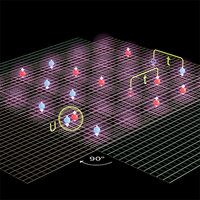
One of the main goals of twistronics—the study of stacked 2D materials rotated slightly with respect to one another—has been to reproduce and better understand the unusual electronic behaviors found in copper oxide, or cuprate, superconductors. Early excitement centered on twisted bilayer graphene, but that system turned out to behave differently and more intricately than expected. We propose a clearer route toward realizing cupratelike physics: rotating two or more rectangular-lattice 2D layers by 90°. This simple rotation produces a square moiré pattern that traps electrons in flat, low-energy bands, allowing their interactions to dominate and give rise to rich collective behavior.
Through first-principles calculations, we show that twisted stacks of GeX or SnX (where X represents sulfur or selenium) naturally form these square lattices. In such structures, electrons can move between lattice sites but also strongly repel each other when they come too close. This balance between movement and repulsion—captured in theoretical models known as Hubbard models—provides a framework for studying how electronic correlations lead to magnetism and superconductivity. The relative strength of these effects can be tuned by changing the material, the number of layers, or by applying electric fields. In double-bilayer GeSe, we find that competing pathways for electron motion may destabilize simple magnetic order and encourage the kind of superconductivity seen in cuprates.
This 90° twist strategy offers a practical and versatile platform for investigating how interacting electrons organize themselves into complex phases. By fabricating and tuning these stacked materials, researchers can experimentally explore magnetism, charge order, strange metals, and superconducting states in a controlled environment.
Article Text
Supplemental Material
References (109)
- J. Hubbard, Electron correlations in narrow energy bands, Proc. R. Soc. A 276, 238 (1963).
- Junjiro Kanamori, Electron correlation and ferromagnetism of transition metals, Prog. Theor. Phys. 30, 275 (1963).
- Martin C. Gutzwiller, Effect of correlation on the ferromagnetism of transition metals, Phys. Rev. Lett. 10, 159 (1963).
- Efstratios Manousakis, The spin-½ Heisenberg antiferromagnet on a square lattice and its application to the cuprous oxides, Rev. Mod. Phys. 63, 1 (1991).
- P. W. Anderson, The resonating valence bond state in and superconductivity, Science 235, 1196 (1987).
- V. J. Emery, Theory of high- superconductivity in oxides, Phys. Rev. Lett. 58, 2794 (1987).
- Bo-Xiao Zheng, Chia-Min Chung, Philippe Corboz, Georg Ehlers, Ming-Pu Qin, Reinhard M. Noack, Hao Shi, Steven R. White, Shiwei Zhang, and Garnet Kin-Lic Chan, Stripe order in the underdoped region of the two-dimensional Hubbard model, Science 358, 1155 (2017).
- Edwin W. Huang, Christian B. Mendl, Hong-Chen Jiang, Brian Moritz, and Thomas P. Devereaux, Stripe order from the perspective of the Hubbard model, npj Quantum Mater. 3, 22 (2018).
- Philip W. Phillips, Nigel E. Hussey, and Peter Abbamonte, Stranger than metals, Science 377, eabh4273 (2022).
- Tom Timusk and Bryan Statt, The pseudogap in high-temperature superconductors: An experimental survey, Rep. Prog. Phys. 62, 61 (1999).
- Mingpu Qin, Thomas Schäfer, Sabine Andergassen, Philippe Corboz, and Emanuel Gull, The Hubbard model: A computational perspective, Annu. Rev. Condens. Matter Phys. 13, 275 (2022).
- Elbio Dagotto, Correlated electrons in high-temperature superconductors, Rev. Mod. Phys. 66, 763 (1994).
- Patrick A. Lee, Naoto Nagaosa, and Xiao-Gang Wen, Doping a Mott insulator: Physics of high-temperature superconductivity, Rev. Mod. Phys. 78, 17 (2006).
- Daniel P. Arovas, Erez Berg, Steven A. Kivelson, and Srinivas Raghu, The Hubbard model, Annu. Rev. Condens. Matter Phys. 13, 239 (2022).
- J. P. F. LeBlanc et al. (Simons Collaboration on the Many-Electron Problem), Solutions of the two-dimensional Hubbard model: Benchmarks and results from a wide range of numerical algorithms, Phys. Rev. X 5, 041041 (2015).
- Steven R. White, Density matrix formulation for quantum renormalization groups, Phys. Rev. Lett. 69, 2863 (1992).
- Steven R. White, Density-matrix algorithms for quantum renormalization groups, Phys. Rev. B 48, 10345 (1993).
- Antoine Georges, Gabriel Kotliar, Werner Krauth, and Marcelo J. Rozenberg, Dynamical mean-field theory of strongly correlated fermion systems and the limit of infinite dimensions, Rev. Mod. Phys. 68, 13 (1996).
- J. E. Hirsch, Two-dimensional Hubbard model: Numerical simulation study, Phys. Rev. B 31, 4403 (1985).
- S. R. White, D. J. Scalapino, R. L. Sugar, E. Y. Loh, J. E. Gubernatis, and R. T. Scalettar, Numerical study of the two-dimensional Hubbard model, Phys. Rev. B 40, 506 (1989).
- Mingpu Qin, Hao Shi, and Shiwei Zhang, Benchmark study of the two-dimensional Hubbard model with auxiliary-field quantum Monte Carlo method, Phys. Rev. B 94, 085103 (2016).
- T. A. Maier, Mark Jarrell, Thomas Pruschke, and M. Hettler, Quantum cluster theories, Rev. Mod. Phys. 77, 1027 (2005).
- Hong-Chen Jiang and Thomas P. Devereaux, Superconductivity in the doped Hubbard model and its interplay with next-nearest hopping t-t’, Science 365, 1424 (2019).
- Dante M. Kennes, Martin Claassen, Lede Xian, Antoine Georges, Andrew J. Millis, James Hone, Cory R. Dean, D. N. Basov, Abhay N. Pasupathy, and Angel Rubio, Moiré heterostructures as a condensed-matter quantum simulator, Nat. Phys. 17, 155 (2021).
- Robert Jördens, Niels Strohmaier, Kenneth Günter, Henning Moritz, and Tilman Esslinger, A Mott insulator of fermionic atoms in an optical lattice, Nature (London) 455, 204 (2008).
- Russell A. Hart, Pedro M. Duarte, Tsung-Lin Yang, Xinxing Liu, Thereza Paiva, Ehsan Khatami, Richard T. Scalettar, Nandini Trivedi, David A. Huse, and Randall G. Hulet, Observation of antiferromagnetic correlations in the Hubbard model with ultracold atoms, Nature (London) 519, 211 (2015).
- Anton Mazurenko, Christie S. Chiu, Geoffrey Ji, Maxwell F. Parsons, Márton Kanász-Nagy, Richard Schmidt, Fabian Grusdt, Eugene Demler, Daniel Greif, and Markus Greiner, A cold-atom Fermi-Hubbard antiferromagnet, Nature (London) 545, 462 (2017).
- Christian Gross and Immanuel Bloch, Quantum simulations with ultracold atoms in optical lattices, Science 357, 995 (2017).
- Achintya Singha, M. Gibertini, B. Karmakar, S. Yuan, M. Polini, Giovanni Vignale, M. I. Katsnelson, A. Pinczuk, L. N. Pfeiffer, K. W. West et al., Two-dimensional Mott-Hubbard electrons in an artificial honeycomb lattice, Science 332, 1176 (2011).
- Toivo Hensgens, Takafumi Fujita, Laurens Janssen, Xiao Li, C. J. Van Diepen, Christian Reichl, Werner Wegscheider, Sankar Das Sarma, and Lieven M. K. Vandersypen, Quantum simulation of a Fermi-Hubbard model using a semiconductor quantum dot array, Nature (London) 548, 70 (2017).
- Dave Wecker, Matthew B. Hastings, Nathan Wiebe, Bryan K. Clark, Chetan Nayak, and Matthias Troyer, Solving strongly correlated electron models on a quantum computer, Phys. Rev. A 92, 062318 (2015).
- Stasja Stanisic, Jan Lukas Bosse, Filippo Maria Gambetta, Raul A. Santos, Wojciech Mruczkiewicz, Thomas E. O’Brien, Eric Ostby, and Ashley Montanaro, Observing ground-state properties of the Fermi-Hubbard model using a scalable algorithm on a quantum computer, Nat. Commun. 13, 5743 (2022).
- Muqing Xu, Lev Haldar Kendrick, Anant Kale, Youqi Gang, Geoffrey Ji, Richard T. Scalettar, Martin Lebrat, and Markus Greiner, Frustration-and doping-induced magnetism in a Fermi-Hubbard simulator, Nature (London) 620, 971 (2023).
- KS Novoselov, Artem Mishchenko, Alexandra Carvalho, and AH Castro Neto, 2D materials and van der Waals heterostructures, Science 353, aac9439 (2016).
- Max C. Lemme, Deji Akinwande, Cedric Huyghebaert, and Christoph Stampfer, 2D materials for future heterogeneous electronics, Nat. Commun. 13, 1392 (2022).
- Pablo Ares and Kostya S. Novoselov, Recent advances in graphene and other 2D materials, Nano Mater. Sci. 4, 3 (2022).
- Soo Ho Choi, Seok Joon Yun, Yo Seob Won, Chang Seok Oh, Soo Min Kim, Ki Kang Kim, and Young Hee Lee, Large-scale synthesis of graphene and other 2D materials towards industrialization, Nat. Commun. 13, 1484 (2022).
- Andres Castellanos-Gomez, Xiangfeng Duan, Zhe Fei, Humberto Rodriguez Gutierrez, Yuan Huang, Xinyu Huang, Jorge Quereda, Qi Qian, Eli Sutter, and Peter Sutter, Van der Waals heterostructures, Nat. Rev. Methods Primers 2, 58 (2022).
- Yuan Cao, Valla Fatemi, Shiang Fang, Kenji Watanabe, Takashi Taniguchi, Efthimios Kaxiras, and Pablo Jarillo-Herrero, Unconventional superconductivity in magic-angle graphene superlattices, Nature (London) 556, 43 (2018).
- Yuan Cao, Valla Fatemi, Ahmet Demir, Shiang Fang, Spencer L. Tomarken, Jason Y. Luo, Javier D. Sanchez-Yamagishi, Kenji Watanabe, Takashi Taniguchi, Efthimios Kaxiras et al., Correlated insulator behaviour at half-filling in magic-angle graphene superlattices, Nature (London) 556, 80 (2018).
- Youngjoon Choi, Jeannette Kemmer, Yang Peng, Alex Thomson, Harpreet Arora, Robert Polski, Yiran Zhang, Hechen Ren, Jason Alicea, Gil Refael et al., Electronic correlations in twisted bilayer graphene near the magic angle, Nat. Phys. 15, 1174 (2019).
- Alexander Kerelsky, Leo J. McGilly, Dante M. Kennes, Lede Xian, Matthew Yankowitz, Shaowen Chen, K. Watanabe, T. Taniguchi, James Hone, Cory Dean et al., Maximized electron interactions at the magic angle in twisted bilayer graphene, Nature (London) 572, 95 (2019).
- Eva Y. Andrei and Allan H. MacDonald, Graphene bilayers with a twist, Nat. Mater. 19, 1265 (2020).
- Lei Wang, En-Min Shih, Augusto Ghiotto, Lede Xian, Daniel A. Rhodes, Cheng Tan, Martin Claassen, Dante M. Kennes, Yusong Bai, Bumho Kim et al., Correlated electronic phases in twisted bilayer transition metal dichalcogenides, Nat. Mater. 19, 861 (2020).
- Yang Xu, Song Liu, Daniel A. Rhodes, Kenji Watanabe, Takashi Taniguchi, James Hone, Veit Elser, Kin Fai Mak, and Jie Shan, Correlated insulating states at fractional fillings of moiré superlattices, Nature (London) 587, 214 (2020).
- Kin Fai Mak and Jie Shan, Semiconductor moiré materials, Nat. Nanotechnol. 17, 686 (2022).
- Yihang Zeng, Zhengchao Xia, Kaifei Kang, Jiacheng Zhu, Patrick Knüppel, Chirag Vaswani, Kenji Watanabe, Takashi Taniguchi, Kin Fai Mak, and Jie Shan, Thermodynamic evidence of fractional Chern insulator in moiré , Nature (London) 622, 69 (2023).
- Heonjoon Park, Jiaqi Cai, Eric Anderson, Yinong Zhang, Jiayi Zhu, Xiaoyu Liu, Chong Wang, William Holtzmann, Chaowei Hu, Zhaoyu Liu et al., Observation of fractionally quantized anomalous Hall effect, Nature (London) 622, 74 (2023).
- Fan Xu, Zheng Sun, Tongtong Jia, Chang Liu, Cheng Xu, Chushan Li, Yu Gu, Kenji Watanabe, Takashi Taniguchi, Bingbing Tong et al., Observation of integer and fractional quantum anomalous Hall effects in twisted bilayer , Phys. Rev. X 13, 031037 (2023).
- Rafi Bistritzer and Allan H. MacDonald, Moiré bands in twisted double-layer graphene, Proc. Natl. Acad. Sci. U.S.A. 108, 12233 (2011).
- Fengcheng Wu, Timothy Lovorn, Emanuel Tutuc, and Allan H. MacDonald, Hubbard model physics in transition metal dichalcogenide moiré bands, Phys. Rev. Lett. 121, 026402 (2018).
- Yanhao Tang, Lizhong Li, Tingxin Li, Yang Xu, Song Liu, Katayun Barmak, Kenji Watanabe, Takashi Taniguchi, Allan H. MacDonald, Jie Shan et al., Simulation of Hubbard model physics in / moiré superlattices, Nature (London) 579, 353 (2020).
- Lede Xian, Martin Claassen, Dominik Kiese, Michael M. Scherer, Simon Trebst, Dante M. Kennes, and Angel Rubio, Realization of nearly dispersionless bands with strong orbital anisotropy from destructive interference in twisted bilayer , Nat. Commun. 12, 5644 (2021).
- Yang Xu, Kaifei Kang, Kenji Watanabe, Takashi Taniguchi, Kin Fai Mak, and Jie Shan, A tunable bilayer Hubbard model in twisted , Nat. Nanotechnol. 17, 934 (2022).
- Dante M. Kennes, Lede Xian, Martin Claassen, and Angel Rubio, One-dimensional flat bands in twisted bilayer germanium selenide, Nat. Commun. 11, 1124 (2020).
- Pengjie Wang, Guo Yu, Yves H. Kwan, Yanyu Jia, Shiming Lei, Sebastian Klemenz, F. Alexandre Cevallos, Ratnadwip Singha, Trithep Devakul, Kenji Watanabe et al., One-dimensional Luttinger liquids in a two-dimensional moiré lattice, Nature (London) 605, 57 (2022).
- Martin Claassen, Lede Xian, Dante M. Kennes, and Angel Rubio, Ultra-strong spin-orbit coupling and topological moiré engineering in twisted bilayers, Nat. Commun. 13, 4915 (2022).
- Lede Xian, Ammon Fischer, Martin Claassen, Jin Zhang, Angel Rubio, and Dante M. Kennes, Engineering three-dimensional moiré flat bands, Nano Lett. 21, 7519 (2021).
- Kai Chang and Stuart S. P. Parkin, Experimental formation of monolayer group-IV monochalcogenides, J. Appl. Phys. 127, 220902 (2020).
- Yixiu Wang, Gang Qiu, Ruoxing Wang, Shouyuan Huang, Qingxiao Wang, Yuanyue Liu, Yuchen Du, William A. Goddard III, Moon J. Kim, Xianfan Xu et al., Field-effect transistors made from solution-grown two-dimensional tellurene, Nat. Electron. 1, 228 (2018).
- Zhi-Qiang Shi, Huiping Li, Qian-Qian Yuan, Ye-Heng Song, Yang-Yang Lv, Wei Shi, Zhen-Yu Jia, Libo Gao, Yan-Bin Chen, Wenguang Zhu et al., Van der Waals heteroepitaxial growth of monolayer in a puckered honeycomb structure, Adv. Mater. 31, 1806130 (2019).
- Zhi-Qiang Shi, Huiping Li, Cheng-Long Xue, Qian-Qian Yuan, Yang-Yang Lv, Yong-Jie Xu, Zhen-Yu Jia, Libo Gao, Yanbin Chen, Wenguang Zhu et al., Tuning the electronic structure of an -antimonene monolayer through interface engineering, Nano Lett. 20, 8408 (2020).
- See Supplemental Material at http://link.aps.org/supplemental/10.1103/wcbz-lbr1 for additional data analysis, which includes Refs. [64–67].
- Wei Ku, Tom Berlijn, and Chi-Cheng Lee, Unfolding first-principles band structures, Phys. Rev. Lett. 104, 216401 (2010).
- Voicu Popescu and Alex Zunger, Extracting E versus effective band structure from supercell calculations on alloys and impurities, Phys. Rev. B 85, 085201 (2012).
- Mattia Angeli and Allan H. MacDonald, valley transition metal dichalcogenide moiré bands, Proc. Natl. Acad. Sci. U.S.A. 118, e2021826118 (2021).
- Manato Fujimoto and Toshikaze Kariyado, Effective continuum model of twisted bilayer and origin of the emerging one-dimensional mode, Phys. Rev. B 104, 125427 (2021).
- Emma C. Regan, Danqing Wang, Chenhao Jin, M. Iqbal Bakti Utama, Beini Gao, Xin Wei, Sihan Zhao, Wenyu Zhao, Zuocheng Zhang, Kentaro Yumigeta et al., Mott and generalized Wigner crystal states in / moiré superlattices, Nature (London) 579, 359 (2020).
- Chun Ning Lau, Marc W. Bockrath, Kin Fai Mak, and Fan Zhang, Reproducibility in the fabrication and physics of moiré materials, Nature (London) 602, 41 (2022).
- Carlos Forsythe, Xiaodong Zhou, Kenji Watanabe, Takashi Taniguchi, Abhay Pasupathy, Pilkyung Moon, Mikito Koshino, Philip Kim, and Cory R. Dean, Band structure engineering of 2D materials using patterned dielectric superlattices, Nat. Nanotechnol. 13, 566 (2018).
- Heribert Wiedemeier, Hans Georg, and Georg von Schnering, Refinement of the structures of , Z. Kristallogr.-Cryst. Mater. 148, 295 (1978).
- Nicolas Mounet, Marco Gibertini, Philippe Schwaller, Davide Campi, Andrius Merkys, Antimo Marrazzo, Thibault Sohier, Ivano Eligio Castelli, Andrea Cepellotti, Giovanni Pizzi et al., Two-dimensional materials from high-throughput computational exfoliation of experimentally known compounds, Nat. Nanotechnol. 13, 246 (2018).
- Likai Li, Jonghwan Kim, Chenhao Jin, Guo Jun Ye, Diana Y. Qiu, Felipe H. Da Jornada, Zhiwen Shi, Long Chen, Zuocheng Zhang, Fangyuan Yang et al., Direct observation of the layer-dependent electronic structure in phosphorene, Nat. Nanotechnol. 12, 21 (2017).
- Shilong Zhao, Erqing Wang, Ebru Alime Üzer, Shuaifei Guo, Ruishi Qi, Junyang Tan, Kenji Watanabe, Takashi Taniguchi, Tom Nilges, Peng Gao et al., Anisotropic moiré optical transitions in twisted monolayer/bilayer phosphorene heterostructures, Nat. Commun. 12, 3947 (2021).
- Shuaifei Guo, Mingyan Luo, Gang Shi, Ning Tian, Zhe Huang, Fangyuan Yang, Liguo Ma, Nai Zhou Wang, Qinzhen Shi, Kailiang Xu et al., An ultra-high vacuum system for fabricating clean two-dimensional material devices, Rev. Sci. Instrum. 94 (2023).
- Wendong Wang, Nicholas Clark, Matthew Hamer, Amy Carl, Endre Tovari, Sam Sullivan-Allsop, Evan Tillotson, Yunze Gao, Hugo de Latour, Francisco Selles et al., Clean assembly of van der Waals heterostructures using silicon nitride membranes, Nat. Electron. 6, 981 (2023).
- C. N. Varney, C.-R. Lee, Z. J. Bai, S. Chiesa, M. Jarrell, and R. T. Scalettar, Quantum Monte Carlo study of the two-dimensional fermion Hubbard model, Phys. Rev. B 80, 075116 (2009).
- Daniel F. Agterberg, J. C. Séamus Davis, Stephen D. Edkins, Eduardo Fradkin, Dale J. Van Harlingen, Steven A. Kivelson, Patrick A. Lee, Leo Radzihovsky, John M. Tranquada, and Yuxuan Wang, The physics of pair-density waves: Cuprate superconductors and beyond, Annu. Rev. Condens. Matter Phys. 11, 231 (2020).
- E. Berg, E. Fradkin, E.-A. Kim, S. A. Kivelson, V. Oganesyan, J. M. Tranquada, and S. C. Zhang, Dynamical layer decoupling in a stripe-ordered high- superconductor, Phys. Rev. Lett. 99, 127003 (2007).
- Patrick A. Lee, Amperean pairing and the pseudogap phase of cuprate superconductors, Phys. Rev. X 4, 031017 (2014).
- Mingpu Qin, Chia-Min Chung, Hao Shi, Ettore Vitali, Claudius Hubig, Ulrich Schollwöck, Steven R. White, Shiwei Zhang, and (Simons Collaboration on the Many-Electron Problem), Absence of superconductivity in the pure two-dimensional Hubbard model, Phys. Rev. X 10, 031016 (2020).
- Kota Ido, Takahiro Ohgoe, and Masatoshi Imada, Competition among various charge-inhomogeneous states and d-wave superconducting state in Hubbard models on square lattices, Phys. Rev. B 97, 045138 (2018).
- Luca F. Tocchio, Arianna Montorsi, and Federico Becca, Metallic and insulating stripes and their relation with superconductivity in the doped Hubbard model, SciPost Phys. 7, 021 (2019).
- Andrew S. Darmawan, Yusuke Nomura, Youhei Yamaji, and Masatoshi Imada, Stripe and superconducting order competing in the Hubbard model on a square lattice studied by a combined variational Monte Carlo and tensor network method, Phys. Rev. B 98, 205132 (2018).
- Boris Ponsioen, Sangwoo S. Chung, and Philippe Corboz, Period 4 stripe in the extended two-dimensional Hubbard model, Phys. Rev. B 100, 195141 (2019).
- Hao Xu, Chia-Min Chung, Mingpu Qin, Ulrich Schollwöck, Steven R. White, and Shiwei Zhang, Coexistence of superconductivity with partially filled stripes in the Hubbard model, Science 384, eadh7691 (2024).
- Yi-Fan Jiang, Jan Zaanen, Thomas P. Devereaux, and Hong-Chen Jiang, Ground state phase diagram of the doped Hubbard model on the four-leg cylinder, Phys. Rev. Res. 2, 033073 (2020).
- W. Metzner, M. Salmhofer, C. Honerkamp, V. Meden, and K. Schonhammer, Functional renormalization group approach to correlated fermion systems, Rev. Mod. Phys. 84, 299 (2012).
- C. Platt, W. Hanke, and R. Thomale, Functional renormalization group for multi-orbital Fermi surface instabilities, Adv. Phys. 62, 453 (2013).
- P. Myles Eugenio, Zhu-Xi Luo, Ashvin Vishwanath, and Pavel A. Volkov, Tunable Hubbard models in twisted square homobilayers, Phys. Rev. Lett. 134, 236503 (2025).
- Georg Kresse and Jürgen Furthmüller, Efficient iterative schemes for ab initio total-energy calculations using a plane-wave basis set, Phys. Rev. B 54, 11169 (1996).
- Peter E. Blöchl, Projector augmented-wave method, Phys. Rev. B 50, 17953 (1994).
- John P. Perdew, Kieron Burke, and Matthias Ernzerhof, Generalized gradient approximation made simple, Phys. Rev. Lett. 77, 3865 (1996).
- Alexandre Tkatchenko and Matthias Scheffler, Accurate molecular van der Waals interactions from ground-state electron density and free-atom reference data, Phys. Rev. Lett. 102, 073005 (2009).
- He Li, Zun Wang, Nianlong Zou, Meng Ye, Runzhang Xu, Xiaoxun Gong, Wenhui Duan, and Yong Xu, Deep-learning density functional theory Hamiltonian for efficient ab initio electronic-structure calculation, Nat. Comput. Sci. 2, 367 (2022).
- T. Ozaki, H. Kino, J. Yu et al., Open source package for material explorer, http://www.openmx-square.org (2019).
- I. Morrison, D. M. Bylander, and L. Kleinman, Nonlocal Hermitian norm-conserving vanderbilt pseudopotential, Phys. Rev. B 47, 6728 (1993).
- Stefan Grimme, Jens Antony, Stephan Ehrlich, and Helge Krieg, A consistent and accurate ab initio parametrization of density functional dispersion correction (DFT-D) for the 94 elements , J. Chem. Phys. 132 (2010).
- Matthias Fey and Jan Eric Lenssen, Fast graph representation learning with pytorch geometric, arXiv:1903.02428.
- Chong Wang, Sibo Zhao, Xiaomi Guo, Xinguo Ren, Bing-Lin Gu, Yong Xu, and Wenhui Duan, First-principles calculation of optical responses based on nonorthogonal localized orbitals, New J. Phys. 21, 093001 (2019).
- Nicolas Tancogne-Dejean, Micael J. T. Oliveira, Xavier Andrade, Heiko Appel, Carlos H. Borca, Guillaume Le Breton, Florian Buchholz, Alberto Castro, Stefano Corni, Alfredo A. Correa et al., Octopus, a computational framework for exploring light-driven phenomena and quantum dynamics in extended and finite systems, J. Chem. Phys. 152, 124119 (2020).
- Nicolas Tancogne-Dejean, Micael J. T. Oliveira, and Angel Rubio, Self-consistent method for real-space time-dependent density functional theory calculations, Phys. Rev. B 96, 245133 (2017).
- C. Hartwigsen, S. Goedecker, and J. Hutter, Relativistic separable dual-space Gaussian pseudopotentials from to , Phys. Rev. B 58, 3641 (1998).
- G. Pizzi et al., Wannier90 as a community code: New features and applications, J. Phys. Condens. Matter 32, 165902 (2020).
- Natalia S. Rytova, Screened potential of a point charge in a thin film, arXiv:1806.00976.
- LV Keldysh, Coulomb interaction in thin semiconductor and semimetal films, in Selected Papers of Leonid V Keldysh (World Scientific, Singapore, 2024), pp. 155–158.
- Pierluigi Cudazzo, Ilya V. Tokatly, and Angel Rubio, Dielectric screening in two-dimensional insulators: Implications for excitonic and impurity states in graphane, Phys. Rev. B 84, 085406 (2011).
- Diana Y. Qiu, Felipe H. da Jornada, and Steven G. Louie, Screening and many-body effects in two-dimensional crystals: Monolayer , Phys. Rev. B 93, 235435 (2016).
- Jonas Profe, Dante M. Kennes, and Lennart Klebl, divERGe implements various exact renormalization group examples, SciPost Phys. Codebases 026 (2024).

