

- Open Access
Predicting Liquid Properties and Behavior via Droplet Pinch-off and Machine Learning
Phys. Rev. X 16, 031021 – Published 29 July, 2026
DOI: https://doi.org/10.1103/v3p1-lmzl
Abstract
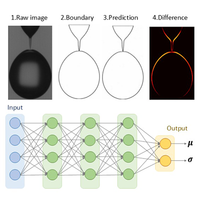
Here, we demonstrate that the time-evolving interface during droplet formation—and, in particular, the morphology near pinch-off—encodes sufficient physical information for machine-learning (ML) models to accurately infer key fluid properties, including viscosity and surface tension. A dataset was constructed from high-speed imaging of droplet formation in both dripping and and jetting regimes. The frame closest to breakup was selected and the contour of the droplet extracted and recorded, along with the corresponding flow conditions and fluid properties. Experiments were conducted using Newtonian fluids, such as silicon oils, aqueous solutions of ethanol and glycerin, and methanol, under controlled conditions, spanning and , providing 840 samples. Supervised regression models were trained to predict fluid properties from these inputs. The models accurately infer surface tension and viscosity across a wide range of fluids using the single high-speed snapshot. Moreover, apart from predicting fluid properties from a snapshot, the proposed framework can carry out the inverse problem and predict droplet shape at breakup based on fluid properties and flow conditions. Unsupervised clustering of the learned representations reveals distinct regions in the Re–Oh and Bo–Oh parameter spaces, indicating that the latent space captures meaningful physical structure and provides insight into droplet dynamics. These results establish a data-driven alternative to conventional measurement techniques, reducing experimental complexity and evaluation time while enabling integration into automated systems.
Physics Subject Headings (PhySH)
Popular Summary
The breakup of a dripping droplet is a rapid and highly nonlinear event, yet its shape encodes essential information about the liquid and its dynamics. We demonstrate that a single high-speed snapshot taken just before pinch-off contains sufficient geometrical detail for machine-learning models to accurately infer their key material properties, including viscosity and surface tension, across a wide range of fluids. By linking image-based observations to quantitative physical parameters, we provide a fast, low volume, accurate, and automation-ready alternative to conventional tensiometry and rheometry. An unsupervised learning model is further employed to relate breakup morphologies to breakup dynamics and liquid properties. We believe this approach provides diagnostic that is both scalable and reliable for a range of applications including inkjet printing, spray coating, additive manufacturing, pharmaceutics, microfluidics, and automated quality control and characterization of complex fluids.
Article Text
References (77)
- A. L. Dearden, P. J. Smith, D.-Y. Shin, N. Reis, B. Derby, and P. O’Brien, A low curing temperature silver ink for use in ink-jet printing and subsequent production of conductive tracks, Macromol. Rapid Commun. 26, 315 (2005).
- J. Stringer and B. Derby, Limits to feature size and resolution in ink jet printing, J. Eur. Ceram. Soc. 29, 913 (2009).
- S. Pan, R. Guo, M. Björnmalm, J. J. Richardson, L. Li, C. Peng, N. Bertleff-Zieschang, W. Xu, J. Jiang, and F. Caruso, Coatings super-repellent to ultralow surface tension liquids, Nat. Mater. 17, 1040 (2018).
- T. Carey, C. Jones, F. Le Moal, D. Deganello, and F. Torrisi, Spray-coating thin films on three-dimensional surfaces for a semitransparent capacitive-touch device, ACS Appl. Mater. Interfaces 10, 19948 (2018).
- C. E. Stauffer, The measurement of surface tension by the pendant drop technique, J. Phys. Chem. 69, 1933 (1965).
- S. M. Saad, Z. Policova, and A. W. Neumann, Design and accuracy of pendant drop methods for surface tension measurement, Colloids Surf. A 384, 442 (2011).
- F. Bashforth and J. C. Adams, An Attempt to Test the Theories of Capillary Action: By Comparing the Theoretical and Measured Forms of Drops of Fluid (Cambridge University Press, Cambridge, United Kingdom, 1883).
- F. Hansen and G. Rødsrud, Surface tension by pendant drop: I. A fast standard instrument using computer image analysis, J. Colloid Interface Sci. 141, 1 (1991).
- J. D. Berry, M. J. Neeson, R. R. Dagastine, D. Y. Chan, and R. F. Tabor, Measurement of surface and interfacial tension using pendant drop tensiometry, J. Colloid Interface Sci. 454, 226 (2015).
- S.-Y. Lin, L.-J. Chen, J.-W. Xyu, and W.-J. Wang, An examination on the accuracy of interfacial tension measurement from pendant drop profiles, Langmuir 11, 4159 (1995).
- S.-Y. Lin, W.-J. Wang, L.-W. Lin, and L.-J. Chen, Systematic effects of bubble volume on the surface tension measured by pendant bubble profiles, Colloids Surf. A 114, 31 (1996).
- A. Morita, D. Carastan, and N. Demarquette, Influence of drop volume on surface tension evaluated using the pendant drop method, Colloid Polym. Sci. 280, 857 (2002).
- W. D. Harkins and H. F. Jordan, A method for the determination of surface and interfacial tension from the maximum pull on a ring, J. Am. Chem. Soc. 52, 1751 (1930).
- M. Simon, Recherches sur la capillarité, in Annales de Chimie et de Physique, 3rd Ser. (Victor Masson, Paris, 1851), Vol. 32, pp. 5–87.
- N. Dixit, D. L. Zeng, and D. S. Kalonia, Application of maximum bubble pressure surface tensiometer to study protein–surfactant interactions, Int. J. Pharm. 439, 317 (2012).
- V. Fainerman and R. Miller, Maximum bubble pressure tensiometry—an analysis of experimental constraints, Adv. Colloid Interface Sci. 108, 287 (2004).
- C. Weber, Zum zerfall eines flüssigkeitsstrahles, Z. Angew. Math. Mech. 11, 136 (1931).
- A. Gaillard, R. Sijs, and D. Bonn, What determines the drop size in sprays of polymer solutions?, J. Non-Newtonian Fluid Mech. 305, 104813 (2022).
- J. R. Castrejón-Pita, A. A. Castrejón-Pita, S. S. Thete, K. Sambath, I. M. Hutchings, J. Hinch, J. R. Lister, and O. A. Basaran, Plethora of transitions during breakup of liquid filaments, Proc. Natl. Acad. Sci. U.S.A. 112, 4582 (2015).
- G. Schramm et al., A practical approach to rheology and rheometry (1994), https://library.wur.nl/WebQuery/titel/2030370.
- E. P. Koehler, D. W. Fowler, C. F. Ferraris, and S. Amziane, A new, portable rheometer for fresh self-consolidating concrete, ACI Spec. Publ. 233, 97 (2005), https://www.researchgate.net/profile/Sofiane-Amziane/publication/265040129_A_NEW_PORTABLE_RHEOMETER_FOR_FRESH_SELF-CONSOLIDATING_CONCRETE_A_NEW_PORTABLE_RHEOMETER_FOR_FRESH_SELF-CONSOLIDATING_CONCRETE/links/555a264c08ae6fd2d8281e79/A-NEW-PORTABLE-RHEOMETER-FOR-FRESH-SELF-CONSOLIDATING-CONCRETE-A-NEW-PORTABLE-RHEOMETER-FOR-FRESH-SELF-CONSOLIDATING-CONCRETE.pdf.
- A. Castrejón-Pita, E. Betton, N. Campbell, N. Jackson, J. Morgan, T. Tuladhar, D. Vadillo, and J. R. Castrejon-Pita, Formulation, quality, cleaning, and other advances in inkjet printing, Atomization Sprays 31, 57 (2021).
- A. A. Castrejón-Pita, J. R. Castrejón-Pita, and I. M. Hutchings, Breakup of liquid filaments, Phys. Rev. Lett. 108, 074506 (2012).
- O. A. Basaran, H. Gao, and P. P. Bhat, Nonstandard inkjets, Annu. Rev. Fluid Mech. 45, 85 (2013).
- O. A. Basaran, Small-scale free surface flows with breakup: Drop formation and emerging applications, AIChE J. 48, 1842 (2002).
- R. F. Day, E. J. Hinch, and J. R. Lister, Self-similar capillary pinchoff of an inviscid fluid, Phys. Rev. Lett. 80, 704 (1998).
- J. R. Castrejón-Pita, A. A. Castrejón-Pita, E. J. Hinch, J. R. Lister, and I. M. Hutchings, Self-similar breakup of near-inviscid liquids, Phys. Rev. E 86, 015301 (2012).
- J. B. Keller and M. J. Miksis, Surface tension driven flows, SIAM J. Appl. Math. 43, 268 (1983).
- A. U. Chen, P. K. Notz, and O. A. Basaran, Computational and experimental analysis of pinch-off and scaling, Phys. Rev. Lett. 88, 174501 (2002).
- I. M. Hauner, A. Deblais, J. K. Beattie, H. Kellay, and D. Bonn, The dynamic surface tension of water, J. Phys. Chem. Lett. 8, 1599 (2017).
- A. Deblais, M. A. Herrada, I. Hauner, K. P. Velikov, T. Van Roon, H. Kellay, J. Eggers, and D. Bonn, Viscous effects on inertial drop formation, Phys. Rev. Lett. 121, 254501 (2018).
- M. Corpart, M. Herrada, A. Deblais, and D. Bonn, Approach to similarity in the pinch-off of a viscous liquid thread, J. Fluid Mech. 1019, A15 (2025).
- J. D. Paulsen, J. C. Burton, S. R. Nagel, S. Appathurai, M. T. Harris, and O. A. Basaran, The inexorable resistance of inertia determines the initial regime of drop coalescence, Proc. Natl. Acad. Sci. U.S.A. 109, 6857 (2012).
- D. T. Papageorgiou, On the breakup of viscous liquid threads, Phys. Fluids 7, 1529 (1995).
- J. Eggers, Universal pinching of 3d axisymmetric free-surface flow, Phys. Rev. Lett. 71, 3458 (1993).
- Y. Li and J. E. Sprittles, Capillary breakup of a liquid bridge: Identifying regimes and transitions, J. Fluid Mech. 797, 29 (2016).
- B. Ambravaneswaran, H. J. Subramani, S. D. Phillips, and O. A. Basaran, Dripping-jetting transitions in a dripping faucet, Phys. Rev. Lett. 93, 034501 (2004).
- P. K. Notz and O. A. Basaran, Dynamics and breakup of a contracting liquid filament, J. Fluid Mech. 512, 223 (2004).
- D. Alveringh, D. Le, J. Groenesteijn, J. Schmitz, and J. Lötters, Fluid classification with integrated flow and pressure sensors using machine learning, Sens. Actuators A 363, 114762 (2023).
- Q. Chen and C. R. Constante-Amores, Low-dimensional multiscale dynamics of intermittent reversals in turbulent rayleigh-benard convection, Chaos 36, 063131 (2026).
- C. R. Constante-Amores, A. J. Linot, and M. D. Graham, Dynamics of a data-driven low-dimensional model of turbulent minimal pipe flow, J. Fluid Mech. 1020, A58 (2025).
- A. Gaikwad, T. Chang, B. Giera, N. Watkins, S. Mukherjee, A. Pascall, D. Stobbe, and P. Rao, In-process monitoring and prediction of droplet quality in droplet-on-demand liquid metal jetting additive manufacturing using machine learning, Journal of Intelligent Manufacturing 33, 2093 (2022).
- H. Chen, Y. Liu, S. Balabani, R. Hirayama, and J. Huang, Machine learning in predicting printable biomaterial formulations for direct ink writing, Research 6, 0197 (2023).
- F. S. Kratz and J. Kierfeld, Pendant drop tensiometry: A machine learning approach, J. Chem. Phys. 153, 094701 (2020).
- T. Li, L. Lu, Q. Zeng, and K. Liao, Machine learning based multi-parameter droplet optimisation model study, Sci. Rep. 15, 25966 (2025).
- S. Kim, M. Cho, and S. Jung, The design of an inkjet drive waveform using machine learning, Sci. Rep. 12, 4841 (2022).
- P. S. Clegg, Characterising soft matter using machine learning, Soft Matter 17, 3991 (2021).
- T. Orlova, A. Piven, D. Darmoroz, T. Aliev, T. M. T. A. Razik, A. Boitsev, N. Grafeeva, and E. Skorb, Machine learning for soft and liquid molecular materials, Digital Discovery 2, 298 (2023).
- M. H. Mobarak, M. A. Mimona, M. A. Islam, N. Hossain, F. T. Zohura, I. Imtiaz, and M. I. H. Rimon, Scope of machine learning in materials research—a review, Appl. Surface Sci. Adv. 18, 100523 (2023).
- J. Masci, U. Meier, D. Cireşan, and J. Schmidhuber, Stacked convolutional auto-encoders for hierarchical feature extraction, in International Conference on Artificial Neural Networks (Springer, New York, 2011), pp. 52–59.
- J. W. Khor, N. Jean, E. S. Luxenberg, S. Ermon, and S. K. Tang, Using machine learning to discover shape descriptors for predicting emulsion stability in a microfluidic channel, Soft Matter 15, 1361 (2019).
- H. Zhang and S. K. Moon, Reviews on machine learning approaches for process optimization in noncontact direct ink writing, ACS Appl. Mater. Interfaces 13, 53323 (2021).
- L. Au-Yeung and P. A. Tsai, Predicting impact outcomes and maximum spreading of drop impact on heated nanostructures using machine learning, Langmuir 39, 18327 (2023).
- M. Tembely, D. C. Vadillo, A. Dolatabadi, and A. Soucemarianadin, A machine learning approach for predicting the maximum spreading factor of droplets upon impact on surfaces with various wettabilities, Processes 10, 1141 (2022).
- M. Pierzyna, D. A. Burzynski, S. E. Bansmer, and R. Semaan, Data-driven splashing threshold model for drop impact on dry smooth surfaces, Phys. Fluids 33, 123317 (2021).
- S. Kim, R. Wenger, O. Bürgy, G. Balestra, U. Jeong, and S. Jung, Predicting inkjet jetting behavior for viscoelastic inks using machine learning, Flexible Printed Electron. 8, 035007 (2023).
- S. Kim, M. Cho, and S. Jung, Reinforcement learning-based dynamic optimization of driving waveforms for inkjet printing of viscoelastic fluids, Langmuir 41, 10831 (2025).
- K. J. Mysels, Some limitations in the interpretation of the time dependence of surface tension measured by the maximum bubble pressure method, Langmuir 5, 442 (1989).
- N. Otsu et al., A threshold selection method from gray-level histograms, Automatica 11, 23 (1975), https://engineering.purdue.edu/kak/computervision/ECE661.08/OTSU_paper.pdf.
- D. P. Kingma, Adam: A method for stochastic optimization, arXiv:1412.6980.
- A. Creswell, K. Arulkumaran, and A. A. Bharath, On denoising autoencoders trained to minimise binary cross-entropy, arXiv:1708.08487.
- T. Chen and C. Guestrin, Xgboost: A scalable tree boosting system, in Proceedings of the 22nd ACM SIGKDD International Conference on Knowledge Discovery and Data Mining, KDD ’16 (ACM, 2016), pp. 785–794.
- R. F. Day, E. J. Hinch, and J. R. Lister, Self-similar capillary pinchoff of an inviscid fluid, Phys. Rev. Lett. 80, 704 (1998).
- J. Eggers, Universal pinching of 3d axisymmetric free-surface flow, Phys. Rev. Lett. 71, 3458 (1993).
- D. T. Papageorgiou, On the breakup of viscous liquid threads, Phys. Fluids 7, 1529 (1995).
- J. R. Castrejón-Pita et al., Plethora of transitions during breakup of liquid filaments, Proc. Natl. Acad. Sci. U.S.A. 111, 1418541112 (2014).
- M. C. Dallaston et al., Stability of similarity solutions of viscous thread pinch-off, Phys. Rev. Fluids 6, 104004 (2021).
- I. Hauner, A. Deblais, J. K. Beattie, H. Kellay, and D. Bonn, Dynamic surface tension from drop pinch-off, J. Phys. Chem. Lett. 8, 1599 (2017).
- D. Lohse, Fundamental fluid dynamics challenges in inkjet printing, Annu. Rev. Fluid Mech. 54, 349 (2022).
- L. Bautista, D. C. Vargas, X. Luo et al., A simple capillary viscometer based on the ideal gas law, RSC Adv. 8, 30441 (2018).
- N. Seimiya and K. Takei, Simultaneous measurement of surface tension and viscosity using a liquid dynamics sensor, Small Methods 9, 2401983 (2025).
- T. H. Phung, S. H. Park, I. Kim, T.-M. Lee, and K.-S. Kwon, Machine learning approach to monitor inkjet jetting status based on the piezo self-sensing, Sci. Rep. 13, 18089 (2023).
- P. S. Lenzen, F. Dingfelder, M. Muller, and P. Arosio, Portable microfluidic viscometer for formulation development and in situ quality control of protein and antibody solutions, Anal. Chem. 96, 13185 (2024).
- S. Tronci, P. Van Neer, E. Giling, U. Stelwagen, D. Piras, R. Mei, F. Corominas, and M. Grosso, In-line monitoring and control of rheological properties through data-driven ultrasound soft-sensors, Sensors 19, 5009 (2019).
- https://github.com/CFTL-Illinois/Droplet-Properties-Prediction.
- P. J. Rousseeuw, Silhouettes: A graphical aid to the interpretation and validation of cluster analysis, J. Comput. Appl. Math. 20, 53 (1987).
- D. L. Davies and D. W. Bouldin, A cluster separation measure, IEEE Trans. Pattern Anal. Mach. Intell. PAMI-1, 224 (1979).

