

- Open Access
Topological Dipoles of Quantum Skyrmions
Phys. Rev. X 15, 041037 – Published 25 November, 2025
DOI: https://doi.org/10.1103/sxgs-38c3
Abstract
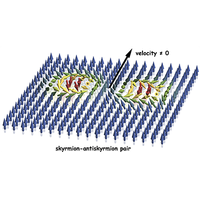
Magnetic skyrmions are spatially localized whirls of spin moments in two dimensions, featuring a nontrivial topological charge and a well-defined topological charge density. We demonstrate that the quantum dynamics of magnetic skyrmions is governed by a dipole conservation law associated with the topological charge, akin to that in fracton theories of excitations with constrained mobility. The dipole conservation law enables a natural definition of the collective coordinate to specify the skyrmion’s position, which ultimately leads to a greatly simplified equation of motion in the form of the Thiele equation. In this formulation, the skyrmion mass, whose existence is often debated, actually vanishes. As a result, an isolated skyrmion is intrinsically pinned to be immobile and cannot move at a constant velocity. In a spin-wave theory, we show that such dynamics corresponds to a precise cancellation between a highly nontrivial motion of the quasiclassical skyrmion spin texture and a cloud of quantum fluctuations in the form of spin waves. Given this quenched kinetic energy of quantum skyrmions, we identify close analogies to the bosonic quantum Hall problem. In particular, the topological charge density is shown to obey the Girvin-MacDonald-Platzman algebra that describes neutral modes of the lowest Landau level in the fractional quantum Hall problem. Consequently, the conservation of the topological dipole suggests that magnetic skyrmion materials offer a promising platform for exploring fractonic phenomena with close analogies to fractional quantum Hall states.
Physics Subject Headings (PhySH)
Popular Summary
Skyrmions are tiny, swirling arrangements of magnetic spins that carry a topological charge—a number describing how many times the spins wrap around a sphere. This topological nature gives rise to many unusual behaviors, but exactly how topology shapes their motion has remained unclear. In this study, we show that the quantum dynamics of skyrmions are governed by the conservation of a dipole moment linked to their topological charge. This conservation law, which follows from translational symmetry and the fact that the topological charge density generates area-preserving deformations, leads to several unexpected and far-reaching consequences.
We demonstrate three key results. First, we identify skyrmions as fractons—an exotic type of quasiparticle that obeys a similar conservation law for dipole moments and, in some cases, higher-order moments. This connection between skyrmions and fractons opens the door to exploring fractonic behavior experimentally, something that has been difficult because experimental realizations of fractons are rare.
Second, we uncover a deep link between skyrmion physics and the quantum Hall effect by showing that the topological charge density of a skyrmion satisfies the same mathematical relations that describe excitations in quantum Hall systems. This points to the possible existence of novel quantum liquids of skyrmions that could host fractionalized excitations, similar to those found in fractional quantum Hall states.
Finally, we resolve a long-standing question about whether skyrmions have mass. We demonstrate how a quantum skyrmion behaves as a massless object as a direct consequence of the conserved topological dipole.
Together, these findings reveal deep theoretical connections between topology, magnetism, and quantum many-body physics, and they motivate future experiments to realize exotic quantum liquids of skyrmions and to test fractonic phenomena in the laboratory.
Article Text
References (78)
- N. Nagaosa and Y. Tokura, Topological properties and dynamics of magnetic skyrmions, Nat. Nanotechnol. 8, 899 (2013).
- R. Wiesendanger, Nanoscale magnetic skyrmions in metallic films and multilayers: A new twist for spintronics, Nat. Rev. Mater. 1, 16044 (2016).
- W. Jiang, G. Chen, K. Liu, J. Zang, S. G. te Velthuis, and A. Hoffmann, Skyrmions in magnetic multilayers, Phys. Rep. 704, 1 (2017).
- A. Fert, N. Reyren, and V. Cros, Magnetic skyrmions: Advances in physics and potential applications, Nat. Rev. Mater. 2, 17031 (2017).
- K. Everschor-Sitte, J. Masell, R. M. Reeve, and M. Kläui, Perspective: Magnetic skyrmions—Overview of recent progress in an active research field, J. Appl. Phys. 124, 240901 (2018).
- C. Back, V. Cros, H. Ebert, K. Everschor-Sitte, A. Fert, M. Garst, T. Ma, S. Mankovsky, T. L. Monchesky, M. Mostovoy, N. Nagaosa, S. S. P. Parkin, C. Pfleiderer, N. Reyren, A. Rosch, Y. Taguchi, Y. Tokura, K. von Bergmann, and J. Zang, The 2020 skyrmionics roadmap, J. Phys. D 53, 363001 (2020).
- B. Göbel, I. Mertig, and O. A. Tretiakov, Beyond skyrmions: Review and perspectives of alternative magnetic quasiparticles, Phys. Rep. 895, 1 (2021).
- A. P. Petrović, C. Psaroudaki, P. Fischer, M. Garst, and C. Panagopoulos, Colloquium: Quantum properties and functionalities of magnetic skyrmions, Rev. Mod. Phys. 97, 031001 (2025).
- Magnetic Skyrmions and Their Applications, edited by G. Finocchio and C. Panagopoulos Woodhead Publishing Series in Electronic and Optical Materials (Woodhead Publishing, Sawston, 2021).
- G. E. Volovik, Linear momentum in ferromagnets, J. Phys. C 20, L83 (1987).
- J. Ye, Y. B. Kim, A. J. Millis, B. I. Shraiman, P. Majumdar, and Z. Tešanović, Berry phase theory of the anomalous Hall effect: Application to colossal magnetoresistance manganites, Phys. Rev. Lett. 83, 3737 (1999).
- P. Bruno, V. K. Dugaev, and M. Taillefumier, Topological Hall effect and Berry phase in magnetic nanostructures, Phys. Rev. Lett. 93, 096806 (2004).
- A. Neubauer, C. Pfleiderer, B. Binz, A. Rosch, R. Ritz, P. G. Niklowitz, and P. Böni, Topological Hall effect in the phase of mnsi, Phys. Rev. Lett. 102, 186602 (2009).
- M. Lee, W. Kang, Y. Onose, Y. Tokura, and N. P. Ong, Unusual Hall effect anomaly in MnSi under pressure, Phys. Rev. Lett. 102, 186601 (2009).
- Y. Shiomi, N. Kanazawa, K. Shibata, Y. Onose, and Y. Tokura, Topological Nernst effect in a three-dimensional skyrmion-lattice phase, Phys. Rev. B 88, 064409 (2013).
- M. Hirschberger, L. Spitz, T. Nomoto, T. Kurumaji, S. Gao, J. Masell, T. Nakajima, A. Kikkawa, Y. Yamasaki, H. Sagayama, H. Nakao, Y. Taguchi, R. Arita, T. H. Arima, and Y. Tokura, Topological Nernst effect of the two-dimensional skyrmion lattice, Phys. Rev. Lett. 125, 076602 (2020).
- A. A. Thiele, Steady-state motion of magnetic domains, Phys. Rev. Lett. 30, 230 (1973).
- M. Mochizuki, Spin-wave modes and their intense excitation effects in skyrmion crystals, Phys. Rev. Lett. 108, 017601 (2012).
- A. Roldán-Molina, A. S. Nunez, and J. Fernández-Rossier, Topological spin waves in the atomic-scale magnetic skyrmion crystal, New J. Phys. 18, 045015 (2016).
- M. Garst, J. Waizner, and D. Grundler, Collective spin excitations of helices and magnetic skyrmions: Review and perspectives of magnonics in non-centrosymmetric magnets, J. Phys. D 50, 293002 (2017).
- N. Papanicolaou and T. Tomaras, Dynamics of magnetic vortices, Nucl. Phys. B360, 425 (1991).
- A. A. Thiele, On the momentum of ferromagnetic domains, J. Appl. Phys. 47, 2759 (1976).
- F. D. M. Haldane, Geometrical interpretation of momentum and crystal momentum of classical and quantum ferromagnetic Heisenberg chains, Phys. Rev. Lett. 57, 1488 (1986).
- H. Watanabe and H. Murayama, Noncommuting momenta of topological solitons, Phys. Rev. Lett. 112, 191804 (2014).
- O. Tchernyshyov, Conserved momenta of a ferromagnetic soliton, Ann. Phys. (Amsterdam) 363, 98 (2015).
- S. Dasgupta and O. Tchernyshyov, Energy-momentum tensor of a ferromagnet, Phys. Rev. B 98, 224401 (2018).
- X. Di and O. Tchernyshyov, Conserved momenta of ferromagnetic solitons through the prism of differential geometry, SciPost Phys. 11, 108 (2021).
- N. Seiberg, Ferromagnets, a new anomaly, instantons, and (noninvertible) continuous translations, SciPost Phys. 18, 063 (2025).
- C. Psaroudaki, S. Hoffman, J. Klinovaja, and D. Loss, Quantum dynamics of skyrmions in chiral magnets, Phys. Rev. X 7, 041045 (2017).
- C. Schütte, J. Iwasaki, A. Rosch, and N. Nagaosa, Inertia, diffusion, and dynamics of a driven skyrmion, Phys. Rev. B 90, 174434 (2014).
- D. D. Sheka, C. Schuster, B. A. Ivanov, and F. G. Mertens, Dynamics of topological solitons in two-dimensional ferromagnets, Eur. Phys. J. B 50, 393 (2006).
- C. Moutafis, S. Komineas, and J. A. C. Bland, Dynamics and switching processes for magnetic bubbles in nanoelements, Phys. Rev. B 79, 224429 (2009).
- F. Büttner, C. Moutafis, M. Schneider, B. Krüger, C. M. Günther, J. Geilhufe, C. v. K. Schmising, J. Mohanty, B. Pfau, S. Schaffert, A. Bisig, M. Foerster, T. Schulz, C. A. F. Vaz, J. H. Franken, H. J. M. Swagten, M. Kläui, and S. Eisebitt, Dynamics and inertia of skyrmionic spin structures, Nat. Phys. 11, 225 (2015).
- X. Wu and O. Tchernyshyov, How a skyrmion can appear both massive and massless, SciPost Phys. 12, 159 (2022).
- B. Ivanov and V. Stephanovich, Two-dimensional soliton dynamics in ferromagnets, Phys. Lett. A 141, 89 (1989).
- I. Makhfudz, B. Krüger, and O. Tchernyshyov, Inertia and chiral edge modes of a skyrmion magnetic bubble, Phys. Rev. Lett. 109, 217201 (2012).
- V. P. Kravchuk, D. D. Sheka, U. K. Rößler, J. van den Brink, and Y. Gaididei, Spin eigenmodes of magnetic skyrmions and the problem of the effective skyrmion mass, Phys. Rev. B 97, 064403 (2018).
- R. Takashima, H. Ishizuka, and L. Balents, Quantum skyrmions in two-dimensional chiral magnets, Phys. Rev. B 94, 134415 (2016).
- H. Ochoa and Y. Tserkovnyak, Quantum skyrmionics, Int. J. Mod. Phys. B 33, 1930005 (2019).
- S. M. Girvin, A. H. MacDonald, and P. M. Platzman, Magneto-roton theory of collective excitations in the fractional quantum Hall effect, Phys. Rev. B 33, 2481 (1986).
- C. Chamon, Quantum glassiness in strongly correlated clean systems: An example of topological overprotection, Phys. Rev. Lett. 94, 040402 (2005).
- S. Bravyi, B. Leemhuis, and B. M. Terhal, Topological order in an exactly solvable 3D spin model, Ann. Phys. (Amsterdam) 326, 839 (2011).
- J. Haah, Local stabilizer codes in three dimensions without string logical operators, Phys. Rev. A 83, 042330 (2011).
- B. Yoshida, Exotic topological order in fractal spin liquids, Phys. Rev. B 88, 125122 (2013).
- S. Vijay, J. Haah, and L. Fu, A new kind of topological quantum order: A dimensional hierarchy of quasiparticles built from stationary excitations, Phys. Rev. B 92, 235136 (2015).
- S. Vijay, J. Haah, and L. Fu, Fracton topological order, generalized lattice gauge theory, and duality, Phys. Rev. B 94, 235157 (2016).
- M. Pretko, Subdimensional particle structure of higher rank spin liquids, Phys. Rev. B 95, 115139 (2017).
- A. Morningstar, V. Khemani, and D. A. Huse, Kinetically constrained freezing transition in a dipole-conserving system, Phys. Rev. B 101, 214205 (2020).
- A. Gromov, A. Lucas, and R. M. Nandkishore, Fracton hydrodynamics, Phys. Rev. Res. 2, 033124 (2020).
- P. Zhang, Subdiffusion in strongly tilted lattice systems, Phys. Rev. Res. 2, 033129 (2020).
- J. Feldmeier, P. Sala, G. De Tomasi, F. Pollmann, and M. Knap, Anomalous diffusion in dipole- and higher-moment-conserving systems, Phys. Rev. Lett. 125, 245303 (2020).
- S. Pai, M. Pretko, and R. M. Nandkishore, Localization in fractonic random circuits, Phys. Rev. X 9, 021003 (2019).
- V. Khemani, M. Hermele, and R. Nandkishore, Localization from Hilbert space shattering: From theory to physical realizations, Phys. Rev. B 101, 174204 (2020).
- P. Sala, T. Rakovszky, R. Verresen, M. Knap, and F. Pollmann, Ergodicity breaking arising from Hilbert space fragmentation in dipole-conserving Hamiltonians, Phys. Rev. X 10, 011047 (2020).
- M. Pretko, Generalized electromagnetism of subdimensional particles: A spin liquid story, Phys. Rev. B 96, 035119 (2017).
- M. Pretko, The fracton gauge principle, Phys. Rev. B 98, 115134 (2018).
- R. M. Nandkishore and M. Hermele, Fractons, Annu. Rev. Condens. Matter Phys. 10, 295 (2019).
- M. Pretko, X. Chen, and Y. You, Fracton phases of matter, Int. J. Mod. Phys. A 35, 2030003 (2020).
- A. Gromov and L. Radzihovsky, Colloquium: Fracton matter, Rev. Mod. Phys. 96, 011001 (2024).
- M. Pretko and L. Radzihovsky, Fracton-elasticity duality, Phys. Rev. Lett. 120, 195301 (2018).
- M. Pretko, Z. Zhai, and L. Radzihovsky, Crystal-to-fracton tensor gauge theory dualities, Phys. Rev. B 100, 134113 (2019).
- J. Gaa, G. Palle, R. M. Fernandes, and J. Schmalian, Fracton-elasticity duality in twisted moiré superlattices, Phys. Rev. B 104, 064109 (2021).
- D. Doshi and A. Gromov, Vortices as fractons, Commun. Phys. 4, 44 (2021).
- Y.-H. Du, U. Mehta, D. X. Nguyen, and D. T. Son, Volume-preserving diffeomorphism as non-Abelian higher-rank gauge symmetry, SciPost Phys. 12, 050 (2022).
- A. Auerbach, Interacting Electrons and Quantum Magnetism, Graduate Texts in Contemporary Physics (Springer, New York, 2012).
- M. E. Peskin and D. V. Schroeder, An Introduction to Quantum Field Theory (Perseus Books Publishing, L.L.C., New York City, 1995).
In more detail, the Jacobian for a change of variables is formally given by the determinant of an infinite-dimensional matrix, , where the matrix indices and correspond to spacetime coordinates. Using the identity and the fact that the derivative has vanishing diagonal matrix elements within a lattice-regularized scheme, one can show that the Jacobian of the transformation is indeed unity at linear order, so the measure of the path integral does not change.
- N. D. Mermin and T.-L. Ho, Circulation and angular momentum in the phase of superfluid helium-3, Phys. Rev. Lett. 36, 594 (1976).
- R. D. Kamien, The geometry of soft materials: A primer, Rev. Mod. Phys. 74, 953 (2002).
- C. Schütte and M. Garst, Magnon-skyrmion scattering in chiral magnets, Phys. Rev. B 90, 094423 (2014).
- M. Stone, Magnus force on skyrmions in ferromagnets and quantum Hall systems, Phys. Rev. B 53, 16573 (1996).
- J. Zang, M. Mostovoy, J. H. Han, and N. Nagaosa, Dynamics of skyrmion crystals in metallic thin films, Phys. Rev. Lett. 107, 136804 (2011).
- O. Petrova and O. Tchernyshyov, Spin waves in a skyrmion crystal, Phys. Rev. B 84, 214433 (2011).
- S. Komineas and N. Papanicolaou, Skyrmion dynamics in chiral ferromagnets, Phys. Rev. B 92, 064412 (2015).
- J. Müller and A. Rosch, Capturing of a magnetic skyrmion with a hole, Phys. Rev. B 91, 054410 (2015).
- C. Psaroudaki and D. Loss, Quantum depinning of a magnetic skyrmion, Phys. Rev. Lett. 124, 097202 (2020).
- J. L. Gervais and B. Sakita, Extended particles in quantum field theories, Phys. Rev. D 11, 2943 (1975).
- H.-B. Braun, Topological effects in nanomagnetism: From superparamagnetism to chiral quantum solitons, Adv. Phys. 61, 1 (2012).

