

- Open Access
Thermalization in Open Many-Body Systems and KMS Detailed Balance
Phys. Rev. X 16, 011040 – Published 27 February, 2026
DOI: https://doi.org/10.1103/sfp3-3sqf
Abstract
Starting from a microscopic description of weak system-bath interactions, we derive from first principles a quantum master equation that does not rely on the well-known rotating wave approximation. This includes generic many-body systems, with Hamiltonians with vanishingly small energy spacings that forbid that approximation. The equation satisfies a general form of detailed balance, called KMS (Kubo-Martin-Schwinger), which ensures exact convergence to the many-body Gibbs state. Unlike the more common notion of GNS (Gelfand-Naimark-Segal) detailed balance, this notion is compatible with the absence of the rotating wave approximation. We show that the resulting Lindbladian dynamics not only reproduces the thermal equilibrium point up to a small renormalization of the system Hamiltonian, but it also approximates the true system evolution with an error that grows at most linearly in time, giving an exponential improvement upon previous estimates. This master equation has quasilocal jump operators, can be efficiently simulated on a quantum computer, and reduces to the usual Davies dynamics in the limit of a coarse-graining time much larger than the inverse of the smallest frequency difference. With it, we provide a rigorous model of many-body thermalization relevant to both open quantum systems and quantum algorithms.
Physics Subject Headings (PhySH)
Popular Summary
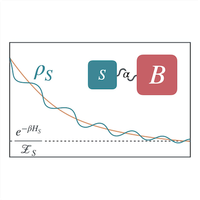
Understanding how quantum systems reach thermal equilibrium from microscopic principles is a central challenge in statistical mechanics. We derived a universal quantum master equation from first principles that describes the weak interaction between a generic many-body system and a thermal bath without relying on the restrictive rotating wave approximation. This approach utilizes Kubo-Martin-Schwinger detailed balance, a general symmetry principle that ensures the system converges to the correct many-body Gibbs state even when energy levels are densely packed. Our resulting model approximates true system evolution with an error that grows only linearly in time, representing an exponential improvement over previous estimates. Because the equation uses quasilocal operators, it can be efficiently simulated on quantum computers to mimic complex thermalization processes. This work provides a rigorous framework for studying open many-body dynamics and developing advanced quantum algorithms for Gibbs sampling.
Article Text
References (83)
- L. Boltzmann, Weitere studien über das wärmegleichgewicht unter gasmolekülen (Aus der kk Hot-und Staatsdruckerei, 1872), Vol. 66.
- A. Einstein, Zur quantentheorie der strahlung (Verlag u. Druck Gebr. Leemann, 1916).
- L. Onsager, Reciprocal relations in irreversible processes. I., Phys. Rev. 37, 405 (1931).
- C. P. Robert, G. Casella, and G. Casella, Monte Carlo Statistical Methods (Springer, New York, 1999), Vol. 2.
- G. Agarwal, Open quantum Markovian systems and the microreversibility, Z. Phys. A 258, 409 (1973).
- R. Alicki, On the detailed balance condition for non-Hamiltonian systems, Rep. Math. Phys. 10, 249 (1976).
- E. B. Davies, Markovian master equations, Commun. Math. Phys. 39, 91 (1974).
- E. B. Davies, Markovian master equations. II, Math. Ann. 219, 147 (1976).
This is connected to the energy-time uncertainty relations, as the duration of the dynamics (the inverse of the interaction strength) needs to become very large in order for the system to distinguish between different oscillation frequencies.
- M. J. Kastoryano and F. G. S. L. Brandão, Quantum Gibbs samplers: The commuting case, Commun. Math. Phys. 344, 915 (2016).
- H. Weimer, A. Kshetrimayum, and R. Orús, Simulation methods for open quantum many-body systems, Rev. Mod. Phys. 93, 015008 (2021).
- R. Fazio, J. Keeling, L. Mazza, and M. Schirò, Many-body open quantum systems, arXiv:2409.10300.
- F. Fagnola and V. Umanità, Generators of detailed balance quantum Markov semigroups, Inf. Dim. Anal. Quant. Prob. Rel. Topics 10, 335 (2007).
- K. Temme, M. J. Kastoryano, M. B. Ruskai, M. M. Wolf, and F. Verstraete, The -divergence and mixing times of quantum Markov processes, J. Math. Phys. (N.Y.) 51, 122201 (2010).
- É. Amorim and E. A. Carlen, Complete positivity and self-adjointness, Linear Algebra Appl. 611, 389 (2021).
- M. Scandi, P. Abiuso, J. Surace, and D. De Santis, Quantum Fisher information and its dynamical nature, Rep. Prog. Phys. 88, 076001 (2023).
- D. Taj and F. Rossi, Completely positive Markovian quantum dynamics in the weak-coupling limit, Phys. Rev. A 78, 052113 (2008).
- F. Nathan and M. S. Rudner, Universal Lindblad equation for open quantum systems, Phys. Rev. B 102, 115109 (2020).
- E. Mozgunov and D. Lidar, Completely positive master equation for arbitrary driving and small level spacing, Quantum 4, 227 (2020).
- D. Davidović, Completely positive, simple, and possibly highly accurate approximation of the redfield equation, Quantum 4, 326 (2020).
- A. Trushechkin, Unified Gorini-Kossakowski-Lindblad-Sudarshan quantum master equation beyond the secular approximation, Phys. Rev. A 103, 062226 (2021).
- G. Kiršanskas, M. Franckié, and A. Wacker, Phenomenological position and energy resolving Lindblad approach to quantum kinetics, Phys. Rev. B 97, 035432 (2018).
- F. Fagnola and V. Umanità, On two quantum versions of the detailed balance condition, Noncommutative harmonic analysis with applications to probability II, Banach Cent. Pub. 89, 105 (2009).
The Lamb-shift Hamiltonian is often the name given to the energy shifts in a system that are induced by its external environment, following its discovery on the electron orbitals of the hydrogen atom [25].
- W. E. Lamb and R. C. Retherford, Fine structure of the hydrogen atom by a microwave method, Phys. Rev. 72, 241 (1947).
- M. Winczewski and R. Alicki, Renormalization in the theory of open quantum systems via the self-consistency condition, arXiv:2112.11962.
- C.-F. Chen, M. J. Kastoryano, F. G. S. L. Brandão, and A. Gilyén, Quantum thermal state preparation, arXiv:2303.18224.
- C.-F. Chen, M. J. Kastoryano, and A. Gilyén, An efficient and exact noncommutative quantum Gibbs sampler, arXiv:2311.09207.
- Z. Ding, B. Li, and L. Lin, Efficient quantum Gibbs samplers with Kubo–Martin–Schwinger detailed balance condition, Commun. Math. Phys. 406 (2025).
- K. Shiraishi, M. Nakagawa, T. Mori, and M. Ueda, Quantum master equation for many-body systems: Derivation based on the Lieb-Robinson bound, arXiv:2404.14067.
- A. Soret, V. Cavina, and M. Esposito, Thermodynamic consistency of quantum master equations, Phys. Rev. A 106, 062209 (2022).
- M. S. Leifer and R. W. Spekkens, Towards a formulation of quantum theory as a causally neutral theory of Bayesian inference, Phys. Rev. A 88, 052130 (2013).
- A. J. Parzygnat and J. Fullwood, From time-reversal symmetry to quantum Bayes’ rules, PRX Quantum 4, 020334 (2023).
The name is connected to the famous GNS construction from operator algebra [35].
- O. Bratteli, D. W. Robinson, O. Bratteli, and D. W. Robinson, Operator Algebras and Quantum Statistical Mechanics: Equilibrium States. Models in Quantum Statistical Mechanics (Springer, New York, 1997), p. 76.
- H.-P. Breuer and F. Petruccione, The Theory of Open Quantum Systems (Oxford University, New York, 2002).
Mathematically, this is justified with the application of the Riemann-Lebesgue lemma [38].
- A. Rivas and S. F. Huelga, Open Quantum Systems (Springer, New York, 2012), Vol. 10.
- D. Petz, Sufficient subalgebras and the relative entropy of states of a von Neumann algebra, Commun. Math. Phys. 105, 123 (1986).
- M. Junge, R. Renner, D. Sutter, M. M. Wilde, and A. Winter, Universal recovery maps and approximate sufficiency of quantum relative entropy, Ann. Henri Poincaré 19, 2955 (2018).
- D. Sutter, Approximate quantum Markov chains, in Approximate Quantum Markov Chains (Springer International Publishing, New York, 2018), pp. 75–100.
- C. C. Aw, F. Buscemi, and V. Scarani, Fluctuation theorems with retrodiction rather than reverse processes, AVS Quantum Sci. 3, 045601 (2021).
GNS detailed balance also implies this property.
This intuitive interpretation becomes exact if or , since in this case one can explicitly carry out the calculation and obtain .
- Á. Rivas, S. F. Huelga, and M. B. Plenio, Quantum non-Markovianity: Characterization, quantification and detection, Rep. Prog. Phys. 77, 094001 (2014).
By convention, whenever the argument of is negative, we set . The same goes for all the other approximate states, that is, .
The dependence in of the unitary term is just a by-product of being in the rescaled time. Going back to real time corresponds to multiplying the right-hand side of Eq. (73) by , so that there is no divergence in the limit .
Indeed, even if the bounds and the functional expressions of the quantities in Sec. 4 are not altered by changing the type of interaction picture, the matrix expression of the jump operators (and, therefore, of the Lamb-shift Hamiltonian) do depend on it.
- A. M. Childs and N. Wiebe, Hamiltonian simulation using linear combinations of unitary operations, Quantum Inf. Comput. 12, 901 (2012).
- A. Gilyén, Y. Su, G. H. Low, and N. Wiebe, Quantum singular value transformation and beyond: Exponential improvements for quantum matrix arithmetics, in Proceedings of the 51st Annual ACM SIGACT Symposium on Theory of Computing, STOC ’19 (Association for Computing Machinery, New York, 2019), pp. 193–204.
- G. H. Low and I. L. Chuang, Hamiltonian simulation by qubitization, Quantum 3, 163 (2019).
- J. M. Martyn, Z. M. Rossi, A. K. Tan, and I. L. Chuang, Grand unification of quantum algorithms, PRX Quantum 2, 040203 (2021).
- Q. T. Nguyen, B. T. Kiani, and S. Lloyd, Block-encoding dense and full-rank kernels using hierarchical matrices: Applications in quantum numerical linear algebra, Quantum 6, 876 (2022).
- D. Camps, L. Lin, R. Van Beeumen, and C. Yang, Explicit quantum circuits for block encodings of certain sparse matrices, SIAM J. Matrix Anal. Appl. 45, 801 (2024).
- C. Sünderhauf, E. Campbell, and J. Camps, Block-encoding structured matrices for data input in quantum computing, Quantum 8, 1226 (2024).
- R. Cleve and C. Wang, Efficient quantum algorithms for simulating Lindblad evolution, in Proceedings of the 44th International Colloquium on Automata, Languages, and Programming (ICALP 2017), Leibniz International Proceedings in Informatics (LIPIcs) Vol. 80 (Schloss Dagstuhl—Leibniz-Zentrum für Informatik, Dagstuhl, Germany, 2017), pp. 17:1–17:14.
- X. Li and C. Wang, Simulating Markovian open quantum systems using higher-order series expansion, in Proceedings of the 50th International Colloquium on Automata, Languages, and Programming (ICALP 2023), Leibniz International Proceedings in Informatics (LIPIcs) Vol. 261, edited by K. Etessami, U. Feige, and G. Puppis (Schloss Dagstuhl—Leibniz-Zentrum für Informatik, Dagstuhl, Germany, 2023), pp. 87:1–87:20.
- Z. Ding, X. Li, and L. Lin, Simulating open quantum systems using Hamiltonian simulations, PRX Quantum 5, 020332 (2024).
In order to highlight the similarity with our derivation, we use a different notation as compared to Ref. [28]. In particular, the jump operators are related to the ones defined there as .
- M. J. Kastoryano, L. B. Kristensen, C.-F. Chen, and A. Gilyén, A little bit of self-correction, arXiv:2408.14970.
- A. M. Childs, Y. Su, M. C. Tran, N. Wiebe, and S. Zhu, Theory of Trotter error with commutator scaling, Phys. Rev. X 11, 011020 (2021).
- A. Rivas, A. D. K Plato, S. F. Huelga, and M. B Plenio, Markovian master equations: A critical study, New J. Phys. 12, 113032 (2010).
- P. P. Hofer, M. Perarnau-Llobet, L. D. M. Miranda, G. Haack, R. Silva, J. B. Brask, and N. Brunner, Markovian master equations for quantum thermal machines: Local versus global approach, New J. Phys. 19, 123037 (2017).
- J. O. González, L. A. Correa, G. Nocerino, J. P. Palao, D. Alonso, and G. Adesso, Testing the validity of the ‘local’ and ‘global’ GKLS master equations on an exactly solvable model, Open Syst. Inf. Dyn. 24, 1740010 (2017).
- G. De Chiara, G. Landi, A. Hewgill, B. Reid, A. Ferraro, A. J. Roncaglia, and M. Antezza, Reconciliation of quantum local master equations with thermodynamics, New J. Phys. 20, 113024 (2018).
- P. P. Potts, A. A. S. Kalaee, and A. Wacker, A thermodynamically consistent Markovian master equation beyond the secular approximation, New J. Phys. 23, 123013 (2021).
- A. S. Trushechkin, M. Merkli, J. D. Cresser, and J. Anders, Open quantum system dynamics and the mean force Gibbs state, AVS Quantum Sci. 4, 012301 (2022).
- C. Rouzé, D. Stilck França, and Á. M. Alhambra, Efficient thermalization and universal quantum computing with quantum Gibbs samplers, arXiv:2403.12691.
- C.-F. Chen and C. Rouzé, Quantum Gibbs states are locally Markovian, arXiv:2504.02208.
- K. Kato and T. Kuwahara, On the clustering of conditional mutual information via dissipative dynamics, arXiv:2504.02235.
- C. Rouzé, D. Stilck França, and Á. M. Alhambra, Optimal quantum algorithm for Gibbs state preparation, arXiv:2411.04885.
- Štěpán Šmíd, R. Meister, M. Berta, and R. Bondesan, Polynomial time quantum Gibbs sampling for Fermi-Hubbard model at any temperature, arXiv:2501.01412.
- Y. Tong and Y. Zhan, Fast mixing of weakly interacting fermionic systems at any temperature, arXiv:2501.00443.
- Y. Zhan, Z. Ding, J. Huhn, J. Gray, J. Preskill, G. K.-L. Chan, and L. Lin, Rapid quantum ground state preparation via dissipative dynamics, arXiv:2503.15827.
- V. Gorini, A. Kossakowski, and E. C. G. Sudarshan, Completely positive dynamical semigroups of n-level systems, J. Math. Phys. (N.Y.) 17, 821 (1976).
- G. Parravicini and A. Zecca, On the generator of completely positive dynamical semigroups of n-level systems, Rep. Math. Phys. 12, 423 (1977).
- E. A. Carlen and J. Maas, Gradient flow and entropy inequalities for quantum Markov semigroups with detailed balance, J. Funct. Anal. 273, 1810 (2017).
The most common choice in this context is , so that [since we have the equality ].
- M.-D. Choi, Completely positive linear maps on complex matrices, Linear Algebra Appl. 10, 285 (1975).
- M. Reed and B. Simon, Functional Analysis II: Fourier Analysis, Self-Adjointness, Methods of Modern Mathematical Physics (Elsevier Science, New York, 1975).
- E. H. Lieb and D. W. Robinson, The finite group velocity of quantum spin systems, Commun. Math. Phys. 28, 251 (1972).
- J. Haah, M. B. Hastings, R. Kothari, and G. H. Low, Quantum algorithm for simulating real time evolution of lattice Hamiltonians, SIAM J. Comput. 52, FOCS18-250 (2021).
- R. Bhatia, Matrix Analysis (Springer Science & Business Media, New York, 2013), Vol. 169.

