

- Featured in Physics
- Open Access
Quasicrystal Topological Hydrodynamics
Phys. Rev. X 16, 031078 – Published 29 September, 2026
DOI: https://doi.org/10.1103/rfgr-n77g
Abstract
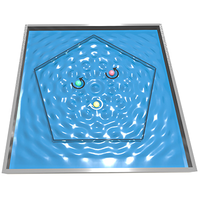
Quasicrystals extend topological concepts beyond periodic systems, but their exploration in mechanical wave systems remains elusive. Here, we experimentally realize two-dimensional quasicrystal water waves with fivefold rotational symmetry via the interference of multiple quasiplane waves. Although topologically indistinguishable in real space, these patterns are uniquely classified by higher-dimensional topological charge vectors that obey an angular-momentum-like conservation law. Using the water-wave amplitude and its in-plane gradient, we construct a synthetic three-dimensional vector field and demonstrate the emergence of skyrmions in water-wave quasicrystals. These skyrmions exhibit dynamically evolving boundaries and orientations, i.e., deformation and propagation due to phasonlike motion during the evolution of the quasicrystal water-wave field. Remarkably, the associated phase singularities can generate forces and torques that stably trap and drive the rotation of floating particles. We demonstrate in experiments the simultaneous manipulation of particles at multiple trapping sites in different ways, opening a path toward programmable control of particle dynamics. By bridging higher-dimensional topology with water-wave quasicrystals and skyrmions, our work not only advances the physics of topological hydrodynamics but also establishes a platform for on-demand particle control in aqueous environments, which is promising for applications in biomedicine, microfluidics, and lab-on-a-chip technologies.
Physics Subject Headings (PhySH)
 synopsis

Quasicrystalline Water Waves
A pattern of surface waves bestowed with fivefold symmetry hosts topological structures.
See more in Physics
Popular Summary
Quasicrystal materials have unlocked new frontiers in topological physics, yet their exploration in classical mechanical wave systems has remained largely uncharted. We experimentally created 2D pentagonal quasicrystal water waves with embedded hydrodynamic skrymions that have dynamically evolving boundaries and orientations. However, their global topological stability remains intact across wave cycles. The phase singularities in the waves generate coherent, location-dependent forces and torques on floating particles. These wave-induced effects stably trap particles, and the local topological structure of the waves drives the particles’ rotation. We demonstrate simultaneous, multiple particle manipulation where floating particles can rotate in the same or opposite direction at different positions. We establish water-wave quasicrystals as a versatile platform for studying topological phenomena in aperiodic matter. This system enables programmable, noninvasive control of floating particles with transformative potential for biomedicine, microfluidics, and lab-on-a-chip technologies, where precise manipulation of cells, microspheres, and biological aggregates in water is critical.
Article Text
Supplemental Material
References (61)
- D. Shechtman, I. Blech, D. Gratias, and J. W. Cahn, Metallic phase with long-range orientational order and no translational symmetry, Phys. Rev. Lett. 53, 1951 (1984).
- W. Man, M. Megens, P. J. Steinhardt, and P. M. Chaikin, Experimental measurement of the photonic properties of icosahedral quasicrystals, Nature (London) 436, 993 (2005).
- A. Ledermann et al., Three-dimensional silicon inverse photonic quasicrystals for infrared wavelengths, Nat. Mater. 5, 942 (2006).
- D. V. Talapin et al., Quasicrystalline order in self-assembled binary nanoparticle superlattices, Nature (London) 461, 964 (2009).
- X. Zeng et al., A columnar liquid quasicrystal with a honeycomb structure that consists of triangular, square and trapezoidal cells, Nat. Chem. 15, 625 (2023).
- W. Gellermann, M. Kohmoto, B. Sutherland, and P. C. Taylor, Localization of light waves in Fibonacci dielectric multilayers, Phys. Rev. Lett. 72, 633 (1994).
- Y. Chan, C. T. Chan, and Z. Y. Liu, Photonic band gaps in two dimensional photonic quasicrystals, Phys. Rev. Lett. 80, 956 (1998).
- M. Zoorob, M. Charlton, G. Parker, J. Baumberg, and M. Netti, Complete photonic bandgaps in 12-fold symmetric quasicrystals, Nature (London) 404, 740 (2000).
- T. Matsui, A. Agrawal, A. Nahata, and Z. V. Vardeny, Transmission resonances through aperiodic arrays of subwavelength apertures, Nature (London) 446, 517 (2007).
- S.-Y. Jeon, H. Kwon, and K. Hur, Intrinsic photonic wave localization in a three-dimensional icosahedral quasicrystal, Nat. Phys. 13, 363 (2017).
- P. Wang et al., Localization and delocalization of light in photonic moiré lattices, Nature (London) 577, 42 (2020).
- S. Vaidya, C. Jörg, K. Linn, M. Goh, and M. C. Rechtsman, Reentrant delocalization transition in one-dimensional photonic quasicrystals, Phys. Rev. Res. 5, 033170 (2023).
- C. Han et al., Observation of dispersive acoustic quasicrystals, Nat. Commun. 16, 1988 (2025).
- G. Xu et al., Hydrodynamic moiré superlattice, Science 386, 1377 (2024).
- H. Huang and F. Liu, Quantum spin Hall effect and spin Bott index in a quasicrystal lattice, Phys. Rev. Lett. 121, 126401 (2018).
- Y. E. Kraus, Y. Lahini, Z. Ringel, M. Verbin, and O. Zilberberg, Topological states and adiabatic pumping in quasicrystals, Phys. Rev. Lett. 109, 106402 (2012).
- Z. Liu et al., Field-tunable valley coupling in a dodecagonal semiconductor quasicrystal, Nat. Phys. 22, 33 (2026).
- A. Shi et al., Observation of topological corner state arrays in photonic quasicrystals, Laser Photonics Rev. 18, 2300956 (2024).
- Y. Nagai, N. Nakai, and M. Machida, Direct numerical demonstration of sign-preserving quasiparticle interference via an impurity inside a vortex core in an unconventional superconductor, Phys. Rev. B 85, 092505 (2012).
- K. Kamiya et al., Discovery of superconductivity in quasicrystal, Nat. Commun. 9, 154 (2018).
- Y. Tokumoto et al., Superconductivity in a van der Waals layered quasicrystal, Nat. Commun. 15, 1529 (2024).
- A. Uri et al., Superconductivity and strong interactions in a tunable moiré quasicrystal, Nature (London) 620, 762 (2023).
- P. Bak, Symmetry, stability, and elastic properties of icosahedral incommensurate crystals, Phys. Rev. B 32, 5764 (1985).
- D. Levine, T. C. Lubensky, S. Ostlund, S. Ramaswamy, P. J. Steinhardt, and J. Toner, Elasticity and dislocations in pentagonal and icosahedral quasicrystals, Phys. Rev. Lett. 54, 1520 (1985).
- J. E. Socolar, T. C. Lubensky, and P. J. Steinhardt, Phonons, phasons, and dislocations in quasicrystals, Phys. Rev. B 34, 3345 (1986).
- Y. E. Kraus, Z. Ringel, and O. Zilberberg, Four-dimensional quantum Hall effect in a two-dimensional quasicrystal, Phys. Rev. Lett. 111, 226401 (2013).
- S. Tsesses et al., Four-dimensional conserved topological charge vectors in plasmonic quasicrystals, Science 387, 644 (2025).
- M. Lohse, C. Schweizer, H. M. Price, O. Zilberberg, and I. Bloch, Exploring 4D quantum Hall physics with a 2D topological charge pump, Nature (London) 553, 55 (2018).
- T. H. R. Skyrme, A unified field theory of mesons and baryons, Nucl. Phys. 31, 556 (1962).
- J. Fukuda and S. Žumer, Quasi-two-dimensional skyrmion lattices in a chiral nematic liquid crystal, Nat. Commun. 2, 246 (2011).
- S. Tsesses et al., Optical skyrmion lattice in evanescent electromagnetic fields, Science 361, 993 (2018).
- T. J. Davis et al., Ultrafast vector imaging of plasmonic skyrmion dynamics with deep subwavelength resolution, Science 368, eaba6415 (2020).
- L. Du, A. Yang, A. V. Zayats, and X. Yuan, Deep-subwavelength features of photonic skyrmions in a confined electromagnetic field with orbital angular momentum, Nat. Phys. 15, 650 (2019).
- H. Ge et al., Observation of acoustic skyrmions, Phys. Rev. Lett. 127, 144502 (2021).
- D. A. Smirnova, F. Nori, and K. Y. Bliokh, Water-wave vortices and skyrmions, Phys. Rev. Lett. 132, 054003 (2024).
- Y. Shen et al., Optical skyrmions and other topological quasiparticles of light, Nat. Photonics 18, 15 (2024).
- B. Wang et al., Topological water-wave structures manipulating particles, Nature (London) 638, 394 (2025).
- J. Wang et al., Dynamic water-wave tweezers, Phys. Rev. Res. 8, L032033 (2026).
- P. Bak, Phenomenological theory of icosahedral incommensurate (‘quasiperiodic’) order in Mn-Al alloys, Phys. Rev. Lett. 54, 1517 (1985).
- K. Y. Bliokh, H. Punzmann, H. Xia, F. Nori, and M. Shats, Field theory spin and momentum in water waves, Sci. Adv. 8, eabm1295 (2022).
- S. Wildeman, Real-time quantitative schlieren imaging by fast Fourier demodulation of a checkered backdrop, Exp. Fluids 59, 97 (2018).
- U. Al Khawaja and H. Stoof, Skyrmions in a ferromagnetic Bose–Einstein condensate, Nature (London) 411, 918 (2001).
- N. Nagaosa and Y. Tokura, Topological properties and dynamics of magnetic skyrmions, Nat. Nanotechnol. 8, 899 (2013).
- A. Fert, N. Reyren, and V. Cros, Magnetic skyrmions: Advances in physics and potential applications, Nat. Rev. Mater. 2, 17031 (2017).
- K. Y. Bliokh et al., Polarization singularities and Möbius strips in sound and water-surface waves, Phys. Fluids 33, 077122 (2021).
- Y. Shen, E. C. Martínez, and C. Rosales-Guzmán, Generation of optical skyrmions with tunable topological textures, ACS Photonics 9, 296 (2022).
- C. Peters, N. Mata-Cervera, P. Ornelas et al., Extracting topological features of skyrmionic light: A tutorial, Adv. Photon. 8, 023001 (2026).
- M. Lin et al., Photonic quasicrystal of spin angular momentum, Sci. Adv. 11, eadv3938 (2025).
- D. G. Grier, A revolution in optical manipulation, Nature (London) 424, 810 (2003).
- D. Gao et al., Optical manipulation from the microscale to the nanoscale: Fundamentals, advances and prospects, Light Sci. Appl. 6, e17039 (2017).
- A. Ozcelik et al., Acoustic tweezers for the life sciences, Nat. Methods 15, 1021 (2018).
- K. Dholakia, B. W. Drinkwater, and M. Ritsch-Marte, Comparing acoustic and optical forces for biomedical research, Nat. Rev. Phys. 2, 480 (2020).
- K. Y. Bliokh and F. Nori, Transverse and longitudinal angular momenta of light, Phys. Rep. 592, 1 (2015).
- K. Y. Bliokh, A. Y. Bekshaev, and F. Nori, Extraordinary momentum and spin in evanescent waves, Nat. Commun. 5, 3300 (2014).
- I. D. Toftul, K. Y. Bliokh, M. I. Petrov, and F. Nori, Acoustic radiation force and torque on small particles as measures of the canonical momentum and spin densities, Phys. Rev. Lett. 123, 183901 (2019).
- See Supplemental Material at http://link.aps.org/supplemental/10.1103/rfgr-n77g for videos showing single-particle trapping and rotation, corotation and counter-rotation of two particles, and simultaneous manipulation of three to five particles in quasicrystal water-wave lattices.
- Chiang C. Mei and L. F. Liu, The damping of surface gravity waves in a bounded liquid, J. Fluid Mech. 59, 239 (1973).
- M. Antuono and A. Colagrossi, The damping of viscous gravity waves, Wave Motion 50, 197 (2013).
- L. Burns, K. Y. Bliokh, F. Nori, and J. Dressel, Acoustic versus electromagnetic field theory: Scalar, vector, spinor representations and the emergence of acoustic spin, New J. Phys. 22, 053050 (2020).
- Y. Meng, Y. Hao, S. Guenneau, S. Wang, and J. Li, Willis coupling in water waves, New J. Phys. 23, 073004 (2021).
- I. Toftul, S. Golat, F. J. Rodriguez-Fortuno, F. Nori, Y. Kivshar, and K. Y. Bliokh, Radiation forces and torques in optics and acoustics, Rev. Mod. Phys. 98, 025002 (2026).

