

- Open Access
Nonmonotonic Band Flattening near the Magic Angle of Twisted Bilayer
Phys. Rev. X 15, 041043 – Published 5 December, 2025
DOI: https://doi.org/10.1103/q11l-9jy1
Abstract
Twisted bilayer () is an emergent platform for exploring exotic quantum phases driven by the interplay between nontrivial band topology and strong electron correlations. Direct experimental access to its momentum-resolved electronic structure is essential for uncovering the microscopic origins of the correlated topological phases therein. Here, we report angle-resolved photoemission spectroscopy measurements of , revealing pronounced twist-angle-dependent band reconstruction shaped by orbital character, interlayer coupling, and moiré potential modulation. Density functional theory captures the qualitative evolution, yet underestimates key energy scales across twist angles, highlighting the importance of electronic correlations. Notably, the hole effective mass at the point exhibits a nonmonotonic dependence on twist angle, peaking near 2°, consistent with band flattening at the magic angle predicted by continuum models. Via electrostatic gating and surface dosing, we further visualize the evolution of electronic structure versus doping, enabling direct observation of the conduction band minimum and confirm as a direct band gap semiconductor. These results establish a spectroscopic foundation for modeling and engineering emergent quantum phases in this moiré platform.
Physics Subject Headings (PhySH)
Popular Summary
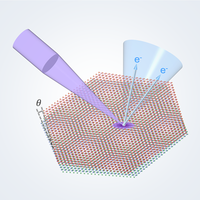
Twisted bilayer () is an emerging platform for exploring exotic quantum phases that arise from the interplay between strong electron interactions and nontrivial band topology. Previous work has mostly relied on transport measurements, leaving open questions about the material’s underlying electronic structure. Here, we use angle-resolved photoemission spectroscopy (ARPES) to directly observe how the electronic bands of change with twist angle and doping.
The energy band shapes shift dramatically as the layers are rotated. In particular, the curvature of the topmost valence band—related to how easily holes can move—changes in a nonmonotonic way: It becomes flattest near a twist angle of 2°, matching predictions of a “magic angle” where electron motion slows and correlations strengthen. Using high-spatial-resolution ARPES measurements, we quantify how this curvature, or “effective mass,” varies with both allowed electron momenta and twist angle. The most pronounced flattening occurs near 2°, particularly in the regions of momentum space that govern transport properties, signaling the strongest localization of electrons and identifying the regime where correlated topological phases are most likely to appear.
We also track how the band structure evolves when extra holes or electrons are added, using both electrostatic gating and potassium dosing. The potassium dosing allows us to see the bottom of the conduction band directly, confirming that is a direct-gap semiconductor with an energy gap of 1.14 eV.
These results provide a detailed spectroscopic view of how twist angle and doping shape the electronic structure of . Our findings establish this system as a tunable platform for engineering interaction-driven quantum phases and motivate future low-temperature ARPES studies to resolve the predicted minibands near the magic angle.
Article Text
Supplemental Material
References (46)
- L. Balents, C. R. Dean, D. K. Efetov, and A. F. Young, Superconductivity and strong correlations in moiré flat bands, Nat. Phys. 16, 725 (2020).
- E. Y. Andrei and A. H. MacDonald, Graphene bilayers with a twist, Nat. Mater. 19, 1265 (2020).
- D. M. Kennes, M. Claassen, L. Xian, A. Georges, A. J. Millis, J. Hone, C. R. Dean, D. N. Basov, A. N. Pasupathy, and A. Rubio, Moiré heterostructures as a condensed-matter quantum simulator, Nat. Phys. 17, 155 (2021).
- E. Y. Andrei, D. K. Efetov, P. Jarillo-Herrero, A. H. MacDonald, K. F. Mak, T. Senthil, E. Tutuc, A. Yazdani, and A. F. Young, The marvels of moiré materials, Nat. Rev. Mater. 6, 201 (2021).
- Y. Cao et al., Correlated insulator behaviour at half-filling in magic-angle graphene superlattices, Nature (London) 556, 80 (2018).
- L. Wang et al., Correlated electronic phases in twisted bilayer transition metal dichalcogenides, Nat. Mater. 19, 861 (2020).
- Y. Cao, V. Fatemi, S. Fang, K. Watanabe, T. Taniguchi, E. Kaxiras, and P. Jarillo-Herrero, Unconventional superconductivity in magic-angle graphene superlattices, Nature (London) 556, 43 (2018).
- Y. Guo et al., Superconductivity in 5.0° twisted bilayer , Nature (London) 637, 839 (2025).
- M. Serlin, C. L. Tschirhart, H. Polshyn, Y. Zhang, J. Zhu, K. Watanabe, T. Taniguchi, L. Balents, and A. F. Young, Intrinsic quantized anomalous Hall effect in a moiré heterostructure, Science 367, 900 (2020).
- J. Cai et al., Signatures of fractional quantum anomalous Hall states in twisted , Nature (London) 622, 63 (2023).
- F. Xu et al., Observation of integer and fractional quantum anomalous Hall effects in twisted bilayer , Phys. Rev. X 13, 031037 (2023).
- K. Kang, B. Shen, Y. Qiu, Y. Zeng, Z. Xia, K. Watanabe, T. Taniguchi, J. Shan, and K. F. Mak, Evidence of the fractional quantum spin Hall effect in moiré , Nature (London) 628, 522 (2024).
- Y. Zeng, Z. Xia, K. Kang, J. Zhu, P. Knüppel, C. Vaswani, K. Watanabe, T. Taniguchi, K. F. Mak, and J. Shan, Thermodynamic evidence of fractional Chern insulator in moiré , Nature (London) 622, 69 (2023).
- H. Park et al., Observation of fractionally quantized anomalous Hall effect, Nature (London) 622, 74 (2023).
- Z. Ji, H. Park, M. E. Barber, C. Hu, K. Watanabe, T. Taniguchi, J.-H. Chu, X. Xu, and Z.-X. Shen, Local probe of bulk and edge states in a fractional Chern insulator, Nature (London) 635, 578 (2024).
- E. Redekop et al., Direct magnetic imaging of fractional Chern insulators in twisted , Nature (London) 635, 584 (2024).
- F. Xu et al., Interplay between topology and correlations in the second moiré band of twisted bilayer , Nat. Phys. 21, 542 (2025).
- H. Park et al., Ferromagnetism and topology of the higher flat band in a fractional Chern insulator, Nat. Phys. 21, 549 (2025).
- C. Wang, X.-W. Zhang, X. Liu, Y. He, X. Xu, Y. Ran, T. Cao, and D. Xiao, Fractional Chern insulator in twisted bilayer , Phys. Rev. Lett. 132, 036501 (2024).
- Y. Jia, J. Yu, J. Liu, J. Herzog-Arbeitman, Z. Qi, H. Pi, N. Regnault, H. Weng, B. A. Bernevig, and Q. Wu, Moiré fractional Chern insulators. I. First-principles calculations and continuum models of twisted bilayer , Phys. Rev. B 109, 205121 (2024).
- W.-X. Qiu, B. Li, X.-J. Luo, and F. Wu, Interaction-driven topological phase diagram of twisted bilayer , Phys. Rev. X 13, 041026 (2023).
- X.-W. Zhang, C. Wang, X. Liu, Y. Fan, T. Cao, and D. Xiao, Polarization-driven band topology evolution in twisted and , Nat. Commun. 15, 4223 (2024).
- N. Mao, C. Xu, J. Li, T. Bao, P. Liu, Y. Xu, C. Felser, L. Fu, and Y. Zhang, Transfer learning relaxation, electronic structure and continuum model for twisted bilayer , Commun. Phys. 7, 262 (2024).
- See Supplemental Material at http://link.aps.org/supplemental/10.1103/q11l-9jy1 for additional ARPES data, AFM cleaning procedures, and detailed DFT and continuum model calculations.
- L. Waldecker et al., Rigid band shifts in two-dimensional semiconductors through external dielectric screening, Phys. Rev. Lett. 123, 206403 (2019).
- F. Wu, T. Lovorn, E. Tutuc, I. Martin, and A. H. MacDonald, Topological insulators in twisted transition metal dichalcogenide homobilayers, Phys. Rev. Lett. 122, 086402 (2019).
- W. Zhao et al., Synthesis and electronic structure of atomically thin 2H-, Nanoscale 17, 10901 (2025).
- Y. Liu et al., Imaging moiré flat bands and wigner molecular crystals in twisted bilayer , arXiv:2406.19310.
- C. Sahoo et al., Quasiparticle gap renormalization driven by internal and external screening in a device, Phys. Rev. Lett. 135, 056401 (2025).
- P. V. Nguyen et al., Visualizing electrostatic gating effects in two-dimensional heterostructures, Nature (London) 572, 220 (2019).
- C. Ruppert, B. Aslan, and T. F. Heinz, Optical properties and band gap of single- and few-layer crystals, Nano Lett. 14, 6231 (2014).
- I. G. Lezama, A. Arora, A. Ubaldini, C. Barreteau, E. Giannini, M. Potemski, and A. F. Morpurgo, Indirect-to-direct band gap crossover in few-layer , Nano Lett. 15, 2336 (2015).
- F. Wu, T. Lovorn, E. Tutuc, and A. H. MacDonald, Hubbard model physics in transition metal dichalcogenide moiré bands, Phys. Rev. Lett. 121, 026402 (2018).
- M. Angeli and A. H. MacDonald, valley transition metal dichalcogenide moiré bands, Proc. Natl. Acad. Sci. U.S.A. 118, e2021826118 (2021).
- C. Chen et al., Visualizing electronic structure of twisted bilayer in devices, arXiv:2509.09080.
- Y. Deng et al., Dataset for nonmonotonic band flattening near the magic angle of twisted bilayer , Zenodo (2025), 10.5281/zenodo.17504164.
- H. Kim et al., Imaging inter-valley coherent order in magic-angle twisted trilayer graphene, Nature (London) 623, 942 (2023).
- K. Kim et al., van der Waals heterostructures with high accuracy rotational alignment, Nano Lett. 16, 1989 (2016).
- S. Xie et al., Strong interlayer interactions in bilayer and trilayer moiré superlattices, Sci. Adv. 8, eabk1911 (2022).
- G. Kresse and J. Hafner, Ab initio molecular dynamics for liquid metals, Phys. Rev. B 47, 558 (1993).
- G. Kresse and J. Furthmüller, Efficient iterative schemes for ab initio total-energy calculations using a plane-wave basis set, Phys. Rev. B 54, 11169 (1996).
- S. Grimme, Semiempirical GGA-type density functional constructed with a long-range dispersion correction, J. Comput. Chem. 27, 1787 (2006).
- K. Lee, É. D. Murray, L. Kong, B. I. Lundqvist, and D. C. Langreth, Higher-accuracy van der Waals density functional, Phys. Rev. B 82, 081101(R) (2010).
- D. Chakraborty, K. Berland, and T. Thonhauser, Next-generation nonlocal van der Waals density functional, J. Chem. Theory Comput. 16, 5893 (2020).
- H. Peng, Z.-H. Yang, J. P. Perdew, and J. Sun, Versatile van der Waals density functional based on a meta-generalized gradient approximation, Phys. Rev. X 6, 041005 (2016).
- J. Ning, M. Kothakonda, J. W. Furness, A. D. Kaplan, S. Ehlert, J. G. Brandenburg, J. P. Perdew, and J. Sun, Workhorse minimally empirical dispersion-corrected density functional with tests for weakly bound systems: , Phys. Rev. B 106, 075422 (2022).

