

- Open Access
Unified Description of Cuprate Superconductors by Fractionalized Electrons Emerging from Integrated Analyses of Photoemission Spectra and Quasiparticle Interference
Phys. Rev. X 16, 011018 – Published 4 February, 2026
DOI: https://doi.org/10.1103/mww7-32gn
Abstract
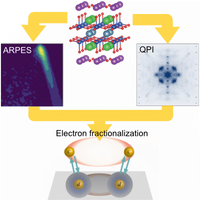
Electronic structure of high-temperature superconducting cuprates is studied by analyzing experimental data independently obtained from two complementary spectroscopies: one, quasiparticle interference (QPI) measured by scanning-tunneling microscopy, and the other, angle-resolved photoemission spectroscopy (ARPES). We combine these two sets of data in a unified theoretical analysis. Through explicit calculations of experimentally measurable quantities, we show that a simple two-component fermion model (TCFM) representing electron fractionalization succeeds in reproducing various detailed features of these experimental data: ARPES and QPI data are concomitantly reproduced by the TCFM in full energy and momentum spaces. The measured QPI pattern reveals a signature characteristic of the TCFM, distinct from the conventional single-component prediction, supporting the validity of the electron fractionalization in the cuprates. The integrated analysis also solves the puzzles of ARPES and QPI data that are seemingly inconsistent with each other. The overall success of the TCFM offers a comprehensive understanding of the electronic structure of the cuprates, in particular, the unoccupied side of the spectra, of which momentum-resolved structure has long been unexplored experimentally. We further predict that a characteristic QPI pattern should appear in the unoccupied high-energy part if the fractionalization is at work. We propose that integrated-spectroscopy analyses offer a promising way to explore challenging issues of strongly correlated electron systems.
Physics Subject Headings (PhySH)
- Electrical properties
- Electron-mediated pairing
- Electronic structure
- Fractionalization
- Impurities in superconductors
- Pairing mechanisms
- Pseudogap
- Quasiparticles & collective excitations
- Superconducting gap
- Superconductivity
- High-temperature superconductors
- Strongly correlated systems
- Angle-resolved photoemission spectroscopy
- Green's function methods
- Lattice models in condensed matter
- Scanning tunneling microscopy
- Scanning tunneling spectroscopy
Popular Summary
Unresolved questions surrounding the mechanism of high-temperature superconductivity in cuprates frequently persist because data from various spectroscopic tools are usually analyzed independently, using sometimes conflicting theories. We addressed this challenge by performing integrated analyses of angle-resolved photoemission spectroscopy and scanning-tunneling microscopy data within a single, unified theoretical framework. By comparing raw experimental data directly with calculated measurable quantities rather than conventional theoretical replacements, we demonstrated that a model incorporating electron fractionalization quantitatively explains both sets of measurements. Our findings are supported by a specific signal in the quasiparticle interference phase-reference map that confirms the reality of fractionalized electrons in these materials. This success suggests that wider integrated analyses incorporating data from other complementary probes, such as neutron scattering, x-ray scattering, and optics, will provide a new avenue for resolving the long-standing mysteries of strongly correlated electron systems.
Article Text
Supplemental Material
References (128)
- J. G. Bednorz and K. A. Müller, Possible high superconductivity in the system, Z. Phys. B Condens. Matter 64, 189 (1986).
- B. Keimer, S. A. Kivelson, M. R. Norman, S. Uchida, and J. Zaanen, From quantum matter to high-temperature superconductivity in copper oxides, Nature (London) 518, 179 (2015).
- A. Damascelli, Z. Hussain, and Z.-X. Shen, Angle-resolved photoemission studies of the cuprate superconductors, Rev. Mod. Phys. 75, 473 (2003).
- J. A. Sobota, Y. He, and Z.-X. Shen, Angle-resolved photoemission studies of quantum materials, Rev. Mod. Phys. 93, 025006 (2021).
- Ø. Fischer, M. Kugler, I. Maggio-Aprile, C. Berthod, and C. Renner, Scanning tunneling spectroscopy of high-temperature superconductors, Rev. Mod. Phys. 79, 353 (2007).
- Y. Hasegawa and P. Avouris, Direct observation of standing wave formation at surface steps using scanning tunneling spectroscopy, Phys. Rev. Lett. 71, 1071 (1993).
- M. F. Crommie, C. P. Lutz, and D. M. Eigler, Imaging standing waves in a two-dimensional electron gas, Nature (London) 363, 524 (1993).
- J. E. Hoffman, K. McElroy, D.-H. Lee, K. M. Lang, H. Eisaki, S. Uchida, and J. C. Davis, Imaging quasiparticle interference in , Science 297, 1148 (2002).
- K. McElroy, R. W. Simmonds, J. E. Hoffman, D.-H. Lee, J. Orenstein, H. Eisaki, S. Uchida, and J. C. Davis, Relating atomic-scale electronic phenomena to wave-like quasiparticle states in superconducting , Nature (London) 422, 592 (2003).
- T. Hanaguri, C. Lupien, Y. Kohsaka, D.-H. Lee, M. Azuma, M. Takano, H. Takagi, and J. C. Davis, A ‘checkerboard’ electronic crystal state in lightly hole-doped , Nature (London) 430, 1001 (2004).
- T. Hanaguri, Y. Kohsaka, J. C. Davis, C. Lupien, I. Yamada, M. Azuma, M. Takano, K. Ohishi, M. Ono, and H. Takagi, Quasiparticle interference and superconducting gap in , Nat. Phys. 3, 865 (2007).
- Y. Kohsaka, C. Taylor, P. Wahl, A. Schmidt, J. Lee, K. Fujita, J. W. Alldredge, K. McElroy, J. Lee, H. Eisaki, S. Uchida, D.-H. Lee, and J. C. Davis, How Cooper pairs vanish approaching the Mott insulator in , Nature (London) 454, 1072 (2008).
- J. Lee, K. Fujita, A. R. Schmidt, C. K. Kim, H. Eisaki, S. Uchida, and J. C. Davis, Spectroscopic fingerprint of phase-incoherent superconductivity in the underdoped , Science 325, 1099 (2009).
- J. W. Alldredge, K. Fujita, H. Eisaki, S. Uchida, and K. McElroy, Three-component electronic structure of the cuprates derived from spectroscopic-imaging scanning tunneling microscopy, Phys. Rev. B 85, 174501 (2012).
- Y. He, Y. Yin, M. Zech, A. Soumyanarayanan, M. M. Yee, T. Williams, M. C. Boyer, K. Chatterjee, W. D. Wise, I. Zeljkovic, T. Kondo, T. Takeuchi, H. Ikuta, P. Mistark, R. S. Markiewicz, A. Bansil, S. Sachdev, E. W. Hudson, and J. E. Hoffman, Fermi surface and pseudogap evolution in a cuprate superconductor, Science 344, 608 (2014).
- K. Fujita, C. K. Kim, I. Lee, J. Lee, M. H. Hamidian, I. A. Firmo, S. Mukhopadhyay, H. Eisaki, S. Uchida, M. J. Lawler, E.-A. Kim, and J. C. Davis, Simultaneous transitions in cuprate momentum-space topology and electronic symmetry breaking, Science 344, 612 (2014).
- T. Machida, Y. Kohsaka, K. Matsuoka, K. Iwaya, T. Hanaguri, and T. Tamegai, Bipartite electronic superstructures in the vortex core of , Nat. Commun. 7, 11747 (2016).
- Q. Gu, S. Wan, Q. Tang, Z. Du, H. Yang, Q.-H. Wang, R. Zhong, J. Wen, G. D. Gu, and H.-H. Wen, Directly visualizing the sign change of d-wave superconducting gap in by phase-referenced quasiparticle interference, Nat. Commun. 10, 1603 (2019).
- Y. Yu, L. Ma, P. Cai, R. Zhong, C. Ye, J. Shen, G. D. Gu, X. H. Chen, and Y. Zhang, High-temperature superconductivity in monolayer , Nature (London) 575, 156 (2019).
- H. Ding, T. Yokoya, J. C. Campuzano, T. Takahashi, M. Randeria, M. R. Norman, T. Mochiku, K. Kadowaki, and J. Giapintzakis, Spectroscopic evidence for a pseudogap in the normal state of underdoped high- superconductors, Nature (London) 382, 51 (1996).
- Z.-X. Shen, D. S. Dessau, B. O. Wells, D. M. King, W. E. Spicer, A. J. Arko, D. Marshall, L. W. Lombardo, A. Kapitulnik, P. Dickinson, S. Doniach, J. DiCarlo, T. Loeser, and C. H. Park, Anomalously large gap anisotropy in the plane of , Phys. Rev. Lett. 70, 1553 (1993).
- M. R. Norman, H. Ding, M. Randeria, J. C. Campuzano, T. Yokoya, T. Takeuchi, T. Takahashi, T. Mochiku, K. Kadowaki, P. Guptasarma, and D. G. Hinks, Destruction of the Fermi surface in underdoped high- superconductors, Nature (London) 392, 157 (1998).
- K. M. Shen, F. Ronning, D. H. Lu, F. Baumberger, N. J. C. Ingle, W. S. Lee, W. Meevasana, Y. Kohsaka, M. Azuma, M. Takano, H. Takagi, and Z.-X. Shen, Nodal quasiparticles and antinodal charge ordering in , Science 307, 901 (2005).
- T. Kondo, R. Khasanov, T. Takeuchi, J. Schmalian, and A. Kaminski, Competition between the pseudogap and superconductivity in the high- copper oxides, Nature (London) 457, 296 (2009).
- T. Kondo, A. D. Palczewski, Y. Hamaya, T. Takeuchi, J. S. Wen, Z. J. Xu, G. Gu, and A. Kaminski, Formation of gapless Fermi arcs and fingerprints of order in the pseudogap state of cuprate superconductors, Phys. Rev. Lett. 111, 157003 (2013).
- K. Tanaka, W. S. Lee, D. H. Lu, A. Fujimori, T. Fujii, null Risdiana, I. Terasaki, D. J. Scalapino, T. P. Devereaux, Z. Hussain, and Z.-X. Shen, Distinct Fermi-momentum-dependent energy gaps in deeply underdoped , Science 314, 1910 (2006).
- T. Kondo, T. Takeuchi, A. Kaminski, S. Tsuda, and S. Shin, Evidence for two energy scales in the superconducting state of optimally doped , Phys. Rev. Lett. 98, 267004 (2007).
- S. H. Pan, J. P. O’Neal, R. L. Badzey, C. Chamon, H. Ding, J. R. Engelbrecht, Z. Wang, H. Eisaki, S. Uchida, A. K. Guptak, K.-W. Ngk, E. W. Hudson, K. M. Lang, and J. C. Davis, Microscopic electronic inhomogeneity in the high- superconductor , Nature (London) 413, 282 (2001).
- Y. Kohsaka, C. Taylor, K. Fujita, A. Schmidt, C. Lupien, T. Hanaguri, M. Azuma, M. Takano, H. Eisaki, H. Takagi, U. S., and J. C. Davis, An intrinsic bond-centered electronic glass with unidirectional domains in underdoped cuprates, Science 315, 1380 (2007).
- R. S. Markiewicz, Bridging and space in the cuprates: Comparing angle-resolved photoemission and STM results, Phys. Rev. B 69, 214517 (2004).
- M. Cheng and W. P. Su, Local density of states and angle-resolved photoemission spectral function of an inhomogeneous -wave superconductor, Phys. Rev. B 72, 094512 (2005).
- K. McElroy, G.-H. Gweon, S. Y. Zhou, J. Graf, S. Uchida, H. Eisaki, H. Takagi, T. Sasagawa, D.-H. Lee, and A. Lanzara, Elastic scattering susceptibility of the high temperature superconductor : A comparison between real and momentum space photoemission spectroscopies, Phys. Rev. Lett. 96, 067005 (2006).
- U. Chatterjee, M. Shi, A. Kaminski, A. Kanigel, H. M. Fretwell, K. Terashima, T. Takahashi, S. Rosenkranz, Z. Z. Li, H. Raffy, A. Santander-Syro, K. Kadowaki, M. R. Norman, M. Randeria, and J. C. Campuzano, Nondispersive Fermi arcs and the absence of charge ordering in the pseudogap phase of , Phys. Rev. Lett. 96, 107006 (2006).
- K. Fujita, I. Drozdov, Z. Du, H. Li, S.-H. Joo, J. Lee, G. Gu, P. D. Johnson, and T. Valla, Combined spectroscopic imaging STM and ARPES study of different gaps measured in the cuprate phase diagram, Phys. Rev. B 101, 045136 (2020).
- I. M. Vishik, E. A. Nowadnick, W. S. Lee, Z. X. Shen, B. Moritz, T. P. Devereaux, K. Tanaka, T. Sasagawa, and T. Fujii, A momentum-dependent perspective on quasiparticle interference in , Nat. Phys. 5, 718 (2009).
- S. Sakai, M. Civelli, and M. Imada, Hidden fermionic excitation boosting high-temperature superconductivity in cuprates, Phys. Rev. Lett. 116, 057003 (2016).
- S. Sakai, M. Civelli, and M. Imada, Hidden-fermion representation of self-energy in pseudogap and superconducting states of the two-dimensional Hubbard model, Phys. Rev. B 94, 115130 (2016).
- S.-i. Tomonaga, Remarks on Bloch’s method of sound waves applied to many-fermion problems, Prog. Theor. Phys. 5, 544 (1950).
- J. M. Luttinger, An exactly soluble model of a many-fermion system, J. Math. Phys. (N.Y.) 4, 1154 (1963).
- A. J. Heeger, S. Kivelson, J. R. Schrieffer, and W. P. Su, Solitons in conducting polymers, Rev. Mod. Phys. 60, 781 (1988).
- R. B. Laughlin, Anomalous quantum Hall effect: An incompressible quantum fluid with fractionally charged excitations, Phys. Rev. Lett. 50, 1395 (1983).
- S. Sachdev, Understanding correlated electron systems by a classification of Mott insulators, Ann. Phys. (Amsterdam) 303, 226 (2003).
- G. Kotliar and A. E. Ruckenstein, New functional integral approach to strongly correlated Fermi systems: The Gutzwiller approximation as a saddle point, Phys. Rev. Lett. 57, 1362 (1986).
- G. Kotliar, S. Y. Savrasov, G. Pálsson, and G. Biroli, Cellular dynamical mean field approach to strongly correlated systems, Phys. Rev. Lett. 87, 186401 (2001).
- T. Maier, M. Jarrell, T. Pruschke, and M. H. Hettler, Quantum cluster theories, Rev. Mod. Phys. 77, 1027 (2005).
- W. Metzner and D. Vollhardt, Correlated lattice fermions in dimensions, Phys. Rev. Lett. 62, 324 (1989).
- A. Georges, G. Kotliar, W. Krauth, and M. J. Rozenberg, Dynamical mean-field theory of strongly correlated fermion systems and the limit of infinite dimensions, Rev. Mod. Phys. 68, 13 (1996).
- C. Huscroft, M. Jarrell, T. Maier, S. Moukouri, and A. N. Tahvildarzadeh, Pseudogaps in the 2D Hubbard model, Phys. Rev. Lett. 86, 139 (2001).
- T. A. Maier, T. Pruschke, and M. Jarrell, Angle-resolved photoemission spectra of the Hubbard model, Phys. Rev. B 66, 075102 (2002).
- D. Sénéchal and A.-M. S. Tremblay, Hot spots and pseudogaps for hole- and electron-doped high-temperature superconductors, Phys. Rev. Lett. 92, 126401 (2004).
- M. Civelli, M. Capone, S. S. Kancharla, O. Parcollet, and G. Kotliar, Dynamical breakup of the Fermi surface in a doped Mott insulator, Phys. Rev. Lett. 95, 106402 (2005).
- D. Sénéchal, P.-L. Lavertu, M.-A. Marois, and A.-M. S. Tremblay, Competition between antiferromagnetism and superconductivity in high- cuprates, Phys. Rev. Lett. 94, 156404 (2005).
- B. Kyung, S. S. Kancharla, D. Sénéchal, A.-M. S. Tremblay, M. Civelli, and G. Kotliar, Pseudogap induced by short-range spin correlations in a doped Mott insulator, Phys. Rev. B 73, 165114 (2006).
- M. Aichhorn, E. Arrigoni, Z. B. Huang, and W. Hanke, Superconducting gap in the Hubbard model and the two-gap energy scales of high- cuprate superconductors, Phys. Rev. Lett. 99, 257002 (2007).
- S. S. Kancharla, B. Kyung, D. Sénéchal, M. Civelli, M. Capone, G. Kotliar, and A.-M. S. Tremblay, Anomalous superconductivity and its competition with antiferromagnetism in doped Mott insulators, Phys. Rev. B 77, 184516 (2008).
- M. Civelli, M. Capone, A. Georges, K. Haule, O. Parcollet, T. D. Stanescu, and G. Kotliar, Nodal-antinodal dichotomy and the two gaps of a superconducting doped Mott insulator, Phys. Rev. Lett. 100, 046402 (2008).
- A. Liebsch and N.-H. Tong, Finite-temperature exact diagonalization cluster dynamical mean-field study of the two-dimensional Hubbard model: Pseudogap, non-Fermi-liquid behavior, and particle-hole asymmetry, Phys. Rev. B 80, 165126 (2009).
- S. Okamoto, D. Sénéchal, M. Civelli, and A.-M. S. Tremblay, Dynamical electronic nematicity from Mott physics, Phys. Rev. B 82, 180511 (2010).
- K.-S. Chen, Z. Y. Meng, T. Pruschke, J. Moreno, and M. Jarrell, Lifshitz transition in the two-dimensional Hubbard model, Phys. Rev. B 86, 165136 (2012).
- E. Gull, O. Parcollet, and A. J. Millis, Superconductivity and the pseudogap in the two-dimensional Hubbard model, Phys. Rev. Lett. 110, 216405 (2013).
- M. Kohno, Spectral properties near the Mott transition in the two-dimensional Hubbard model with next-nearest-neighbor hopping, Phys. Rev. B 90, 035111 (2014).
- N. Lin, E. Gull, and A. J. Millis, Two-particle response in cluster dynamical mean-field theory: Formalism and application to the Raman response of high-temperature superconductors, Phys. Rev. Lett. 109, 106401 (2012).
- S. Sakai, S. Blanc, M. Civelli, Y. Gallais, M. Cazayous, M.-A. Méasson, J. S. Wen, Z. J. Xu, G. D. Gu, G. Sangiovanni, Y. Motome, K. Held, A. Sacuto, A. Georges, and M. Imada, Raman-scattering measurements and theory of the energy-momentum spectrum for underdoped superconductors: Evidence of an -wave structure for the pseudogap, Phys. Rev. Lett. 111, 107001 (2013).
- B. Loret, S. Sakai, Y. Gallais, M. Cazayous, M.-A. Méasson, A. Forget, D. Colson, M. Civelli, and A. Sacuto, Unconventional high-energy-state contribution to the Cooper pairing in the underdoped copper-oxide superconductor , Phys. Rev. Lett. 116, 197001 (2016).
- B. Loret, S. Sakai, S. Benhabib, Y. Gallais, M. Cazayous, M. A. Méasson, R. D. Zhong, J. Schneeloch, G. D. Gu, A. Forget, D. Colson, I. Paul, M. Civelli, and A. Sacuto, Vertical temperature boundary of the pseudogap under the superconducting dome in the phase diagram of , Phys. Rev. B 96, 094525 (2017).
- N. Lin, E. Gull, and A. J. Millis, Optical conductivity from cluster dynamical mean-field theory: Formalism and application to high-temperature superconductors, Phys. Rev. B 80, 161105 (2009).
- M. Ferrero, O. Parcollet, A. Georges, G. Kotliar, and D. N. Basov, Interplane charge dynamics in a valence-bond dynamical mean-field theory of cuprate superconductors, Phys. Rev. B 82, 054502 (2010).
- M. Ferrero, P. S. Cornaglia, L. De Leo, O. Parcollet, G. Kotliar, and A. Georges, Pseudogap opening and formation of Fermi arcs as an orbital-selective Mott transition in momentum space, Phys. Rev. B 80, 064501 (2009).
- S. Sakai, Y. Motome, and M. Imada, Doped high- cuprate superconductors elucidated in the light of zeros and poles of the electronic Green’s function, Phys. Rev. B 82, 134505 (2010).
- G. Sordi, P. Sémon, K. Haule, and A.-M. S. Tremblay, Strong coupling superconductivity, pseudogap, and Mott transition, Phys. Rev. Lett. 108, 216401 (2012).
- T. D. Stanescu and G. Kotliar, Fermi arcs and hidden zeros of the Green function in the pseudogap state, Phys. Rev. B 74, 125110 (2006).
- M. Civelli, Evolution of the dynamical pairing across the phase diagram of a strongly correlated high-temperature superconductor, Phys. Rev. Lett. 103, 136402 (2009).
- B. Kyung, D. Sénéchal, and A.-M. S. Tremblay, Pairing dynamics in strongly correlated superconductivity, Phys. Rev. B 80, 205109 (2009).
- S. Sakai, Y. Motome, and M. Imada, Evolution of electronic structure of doped Mott insulators: Reconstruction of poles and zeros of Green’s function, Phys. Rev. Lett. 102, 056404 (2009).
- E. Gull and A. J. Millis, Quasiparticle properties of the superconducting state of the two-dimensional Hubbard model, Phys. Rev. B 91, 085116 (2015).
- S. Sakai, M. Civelli, and M. Imada, Direct connection between Mott insulators and -wave high-temperature superconductors revealed by continuous evolution of self-energy poles, Phys. Rev. B 98, 195109 (2018).
- M. Imada, Fermi machine—Quantum many-body solver derived from correspondence between noninteracting and strongly correlated fermions, J. Phys. Soc. Jpn. 93, 104002 (2024).
- S. Sakai, Nonperturbative calculations for spectroscopic properties of cuprate high-temperature superconductors, J. Phys. Soc. Jpn. 92, 092001 (2023).
- Y. Yamaji, T. Yoshida, A. Fujimori, and M. Imada, Hidden self-energies as origin of cuprate superconductivity revealed by machine learning, Phys. Rev. Res. 3, 043099 (2021).
- M. Imada, Resonant inelastic x-ray scattering spectra of cuprate superconductors predicted by model of fractionalized fermions, J. Phys. Soc. Jpn. 90, 074702 (2021).
- A. Singh, H. Y. Huang, J. D. Xie, J. Okamoto, C. T. Chen, T. Watanabe, A. Fujimori, M. Imada, and D. J. Huang, Unconventional exciton evolution from the pseudogap to superconducting phases in cuprates, Nat. Commun. 13, 7906 (2022).
- N. Lanatà, T.-H. Lee, Y.-X. Yao, and V. Dobrosavljević, Emergent Bloch excitations in Mott matter, Phys. Rev. B 96, 195126 (2017).
- Y.-H. Zhang and S. Sachdev, From the pseudogap metal to the Fermi liquid using ancilla qubits, Phys. Rev. Res. 2, 023172 (2020).
- M. Imada and T. J. Suzuki, Excitons and dark fermions as origins of Mott gap, pseudogap and superconductivity in cuprate superconductors—General concept and basic formalism based on gap physics, J. Phys. Soc. Jpn. 88, 024701 (2019).
- M. T. Schmid, J.-B. Morée, R. Kaneko, Y. Yamaji, and M. Imada, Superconductivity studied by solving ab initio low-energy effective Hamiltonians for carrier doped , , , and , Phys. Rev. X 13, 041036 (2023).
- A. D. Palczewski, T. Kondo, J. S. Wen, G. Z. J. Xu, G. Gu, and A. Kaminski, Controlling the carrier concentration of the high-temperature superconductor in angle-resolved photoemission spectroscopy experiments, Phys. Rev. B 81, 104521 (2010).
- Y. Yamaji and M. Imada, Composite fermion theory for pseudogap phenomena and superconductivity in underdoped cuprate superconductors, Phys. Rev. B 83, 214522 (2011).
- Y. Yamaji and M. Imada, Composite-fermion theory for pseudogap, Fermi arc, hole pocket, and non-Fermi liquid of underdoped cuprate superconductors, Phys. Rev. Lett. 106, 016404 (2011).
- J.-B. Morée, M. Hirayama, M. T. Schmid, Y. Yamaji, and M. Imada, Ab initio low-energy effective Hamiltonians for the high-temperature superconducting cuprates , , , and , Phys. Rev. B 106, 235150 (2022).
- C. M. Varma, P. B. Littlewood, S. Schmitt-Rink, E. Abrahams, and A. E. Ruckenstein, Phenomenology of the normal state of high-temperature superconductors, Phys. Rev. Lett. 63, 1996 (1989).
- S. Sachdev, Holographic metals and the fractionalized Fermi liquid, Phys. Rev. Lett. 105, 151602 (2010).
- J. Zaanen, Planckian dissipation, minimal viscosity and the transport in cuprate strange metals, SciPost Phys. 6, 061 (2019).
- J. P. Carbotte, T. Timusk, and J. Hwang, Bosons in high-temperature superconductors: An experimental survey, Rep. Prog. Phys. 74, 066501 (2011).
- M. R. Norman, M. Randeria, H. Ding, and J. C. Campuzano, Phenomenological models for the gap anisotropy of as measured by angle-resolved photoemission spectroscopy, Phys. Rev. B 52, 615 (1995).
- H. Li, X. Zhou, S. Parham, T. J. Reber, H. Berger, G. B. Arnold, and D. S. Dessau, Coherent organization of electronic correlations as a mechanism to enhance and stabilize high- cuprate superconductivity, Nat. Commun. 9, 26 (2018).
- A. Kaminski, M. Randeria, J. C. Campuzano, M. R. Norman, H. Fretwell, J. Mesot, T. Sato, T. Takahashi, and K. Kadowaki, Renormalization of spectral line shape and dispersion below in , Phys. Rev. Lett. 86, 1070 (2001).
- Q. Liu, X.-L. Qi, and S.-C. Zhang, Stationary phase approximation approach to the quasiparticle interference on the surface of a strong topological insulator, Phys. Rev. B 85, 125314 (2012).
- Y. Kohsaka (unpublished).
- L. Dell’Anna, J. Lorenzana, M. Capone, C. Castellani, and M. Grilli, Effect of mesoscopic inhomogeneities on local tunneling density of states in cuprates, Phys. Rev. B 71, 064518 (2005).
- T. Tohyama, Asymmetry of the electronic states in hole- and electron-doped cuprates: Exact diagonalization study of the model, Phys. Rev. B 70, 174517 (2004).
- S. Chi, W. N. Hardy, R. Liang, P. Dosanjh, P. Wahl, S. A. Burke, and D. A. Bonn, Extracting phase information about the superconducting order parameter from defect bound states, arXiv:1710.09088.
- S. Chi, W. N. Hardy, R. Liang, P. Dosanjh, P. Wahl, S. A. Burke, and D. A. Bonn, Determination of the superconducting order parameter from defect bound state quasiparticle interference, arXiv:1710.09089.
- See Supplemental Material at http://link.aps.org/supplemental/10.1103/mww7-32gn for additional calculated results and their comparison with experimental ARPES and QPI data.
- S. Smit, E. Mauri, L. Bawden, F. Heringa, F. Gerritsen, E. van Heumen, Y. K. Huang, T. Kondo, T. Takeuchi, N. E. Hussey, M. Allan, T. K. Kim, C. Cacho, A. Krikun, K. Schalm, H. T. C. Stoof, and M. S. Golden, Momentum-dependent scaling exponents of nodal self-energies measured in strange metal cuprates and modelled using semi-holography, Nat. Commun. 15, 4581 (2024).
- J. M. Bok, J. H. Yun, H.-Y. Choi, W. Zhang, X. J. Zhou, and C. M. Varma, Momentum dependence of the single-particle self-energy and fluctuation spectrum of slightly underdoped from high-resolution laser angle-resolved photoemission, Phys. Rev. B 81, 174516 (2010).
- J. R. Schrieffer, D. J. Scalapino, and J. W. Wilkins, Effective tunneling density of states in superconductors, Phys. Rev. Lett. 10, 336 (1963).
- D. J. Scalapino, J. R. Schrieffer, and J. W. Wilkins, Strong-coupling superconductivity. I, Phys. Rev. 148, 263 (1966).
- A. V. Chubukov and J. Schmalian, Pairing glue in cuprate superconductors from the self-energy revealed via machine learning, Phys. Rev. B 101, 180510 (2020).
- Y. Pavlyukh, A.-M. Uimonen, G. Stefanucci, and R. van Leeuwen, Vertex corrections for positive-definite spectral functions of simple metals, Phys. Rev. Lett. 117, 206402 (2016).
- A. Macridin, M. Jarrell, T. Maier, and D. J. Scalapino, High-energy kink in the single-particle spectra of the two-dimensional Hubbard model, Phys. Rev. Lett. 99, 237001 (2007).
- M. Charlebois and M. Imada, Single-particle spectral function formulated and calculated by variational Monte Carlo method with application to -wave superconducting state, Phys. Rev. X 10, 041023 (2020).
- Z. Li, M. Wu, Y.-H. Chan, and S. G. Louie, Unmasking the origin of kinks in the photoemission spectra of cuprate superconductors, Phys. Rev. Lett. 126, 146401 (2021).
- Q.-H. Wang and D.-H. Lee, Quasiparticle scattering interference in high-temperature superconductors, Phys. Rev. B 67, 020511 (2003).
- P. Choubey, T. Berlijn, A. Kreisel, C. Cao, and P. J. Hirschfeld, Visualization of atomic-scale phenomena in superconductors: Application to , Phys. Rev. B 90, 134520 (2014).
- A. Kreisel, P. Choubey, T. Berlijn, W. Ku, B. M. Andersen, and P. J. Hirschfeld, Interpretation of scanning tunneling quasiparticle interference and impurity states in cuprates, Phys. Rev. Lett. 114, 217002 (2015).
- E. Dalla Torre, Y. He, and E. Demler, Holographic maps of quasiparticle interference, Nat. Phys. 12, 1052 (2016).
- P. Choubey, A. Kreisel, T. Berlijn, B. M. Andersen, and P. J. Hirschfeld, Universality of scanning tunneling microscopy in cuprate superconductors, Phys. Rev. B 96, 174523 (2017).
- B. M. Andersen and P. Hedegård, Quantum interference between multiple impurities in anisotropic superconductors, Phys. Rev. B 67, 172505 (2003).
- L. Capriotti, D. J. Scalapino, and R. D. Sedgewick, Wave-vector power spectrum of the local tunneling density of states: Ripples in a -wave sea, Phys. Rev. B 68, 014508 (2003).
- T. Pereg-Barnea and M. Franz, Theory of quasiparticle interference patterns in the pseudogap phase of the cuprate superconductors, Phys. Rev. B 68, 180506 (2003).
- D. Zhang and C. S. Ting, Energy-dependent modulations in the local density of states of the cuprate superconductors, Phys. Rev. B 67, 100506 (2003).
- J. Böker, M. A. Sulangi, A. Akbari, J. C. S. Davis, P. J. Hirschfeld, and I. M. Eremin, Phase-sensitive determination of nodal -wave order parameter in single-band and multiband superconductors, Phys. Rev. B 101, 214505 (2020).
- L. Zhu, W. A. Atkinson, and P. J. Hirschfeld, Power spectrum of many impurities in a -wave superconductor, Phys. Rev. B 69, 060503 (2004).
- T. S. Nunner, W. Chen, B. M. Andersen, A. Melikyan, and P. J. Hirschfeld, Fourier transform spectroscopy of -wave quasiparticles in the presence of atomic scale pairing disorder, Phys. Rev. B 73, 104511 (2006).
- T. S. Nunner, B. M. Andersen, A. Melikyan, and P. J. Hirschfeld, Dopant-modulated pair interaction in cuprate superconductors, Phys. Rev. Lett. 95, 177003 (2005).
- M. A. Sulangi, M. P. Allan, and J. Zaanen, Revisiting quasiparticle scattering interference in high-temperature superconductors: The problem of narrow peaks, Phys. Rev. B 96, 134507 (2017).
- A. P. Kampf and T. P. Devereaux, Extended impurity potential in a superconductor, Phys. Rev. B 56, 2360 (1997).
- I. Vekhter and C. M. Varma, Proposal to determine the spectrum of pairing glue in high-temperature superconductors, Phys. Rev. Lett. 90, 237003 (2003).

