

- Open Access
Competing Electronic Ground States in the Heavy-Fermion Superconductor
Phys. Rev. X 15, 041057 – Published 29 December, 2025
DOI: https://doi.org/10.1103/m44c-tzrj
Abstract
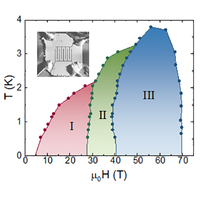
is rare among superconductors, in that the magnetic field tunes it between two distinct superconducting phases. Combined with a lack of local inversion symmetry and an upper critical field exceeding the Pauli paramagnetic limit, this excitingly suggests triplet multicomponent superconductivity. Preceding the superconducting onset, -electron correlations cause long-range order, attributed both to local antiferromagnetism and itinerant (quadrupole) density waves. A magnetic field provides a significant perturbation of the electrons and may reveal the nature of the many-body correlations. Therefore, we report comprehensive magnetization and magnetotransport studies on microstructured devices in fields of up to 73 T. Applied along the axis, the field causes a low-temperature change of majority (hole) carrier density at . By contrast, in-plane fields produce a cascade of phase transitions; the field-induced in-plane conductivity anisotropy and lack of accompanying magnetic features, plus the closed-dome nature of the overall phase boundary is consistent with a hierarchy of field-induced density-wave states.
Physics Subject Headings (PhySH)
- Electrical conductivity
- Hall effect
- High magnetic fields
- Kondo effect
- Localization
- Magnetic susceptibility
- Magnetism
- Magnetotransport
- Phase diagrams
- Phase transitions
- Superconducting order parameter
- Superconducting phase transition
- Device fabrication
- Heavy-fermion systems
- Low-temperature superconductors
- Strongly correlated systems
- Superconductors
- Unconventional superconductors
- Crystal growth
- Focused ion beam
- Hall bar
- Liquid helium cooling
- Magnetization measurements
- Resistivity measurements
Popular Summary
Understanding the interplay of magnetic order and multiple distinct superconducting phases is a major challenge in condensed matter physics, particularly in highly correlated materials like . We used microscale devices fabricated via focused ion beam lithography to probe the material’s response to very strong magnetic fields up to 73 T, revealing the coexistence and transition between multiple superconducting states. Our research demonstrates how magnetic field tunes the electronic interactions, leading to different superconducting symmetries and ultimately promoting a cascade of density-wave states when the field is applied in plane. Our extensive exploration of the complex interplay between strong electronic correlations and local symmetry breaking offers fundamental insights into the mechanisms of unconventional superconductivity in strongly correlated metals generally.
Article Text
Supplemental Material
References (54)
- A. C. Hewson, The Kondo Problem to Heavy Fermions (Cambridge University Press, Cambridge, England, 1997).
- N. Maksimovic et al., Evidence for a delocalization quantum phase transition without symmetry breaking in , Science 375, 76 (2022).
- H. Hegger, C. Petrovic, E. G. Moshopoulou, M. F. Hundley, J. L. Sarrao, Z. Fisk, and J. D. Thompson, Pressure-induced superconductivity in quasi-2D , Phys. Rev. Lett. 84, 4986 (2000).
- P. Gegenwart, Q. Si, and F. Steglich, Quantum criticality in heavy-fermion metals, Nat. Phys. 4, 186 (2008).
- D. Aoki, W. Knafo, and I. Sheikin, Heavy fermions in a high magnetic field, C.R. Phys. 14, 53 (2013).
- F. Ronning et al., Electronic in-plane symmetry breaking at field-tuned quantum criticality in , Nature (London) 548, 313 (2017).
- T. Helm et al., Non-monotonic pressure dependence of high-field nematicity and magnetism in , Nat. Commun. 11, 3482 (2020).
- P. J. W. Moll, B. Zeng, L. Balicas, S. Galeski, F. F. Balakirev, E. D. Bauer, and F. Ronning, Field-induced density wave in the heavy-fermion compound , Nat. Commun. 6, 6663 (2015).
- S. Ran et al., Extreme magnetic field-boosted superconductivity, Nat. Phys. 15, 1250 (2019).
- S. Khim et al., Field-induced transition within the superconducting state of , Science 373, 1012 (2021).
- G. Bruls, D. Weber, B. Wolf, P. Thalmeier, B. Lüthi, A. de Visser, and A. Menovsky, Strain--order-parameter coupling and phase diagrams in superconducting , Phys. Rev. Lett. 65, 2294 (1990).
- R. A. Fisher, S. Kim, B. F. Woodfield, N. E. Phillips, L. Taillefer, K. Hasselbach, J. Flouquet, A. L. Giorgi, and J. L. Smith, Specific heat of : Evidence for unconventional superconductivity, in Ten Years of Superconductivity: 1980–1990, edited by H. R. Ott (Springer Netherlands, Dordrecht, 1993), pp. 189–192.
- T. Yoshida, M. Sigrist, and Y. Yanase, Pair-density wave states through spin-orbit coupling in multilayer superconductors, Phys. Rev. B 86, 134514 (2012).
- K. Nogaki, A. Daido, J. Ishizuka, and Y. Yanase, Topological crystalline superconductivity in locally noncentrosymmetric , Phys. Rev. Res. 3, L032071 (2021).
- T. Hazra and P. Coleman, Triplet pairing mechanisms from Hund’s-Kondo models: Applications to and , Phys. Rev. Lett. 130, 136002 (2023).
- A. Pourret and G. Knebel, Driving multiphase superconductivity, Science 373, 962 (2021).
- J. F. Landaeta et al., Field-angle dependence reveals odd-parity superconductivity in , Phys. Rev. X 12, 031001 (2022).
- X. Chen et al., Coexistence of near-E_F flat band and van Hove singularity in a two-phase superconductor, Phys. Rev. X 14, 021048 (2024).
- J. Ishizuka, K. Nogaki, M. Sigrist, and Y. Yanase, Correlation-induced Fermi surface evolution and topological crystalline superconductivity in , Phys. Rev. B 110, L140505 (2024).
- M. Sato and Y. Ando, Topological superconductors: A review, Rep. Prog. Phys. 80, 076501 (2017).
- C. W. J. Beenakker, Search for Majorana fermions in superconductors, Annu. Rev. Condens. Matter Phys. 4, 113 (2013).
- G. Chajewski and D. Kaczorowski, Discovery of magnetic phase transitions in heavy-fermion superconductor , Phys. Rev. Lett. 132, 076504 (2024).
- S. Mishra, Y. Liu, E. D. Bauer, F. Ronning, and S. M. Thomas, Anisotropic magnetotransport properties of the heavy-fermion superconductor , Phys. Rev. B 106, L140502 (2022).
- D. Hafner et al., Possible quadrupole density wave in the superconducting Kondo lattice , Phys. Rev. X 12, 011023 (2022).
- S. Khim et al., Coexistence of local magnetism and superconductivity in the heavy-fermion revealed by studies, Phys. Rev. B 111, 115134 (2025).
- K. Machida, Violation of Pauli-Clogston limit in the heavy-fermion superconductor : Duality of itinerant and localized 4f electrons, Phys. Rev. B 106, 184509 (2022).
- M. Kibune et al., Observation of antiferromagnetic order as odd-parity multipoles inside the superconducting phase in , Phys. Rev. Lett. 128, 057002 (2022).
- P. J. W. Moll, Focused ion beam microstructuring of quantum matter, Annu. Rev. Condens. Matter Phys. 9, 147 (2018).
- K. Semeniuk, M. Pfeiffer, J. F. Landaeta, M. Nicklas, C. Geibel, M. Brando, S. Khim, and E. Hassinger, Exposing the odd-parity superconductivity in with hydrostatic pressure, Phys. Rev. B 110, L100504 (2024).
- G. Chajewski, D. Szymański, M. Daszkiewicz, and D. Kaczorowski, Horizontal flux growth as an efficient preparation method of single crystals, Mater. Horiz. 11, 855 (2024).
- S. Onishi, U. Stockert, S. Khim, J. Banda, M. Brando, and E. Hassinger, Low-temperature thermal conductivity of the two-phase superconductor , Front. Electron. Mater. 2 (2022).
- K. Semeniuk, D. Hafner, P. Khanenko, T. Lühmann, J. Banda, J. F. Landaeta, C. Geibel, S. Khim, E. Hassinger, and M. Brando, Decoupling multiphase superconductivity from normal state ordering in , Phys. Rev. B 107, L220504 (2023).
- See Supplemental Material at http://link.aps.org/supplemental/10.1103/m44c-tzrj for additional measurements and calculated derivatives used to determine phase boundaries.
- M. Scheffler, M. Dressel, M. Jourdan, and H Adrian, Extremely slow Drude relaxation of correlated electrons, Nature (London) 438, 1135 (2005).
- P. Thalmeier, A. Akbari, and B. Schmidt, Thermodynamics, elastic anomalies and excitations in the field induced phases of , New J. Phys. 27, 033026 (2025).
- K. Götze et al., Unusual phase boundary of the magnetic-field-tuned valence transition in , Phys. Rev. B 101, 075102 (2020).
- M. O. Dzero, Crystal-field effects in the first-order valence transition in induced by an external magnetic field, J. Phys. Condens. Matter 14, 631 (2002).
- N. Harrison and M. Jaime, Hidden valence transition in ?, arXiv:1902.06588.
- F. Drymiotis, J. Singleton, N. Harrison, J. C. Lashley, A. Bangura, C. H. Mielke, L. Balicas, Z. Fisk, A. Migliori, and J. L. Smith, Suppression of the structural phase transition in by large magnetic fields, J. Phys. Condens. Matter 17, L77 (2005).
- N. Harrison, J. B. Betts, M. R. Wartenbe, F. F. Balakirev, S. Richmond, M. Jaime, and P. H. Tobash, Phase stabilization by electronic entropy in plutonium, Nat. Commun. 10, 3159 (2019).
- G. Gruner, Density Waves In Solids (CRC Press, Boca Raton, 2018).
- B. Chen et al., Exploring possible Fermi surface nesting and the nature of heavy quasiparticles in the spin-triplet superconductor candidate , Phys. Rev. B 110, L041120 (2024).
- T. Chen et al., Quasi-two-dimensional antiferromagnetic spin fluctuations in the spin-triplet superconductor candidate , arXiv:2406.03566.
- Y. Wu et al., Fermi surface nesting with heavy quasiparticles in the locally noncentrosymmetric superconductor , Chin. Phys. Lett. 41, 097403 (2024).
- A. Ptok, K. J. Kapcia, P. T. Jochym, J. Łażewski, A. M. Oleś, and P. Piekarz, Electronic and dynamical properties of : Role of layers and expected orbital order, Phys. Rev. B 104, L041109 (2021).
- D. Zanchi, A. Bjeliš, and G. Montambaux, Phase diagram for charge-density waves in a magnetic field, Phys. Rev. B 53, 1240 (1996).
- D. Graf, E. S. Choi, J. S. Brooks, R. T. Henriques, M. Almeida, and M. Matos, High magnetic field induced charge density wave state in a quasi-one-dimensional organic conductor, Phys. Rev. Lett. 93, 076406 (2004).
- N. Harrison, R. D. McDonald, and J. Singleton, Orbitally quantized density-wave states perturbed from equilibrium, in The Physics of Organic Superconductors and Conductors, edited by A. Lebed (Springer, Berlin, Heidelberg, 2008), pp. 551–568.
- J. Singleton, R. D. McDonald, and N. Harrison, High-field magnetoresistive effects in reduced-dimensionality organic metals and superconductors, in The Physics of Organic Superconductors and Conductors, edited by A. Lebed (Springer, Berlin, Heidelberg, 2008), pp. 247–276.
- H. Yaguchi and J. Singleton, Destruction of the field-induced density-wave state in graphite by large magnetic fields, Phys. Rev. Lett. 81, 5193 (1998).
- H. Yaguchi and J. Singleton, A high-magnetic-field-induced density-wave state in graphite, J. Phys. Condens. Matter 21, 344207 (2009).
- Z. Zhu, P. Nie, B. Fauqué, B. Vignolle, C. Proust, R. D. McDonald, N. Harrison, and K. Behnia, Graphite in 90 T: Evidence for strong-coupling excitonic pairing, Phys. Rev. X 9, 011058 (2019).
- P. A. Goddard et al., Experimentally determining the exchange parameters of quasi-two-dimensional Heisenberg magnets, New J. Phys. 10, 083025 (2008).
- J. Blawat, G. Chajewski, D. Gnida, J. Singleton, O. A. Valenzuela, D. Kaczorowski, and R. McDonald, Data for the Article “Competing electronic ground states in the heavy-fermion superconductor ”, 10.17605/OSF.IO/XKN4Z (2025).

