

- Open Access
Leading and Beyond Leading-Order Spectral Form Factor in Chaotic Quantum Many-Body Systems Across All Dyson Symmetry Classes
Phys. Rev. X 16, 031019 – Published 27 July, 2026
DOI: https://doi.org/10.1103/kwh6-hncn
Abstract
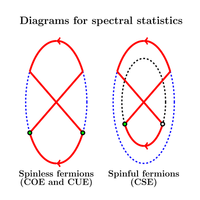
We show the emergence of random matrix theory (RMT) spectral correlations in the chaotic phase of generic, periodically kicked, interacting, quantum many-body systems by analytically calculating the spectral form factor (SFF), , up to two leading orders in time, . We explicitly consider the presence or absence of time-reversal () symmetry to investigate all three Dyson symmetry classes, namely, the circular orthogonal ensemble (COE) for -invariant systems with , the circular unitary ensemble (CUE) in the absence of symmetry, and the circular symplectic ensemble (CSE) for -invariant systems with . Our derivation applies the random phase approximation to perform ensemble averages, and we give its justification for generic many-body interactions. We express the SFF as a sum of contributions of certain diagrams. While the number of diagrams that contribute to the SFF in the first and second orders in for the COE and CUE classes is finite, the number of such diagrams is exponentially large in for the CSE class. Thus, we have developed a new diagrammatic technique that uses reduced diagrams to incorporate contributions from many diagrams. For the COE class, we show that beyond Thouless time , the SFF takes the form up to second order in time, where is the Hilbert space dimension. For the CUE class, we show that beyond , and there is no universal term in the second order, unlike the COE case. For the CSE class, we show that up to two orders in time beyond . The above findings of the SFF up to second order in time are in agreement with the RMT predictions for these classes. In all three cases, the scaling of with system size is determined by the eigenvalues of a doubly stochastic matrix . For strongly interacting fermionic chains, is invariant in all three cases, leading to in the presence of symmetry. In the absence of symmetry, we find , due to the gapped, nondegenerate, second-largest eigenvalue of , or , due to the gapped second-largest eigenvalue with degeneracy proportional to , . Our calculation of the SFF is plausible in higher space dimensions as well, where similar system-size scalings of can be obtained.
Physics Subject Headings (PhySH)
Popular Summary
The emergence of random matrix theory spectral correlations in chaotic quantum many-body systems lacks a general microscopic explanation across different symmetry classes. We solve this problem by analytically calculating the spectral form factor up to the two leading orders in time for periodically kicked interacting systems. We explicitly incorporate time-reversal symmetry to investigate the circular orthogonal, unitary, and symplectic ensembles, utilizing a random phase approximation to perform ensemble averages. Our diagrammatic technique using reduced diagrams shows that the leading order yields the universal linear ramp, while specific diagrams dictate the second-order corrections, which precisely match random matrix theory predictions. Furthermore, we characterize the Thouless timescale and its system-size scaling based on the eigenvalues of a doubly stochastic matrix. These findings establish a unified framework to understand quantum ergodicity in finite local Hilbert spaces, providing analytical insights that are applicable to higher spatial dimensions.
Article Text
References (61)
- O. Bohigas, M. J. Giannoni, and C. Schmit, Characterization of chaotic quantum spectra and universality of level fluctuation laws, Phys. Rev. Lett. 52, 1 (1984).
- S. W. McDonald and A. N. Kaufman, Spectrum and eigenfunctions for a Hamiltonian with stochastic trajectories, Phys. Rev. Lett. 42, 1189 (1979).
- G. Casati, F. Valz-Gris, and I. Guarnieri, On the connection between quantization of nonintegrable systems and statistical theory of spectra, Lett. Nuovo Cimento 28, 279 (1980).
- M. V. Berry and M. Tabor, Level clustering in the regular spectrum, Proc. R. Soc. A 356, 375 (1977).
- M. V. Berry, Quantizing a classically ergodic system: Sinai’s billiard and the KKR method, Ann. Phys. (N.Y.) 131, 163 (1981).
- M. L. Mehta, Random Matrices, 2nd ed. (Academic Press, San Diego, 1991), 10.1016/C2009-0-22297-5.
- E. P. Wigner, Characteristic vectors of bordered matrices with infinite dimensions, Ann. Math. 62, 548 (1955).
- E. P. Wigner, Group Theory and its Application to the Quantum Mechanics of Atomic Spectra (Academic Press Inc., New York, 1959), 10.1119/1.1935822.
- F. J. Dyson, Statistical theory of the energy levels of complex systems. I, J. Math. Phys. (N.Y.) 3, 140 (1962).
- F. J. Dyson, Correlations between eigenvalues of a random matrix, Commun. Math. Phys. 19, 235 (1970).
- M. V. Berry, Theory of spectral rigidity, Proc. R. Soc. A 400, 229 (1985).
- M. Sieber and K. Richter, Correlations between periodic orbits and their role in spectral statistics, Phys. Scr. T 90, 128 (2001).
- M. Sieber, Leading off-diagonal approximation for the spectral form factor for uniformly hyperbolic systems, J. Phys. A 35, L613 (2002).
- S. Müller, S. Heusler, P. Braun, F. Haake, and A. Altland, Semiclassical foundation of universality in quantum chaos, Phys. Rev. Lett. 93, 014103 (2004).
- S. Müller, S. Heusler, P. Braun, F. Haake, and A. Altland, Periodic-orbit theory of universality in quantum chaos, Phys. Rev. E 72, 046207 (2005).
- Z. Pluhař and H. A. Weidenmüller, Universal quantum graphs, Phys. Rev. Lett. 112, 144102 (2014).
- Z. Pluhar and H. A. Weidenmüller, Quantum graphs and random-matrix theory, J. Phys. A 48, 275102 (2015).
- R. Dubertrand and S. Müller, Spectral statistics of chaotic many-body systems, New J. Phys. 18, 033009 (2016).
- P. Kos, M. Ljubotina, and T. Prosen, Many-body quantum chaos: Analytic connection to random matrix theory, Phys. Rev. X 8, 021062 (2018).
- A. Chan, A. De Luca, and J. T. Chalker, Solution of a minimal model for many-body quantum chaos, Phys. Rev. X 8, 041019 (2018).
- A. Chan, A. De Luca, and J. T. Chalker, Spectral statistics in spatially extended chaotic quantum many-body systems, Phys. Rev. Lett. 121, 060601 (2018).
- B. Bertini, P. Kos, and T. Prosen, Exact spectral form factor in a minimal model of many-body quantum chaos, Phys. Rev. Lett. 121, 264101 (2018).
- B. Bertini, P. Kos, and T. Prosen, Exact correlation functions for dual-unitary lattice models in dimensions, Phys. Rev. Lett. 123, 210601 (2019).
- B. Bertini, P. Kos, and T. Prosen, Entanglement spreading in a minimal model of maximal many-body quantum chaos, Phys. Rev. X 9, 021033 (2019).
- A. J. Friedman, A. Chan, A. De Luca, and J. T. Chalker, Spectral statistics and many-body quantum chaos with conserved charge, Phys. Rev. Lett. 123, 210603 (2019).
- D. Roy and T. Prosen, Random matrix spectral form factor in kicked interacting fermionic chains, Phys. Rev. E 102, 060202(R) (2020).
- S. Moudgalya, A. Prem, D. A. Huse, and A. Chan, Spectral statistics in constrained many-body quantum chaotic systems, Phys. Rev. Res. 3, 023176 (2021).
- B. Bertini, P. Kos, and T. Prosen, Random matrix spectral form factor of dual-unitary quantum circuits, Commun. Math. Phys. 387, 597 (2021).
- S. J. Garratt and J. T. Chalker, Local pairing of Feynman histories in many-body Floquet models, Phys. Rev. X 11, 021051 (2021).
- D. Roy, D. Mishra, and T. Prosen, Spectral form factor in a minimal bosonic model of many-body quantum chaos, Phys. Rev. E 106, 024208 (2022).
- K. Richter, J. Diego Urbina, and S. Tomsovic, Semiclassical roots of universality in many-body quantum chaos, J. Phys. A 55, 453001 (2022).
- M. Winer and B. Swingle, Hydrodynamic theory of the connected spectral form factor, Phys. Rev. X 12, 021009 (2022).
- M. Winer and B. Swingle, The Loschmidt spectral form factor, J. High Energy Phys. 10 (2022) 137.
- Y. Liao and V. Galitski, Emergence of many-body quantum chaos via spontaneous breaking of unitarity, Phys. Rev. B 105, L140202 (2022).
- L. K. Joshi, A. Elben, A. Vikram, B. Vermersch, V. Galitski, and P. Zoller, Probing many-body quantum chaos with quantum simulators, Phys. Rev. X 12, 011018 (2022).
- C. Dag, S. Mistakidis, A. Chan, and H. R. Sadeghpour, Many-body quantum chaos in stroboscopically-driven cold atoms, Commun. Phys. 6, 136 (2023).
- V. Kumar and D. Roy, Many-body quantum chaos in mixtures of multiple species, Phys. Rev. E 109, L032201 (2024).
- A. Vikram and V. Galitski, Exact universal bounds on quantum dynamics and fast scrambling, Phys. Rev. Lett. 132, 040402 (2024).
- M. Akila, D. Waltner, B. Gutkin, and T. Guhr, Particle-time duality in the kicked Ising spin chain, J. Phys. A 49, 375101 (2016).
- T. N. Ikeda, L. Vidmar, and M. O. Flynn, Exact spectral form factors of noninteracting fermions with Dyson statistics, Phys. Rev. B 111, 144312 (2025).
- M. O. Flynn, L. Vidmar, and T. N. Ikeda, Single-particle universality of the many-body spectral form factor, Phys. Rev. Lett. 134, 160403 (2025).
- F. Haake, Quantum Signatures of Chaos, 2nd ed. (Springer, New York, 2001), 10.1007/978-3-319-97580-1.
- G. Berkolaiko, H. Schanz, and R. S. Whitney, Leading off-diagonal correction to the form factor of large graphs, Phys. Rev. Lett. 88, 104101 (2002).
- G. Berkolaiko, H. Schanz, and R. S. Whitney, Form factor for a family of quantum graphs: An expansion to third order, J. Phys. A 36, 8373 (2003).
- T. Kottos and U. Smilansky, Quantum chaos on graphs, Phys. Rev. Lett. 79, 4794 (1997).
- A. Altland and M. R. Zirnbauer, Field theory of the quantum kicked rotor, Phys. Rev. Lett. 77, 4536 (1996).
- M. R. Zirnbauer, Supersymmetry for systems with unitary disorder: Circular ensembles, J. Phys. A 29, 7113 (1996).
- M. R. Zirnbauer, The color-flavor transformation and a new approach to quantum chaotic maps, arXiv:chao-dyn/9810016.
- K. M. Frahm, Localization in a rough billiard: A -model formulation, Phys. Rev. B 55, R8626 (1997).
- K. M. Frahm, Quantum relaxation in open chaotic systems, Phys. Rev. E 56, R6237 (1997).
- H. Gharibyan, M. Hanada, S. H. Shenker, and M. Tezuka, Onset of random matrix behavior in scrambling systems, J. High Energy Phys. 07 (2018) 124.
- D. Waltner and P. Braun, Localization in the kicked Ising chain, Phys. Rev. B 104, 054432 (2021).
- S. Heusler, The semiclassical origin of the logarithmic singularity in the symplectic form factor, J. Phys. A 34, L483 (2001).
- G. Berkolaiko, Quantum Graphs and Their Applications: Proceedings of an AMS-IMS-SIAM Joint Summer Research Conference on Quantum Graphs and Their Applications, 2005, Snowbird, Utah (American Mathematical Society, Providence, 2006), Vol. 415.
- A. K. Das, C. Cianci, D. G. A. Cabral, D. A. Zarate-Herrada, P. Pinney, S. Pilatowsky-Cameo, A. S. Matsoukas-Roubeas, V. S. Batista, A. del Campo, E. J. Torres-Herrera, and L. F. Santos, Proposal for many-body quantum chaos detection, Phys. Rev. Res. 7, 013181 (2025).
- H. Dong et al., Measuring the spectral form factor in many-body chaotic and localized phases of quantum processors, Phys. Rev. Lett. 134, 010402 (2025).
- L. E. Fischer, M. Leahy, A. Eddins, N. Keenan, D. Ferracin, M. A. Rossi, Y. Kim, A. He, F. Pietracaprina, B. Sokolov et al., Dynamical simulations of many-body quantum chaos on a quantum computer, Nat. Phys. 22, 302 (2026).
- A. Altland and M. R. Zirnbauer, Nonstandard symmetry classes in mesoscopic normal-superconducting hybrid structures, Phys. Rev. B 55, 1142 (1997).
- http://dspace.rri.res.in/handle/2289/8725.
- S. A. Gershgorin, Uber die abgrenzung der eigenwerte einer matrix, Izv. Math. 6, 749 (1931), http://mi.mathnet.ru//eng/im5235.
- R. A. Horn and C. R. Johnson, Matrix Analysis (Cambridge University Press, Cambridge, England, 1985), 10.1017/CBO9780511810817.

