

- Open Access
Floquet-Based Ising Machines Escape Local Minima in QUBO Problems
Phys. Rev. X 16, 031010 – Published 17 July, 2026
DOI: https://doi.org/10.1103/kgfb-5g2w
Abstract
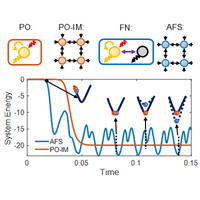
Solving large-scale quadratic unconstrained binary optimization (QUBO) problems is critical in various fields, including physics, finance, and engineering. However, these problems remain intractable on conventional computing architectures. Alternative solvers, such as Ising machines (IMs) based on networks of coupled electronic, mechanical, or photonic parametric oscillators (POs), have recently been developed. PO-based IMs aim to find the ground state of an Ising Hamiltonian, which encodes the solution to a QUBO problem. However, their analog nature and their energy-minimization process based on gradient descent make PO-based IMs inherently susceptible to identifying inaccurate solutions. In this work, we introduce and validate a QUBO solver—the analog Floquet solver (AFS)—which enhances the dynamics of PO-based IMs by leveraging Floquet states that emerge spontaneously in POs coupled to high-quality-factor resonances. These states enable the AFS to embed periodic time modulation into its energy-minimization process, allowing it to escape local minima during the search for QUBO problem solutions. As a result, the AFS significantly increases the likelihood of identifying accurate solutions compared to conventional PO-based IMs. More generally, this work defines a new paradigm in analog computing—spanning both classical and quantum realms—that can be physically realized with existing technologies across diverse physical domains.
Physics Subject Headings (PhySH)
Popular Summary
Ising machines, implemented as dynamical systems featuring a network of coupled parametric oscillators representing artificial Ising spins, are promising analog computing platforms capable of quickly and efficiently solving quadratic unconstrained binary optimization (QUBO) problems. However, many such Ising machines are prone to become trapped in local minima during their energy minimization process, leading them to often produce suboptimal solutions to the QUBO problems. To address this, Floquet amplitude modulations are dynamically activated in the artificial Ising spins by strongly coupling an external resonant mode to each parametric oscillator. These modulations enable the dynamical system, dubbed an analog Floquet solver, to escape from local minima and consequently reach more optimal solutions than the ones achieved by the parametric oscillator-based Ising machine counterpart. Because of the generality of the approach to activate Floquet modulations in parametric oscillator-based artificial Ising spins, analog Floquet solvers can be easily implemented across many possible physical domains.
Article Text
Supplemental Material
References (122)
- D. De Santis, S. Tirone, S. Marmi, and V. Giovannetti, Optimized QUBO formulation methods for quantum computing, arXiv:2406.07681.
- F. Glover, G. Kochenberger, R. Hennig, and Y. Du, Quantum bridge analytics I: A tutorial on formulating and using QUBO models, Ann. Oper. Res. 314, 141 (2022).
- H. Goto et al., High-performance combinatorial optimization based on classical mechanics, Sci. Adv. 7, eabe7953 (2021).
- G. Dominijanni et al., The neural resource allocation problem when enhancing human bodies with extra robotic limbs, Nat. Mach. Intell. 3, 850 (2021).
- A. Perdomo-Ortiz et al., Readiness of quantum optimization machines for industrial applications, Phys. Rev. Appl. 12, 014004 (2019).
- M. J. A. Schuetz, J. K. Brubaker, and H. G. Katzgraber, Combinatorial optimization with physics-inspired graph neural networks, Nat. Mach. Intell. 4, 367 (2022).
- A. Merchant, S. Batzner, S. S. Schoenholz, M. Aykol, G. Cheon, and E. D. Cubuk, Scaling deep learning for materials discovery, Nature (London) 624, 80 (2023).
- A. V. Sadybekov and V. Katritch, Computational approaches streamlining drug discovery, Nature (London) 616, 673 (2023).
- E. Pelofske, G. Hahn, and H. N. Djidjev, Increasing the hardness of posiform planting using random QUBOs for programmable quantum annealer benchmarking, npj Unconv. Comput. 2, 17 (2025).
- M. X. Goemans and D. P. Williamson, Improved approximation algorithms for maximum cut and satisfiability problems using semidefinite programming, J. Assoc. Comput. Mach. 42, 1115 (1995).
- E. Farhi, J. Goldstone, and S. Gutmann, A quantum approximate optimization algorithm, arXiv:1411.4028.
- R. Nieuwenhuis, A. Oliveras, and C. Tinelli, Solving SAT and SAT modulo theories: From an abstract Davis--Putnam--Logemann--Loveland procedure to DPLL (T), J. Assoc. Comput. Mach. 53, 937 (2006).
- D. J. Gauthier, E. Bollt, A. Griffith, and W. A. S. Barbosa, Next generation reservoir computing, Nat. Commun. 12, 5564 (2021).
- D. Kudithipudi et al., Neuromorphic computing at scale, Nature (London) 637, 801 (2025).
- T. D. Ladd, F. Jelezko, R. Laflamme, Y. Nakamura, C. Monroe, and J. L. O’Brien, Quantum computers, Nature (London) 464, 45 (2010).
- Y. Yamamoto et al., Coherent Ising machines—optical neural networks operating at the quantum limit, npj Quantum Inf. 3, 49 (2017).
- N. Mohseni, P. L. McMahon, and T. Byrnes, Ising machines as hardware solvers of combinatorial optimization problems, Nat. Rev. Phys. 4, 363 (2022).
- O. Maher et al., A CMOS-compatible oscillation-based VO2 Ising machine solver, Nat. Commun. 15, 3334 (2024).
- H. C𝚤lasun et al., A coupled-oscillator-based Ising chip for combinatorial optimization, Nat. Electron. 8, 537 (2025).
- G. F. Newell and E. W. Montroll, On the theory of the Ising model of ferromagnetism, Rev. Mod. Phys. 25, 353 (1953).
- F. Barahona, On the computational complexity of Ising spin glass models, J. Phys. A 15, 3241 (1982).
- S. Nikhar, S. Kannan, N. A. Aadit, S. Chowdhury, and K. Y. Camsari, All-to-all reconfigurability with sparse and higher-order Ising machines, Nat. Commun. 15, 8977 (2024).
- K. Tatsumura, M. Yamasaki, and H. Goto, Scaling out Ising machines using a multi-chip architecture for simulated bifurcation, Nat. Electron. 4, 208 (2021).
- N. A. Aadit et al., Massively parallel probabilistic computing with sparse Ising machines, Nat. Electron. 5, 460 (2022).
- K. Lee, S. Chowdhury, and K. Y. Camsari, Noise-augmented chaotic Ising machines for combinatorial optimization and sampling, Commun. Phys. 8, 35 (2025).
- See Supplemental Material at http://link.aps.org/supplemental/10.1103/kgfb-5g2w for further discussions relating to the benchmarking, analytical treatment, electronic implementation, solution identification, and robustness to failure modes of the AFS and the PO-based IM.
- N. A. Aadit et al., Massively parallel probabilistic computing with sparse Ising machines, Nat. Electron. 5, 460 (2022).
- J. Kaiser and S. Datta, Probabilistic computing with p-bits, Appl. Phys. Lett. 119, 150503 (2021).
- K. Y. Camsari, R. Faria, B. M. Sutton, and S. Datta, Stochastic p -bits for invertible logic, Phys. Rev. X 7, 031014 (2017).
- Y. Haribara, H. Ishikawa, S. Utsunomiya, K. Aihara, and Y. Yamamoto, Performance evaluation of coherent Ising machines against classical neural networks, Quantum Sci. Technol. 2, 044002 (2017).
- D. J. Earl and M. W. Deem, Parallel tempering: Theory, applications, and new perspectives, Phys. Chem. Chem. Phys. 7, 3910 (2005).
- W. Wang, J. Machta, and H. G. Katzgraber, Comparing Monte Carlo methods for finding ground states of Ising spin glasses: Population annealing, simulated annealing, and parallel tempering, Phys. Rev. E 92, 013303 (2015).
- M. Weigel, L. Barash, L. Shchur, and W. Janke, Understanding population annealing Monte Carlo simulations, Phys. Rev. E 103, 053301 (2021).
- M. Calvanese Strinati, L. Bello, A. Pe’er, and E. G. Dalla Torre, Theory of coupled parametric oscillators beyond coupled Ising spins, Phys. Rev. A 100, 023835 (2019).
- T. L. Heugel, O. Zilberberg, C. Marty, R. Chitra, and A. Eichler, Ising machines with strong bilinear coupling, Phys. Rev. Res. 4, 013149 (2022).
- P. L. McMahon et al., A fully programmable 100-spin coherent Ising machine with all-to-all connections, Science 354, 614 (2016).
- M. Honari-Latifpour, M. S. Mills, and M.-A. Miri, Combinatorial optimization with photonics-inspired clock models, Commun. Phys. 5, 104 (2022).
- M. Calvanese Strinati, I. Aharonovich, S. Ben-Ami, E. G. Dalla Torre, L. Bello, and A. Pe’er, Coherent dynamics in frustrated coupled parametric oscillators, New J. Phys. 22, 085005 (2020).
- P. N. Butcher and D. Cotter, The Elements of Nonlinear Optics, 1st ed. (Cambridge University Press, Cambridge, England, 1990).
- Q. Cen et al., Large-scale coherent Ising machine based on optoelectronic parametric oscillator, Light Sci. Appl. 11, 333 (2022).
- N. Casilli, L. Colombo, and C. Cassella, A UHF passive subharmonic tag with a 13 m read-range, IEEE Microwave Wireless Tech. Lett. 33, 939 (2023).
- H. M. E. Hussein, M. A. A. Ibrahim, G. Michetti, M. Rinaldi, M. Onabajo, and C. Cassella, Systematic synthesis and design of ultralow threshold parametric frequency dividers, IEEE Trans. Microwave Theor. Technol. 68, 3497 (2020).
- H. M. E. Hussein, M. Rinaldi, M. Onabajo, and C. Cassella, Capturing and recording cold chain temperature violations through parametric alarm-sensor tags, Appl. Phys. Lett. 119, 014101 (2021).
- H. M. E. Hussein, M. Rinaldi, M. Onabajo, and C. Cassella, A chip-less and battery-less subharmonic tag for wireless sensing with parametrically enhanced sensitivity and dynamic range, Sci. Rep. 11, 3782 (2021).
- L. Colombo, A. Kochhar, G. Vidal-Alvarez, and G. Piazza, High-figure-of-merit X-cut lithium niobate MEMS resonators operating around 50 MHz for large passive voltage amplification in radio frequency applications, IEEE Trans. Ultrasonics Ferroelectr. Freq. Control 67, 1392 (2020).
- G. Giribaldi, L. Colombo, P. Simeoni, and M. Rinaldi, Compact and wideband nanoacoustic pass-band filters for future 5G and 6G cellular radios, Nat. Commun. 15, 304 (2024).
- G. Maltese et al., Generation and symmetry control of quantum frequency combs, npj Quantum Inf. 6, 13 (2020).
- D. A. R. Dalvit, T. J. Volkoff, Y.-S. Choi, A. K. Azad, H.-T. Chen, and P. W. Milonni, Quantum frequency combs with path identity for quantum remote sensing, Phys. Rev. X 14, 041058 (2024).
- T. Yamazaki, T. Arizono, T. Kobayashi, R. Ikuta, and T. Yamamoto, Linear optical quantum computation with frequency-comb qubits and passive devices, Phys. Rev. Lett. 130, 200602 (2023).
- T. Albash, V. Martin-Mayor, and I. Hen, Analog errors in Ising machines, Quantum Sci. Technol. 4, 02LT03 (2019).
- T. Leleu, Y. Yamamoto, P. L. McMahon, and K. Aihara, Destabilization of local minima in analog spin systems by correction of amplitude heterogeneity, Phys. Rev. Lett. 122, 040607 (2019).
- F. Böhm, G. Verschaffelt, and G. Van der Sande, A poor man’s coherent Ising machine based on opto-electronic feedback systems for solving optimization problems, Nat. Commun. 10, 3538 (2019).
- W. Verstraelen, P. Deuar, M. Matuszewski, and T. C. H. Liew, Analog spin simulators: How to keep the amplitude homogeneous, Phys. Rev. Appl. 21, 024057 (2024).
- R. Shi, F. Böhm, T. Van Vaerenbergh, and P. Bienstman, Enhancing the performance of coherent Ising machines in the large-noise regime with a fifth-order nonlinearity, Opt. Express 32, 21681 (2024).
- J. Lamers, G. Verschaffelt, and G. Van Der Sande, Using continuation methods to analyse the difficulty of problems solved by Ising machines, Commun. Phys. 7 (2024).
- M. Calvanese Strinati, L. Bello, E. G. Dalla Torre, and A. Pe’er, Can nonlinear parametric oscillators solve random Ising models?, Phys. Rev. Lett. 126, 143901 (2021).
- F. Böhm et al., Understanding dynamics of coherent Ising machines through simulation of large-scale 2D Ising models, Nat. Commun. 9, 5020 (2018).
- C. Cook, H. Zhao, T. Sato, M. Hiromoto, and S. X.-D. Tan, GPU-based Ising computing for solving max-cut combinatorial optimization problems, Integration, The VLSI Journal 69, 335 (2019).
- N. Onizawa and T. Hanyu, GPU-accelerated simulated annealing based on p-bits with real-world device-variability modeling, Sci. Rep. 15, 6118 (2025).
- O. Hassan, S. Datta, and K. Y. Camsari, Quantitative evaluation of hardware binary stochastic neurons, Phys. Rev. Appl. 15, 064046 (2021).
- D. Pierangeli, G. Marcucci, D. Brunner, and C. Conti, Noise-enhanced spatial-photonic Ising machine, Nanophotonics 9, 4109 (2018).
- R. Kleinberg, Y. Li, and Y. Yuan, An alternative view: When does SGD escape local minima?, arXiv:1802.06175.
- P. Xiao, Optoelectronics for refrigeration and analog circuits for combinatorial optimization, (University of California, Berkeley, 2019), https://www2.eecs.berkeley.edu/Pubs/TechRpts/2019/Archive/EECS-2019-74.pdf.
- A. Bonfanti, S. Levantino, C. Samori, and A. L. Lacaita, A varactor configuration minimizing the amplitude-to-phase noise conversion in VCOs, IEEE Trans. Circuits Syst. I 53, 481 (2006).
- B. C. McGoldrick, J. Z. Sun, and L. Liu, Ising machine based on electrically coupled spin Hall nano-oscillators, Phys. Rev. Appl. 17, 014006 (2022).
- N. Casilli et al., An Ising tag with a Resonator For Temperature Threshold Sensing, in 2023 Joint Conference of the European Frequency and Time Forum and IEEE International Frequency Control Symposium (EFTF/IFCS) (IEEE, Toyama, Japan, 2023), pp. 1–2, https://ieeexplore.ieee.org/abstract/document/10272142.
- D. Pierangeli, G. Marcucci, and C. Conti, Adiabatic evolution on a spatial-photonic Ising machine, Optica 7, 1535 (2020).
- M. Calvanese Strinati and C. Conti, Multidimensional hyperspin machine, Nat. Commun. 13, 7248 (2022).
- T. Wang and J. Roychowdhury, OIM: Oscillator-based Ising machines for solving combinatorial optimisation problems, arXiv:1903.07163.
- R. Hamerly et al., Experimental investigation of performance differences between coherent Ising machines and a quantum annealer, Sci. Adv. 5, eaau0823 (2019).
- Y. Okawachi et al., Demonstration of chip-based coupled degenerate optical parametric oscillators for realizing a nanophotonic spin-glass, Nat. Commun. 11, 4119 (2020).
- D.-W. Quantum, Get started with quantum computing. D-wave quantum [Online]. Available: https://docs.dwavequantum.com/en/latest/quantum_research/index_get_started.html (Accessed: Mar. 18, 2026).
- N. Casilli, T. Kaisar, L. Colombo, S. Ghosh, P. X.-L. Feng, and C. Cassella, Parametric frequency divider based Ising machines, Phys. Rev. Lett. 132, 147301 (2024).
- B. Wu et al., A monolithically integrated optical Ising machine, Nat. Commun. 16, 4296 (2025).
- L. Q. English, A. V. Zampetaki, K. P. Kalinin, N. G. Berloff, and P. G. Kevrekidis, An Ising machine based on networks of subharmonic electrical resonators, Commun. Phys. 5, 333 (2022).
- Y. Okawachi et al., Demonstration of chip-based coupled degenerate optical parametric oscillators for realizing a nanophotonic spin-glass, Nat. Commun. 11, 4119 (2020).
- N. Casilli et al., Programmable threshold sensing in wireless devices using Ising dynamics, Nat. Electron. 8, 529 (2025).
- M. Calvanese Strinati, L. Bello, A. Pe’er, and E. G. Dalla Torre, Theory of coupled parametric oscillators beyond coupled Ising spins, Phys. Rev. A 100, 023835 (2019).
- Y. Chen, X. Chen, X. Ren, M. Gong, and G. Guo, Tight-binding model in optical waveguides: Design principle and transferability for simulation of complex photonics networks, Phys. Rev. A 104, 023501 (2021).
- H. M. E. Hussein, M. A. A. Ibrahim, G. Michetti, M. Rinaldi, M. Onabajo, and C. Cassella, Systematic synthesis and design of ultralow threshold parametric frequency dividers, IEEE Trans. Microwave Theory Technol. 68, 3497 (2020).
- H. M. E. Hussein, S. Kim, M. Rinaldi, A. Alù, and C. Cassella, Passive frequency comb generation at radiofrequency for ranging applications, Nat. Commun. 15, 2844 (2024).
- I. Mahboob, H. Okamoto, and H. Yamaguchi, An electromechanical Ising Hamiltonian, Sci. Adv. 2, e1600236 (2016).
- S. Razmkhah, M. Kamal, N. Yoshikawa, and M. Pedram, Josephson parametric oscillator based Ising machine, Phys. Rev. B 109, 014511 (2024).
- C. Gneiting, F. Khoyratee, E. Rinaldi, K. Jain, R. Khincha, and F. Nori, Noise resilience of deterministic analog combinatorial optimization solvers, arXiv:2506.12914.
- J. Roychowdhury, A global Lyapunov function for the coherent Ising machine, NOLTA 13, 227 (2022).
- S. K. Vadlamani, T. P. Xiao, and E. Yablonovitch, Physics successfully implements Lagrange multiplier optimization, Proc. Natl. Acad. Sci. U.S.A. 117, 26639 (2020).
- T. Leleu, Y. Yamamoto, P. L. McMahon, and K. Aihara, Destabilization of local minima in analog spin systems by correction of amplitude heterogeneity, Phys. Rev. Lett. 122, 040607 (2019).
- A. Yamamura, H. Mabuchi, and S. Ganguli, Geometric landscape annealing as an optimization principle underlying the coherent Ising machine, Phys. Rev. X 14, 031054 (2024).
- J. S. Cummins, H. Salman, and N. G. Berloff, Ising Hamiltonian minimization: Gain-based computing with manifold reduction of soft spins vs quantum annealing, Phys. Rev. Res. 7, 013150 (2025).
- J. S. Cummins and N. G. Berloff, Vector Ising spin annealer for minimizing Ising Hamiltonians, Commun. Phys. 8, 225 (2025).
- J. Wang, D. Ebler, K. Y. M. Wong, D. S. W. Hui, and J. Sun, Bifurcation behaviors shape how continuous physical dynamics solves discrete Ising optimization, Nat. Commun. 14, 2510 (2023).
- M. Calvanese Strinati and C. Conti, Hyperscaling in the coherent hyperspin machine, Phys. Rev. Lett. 132, 017301 (2024).
- M. C. Strinati and C. Conti, Equalized hyperspin machine, Phys. Rev. A 112, 053505 (2025).
- Y. Inui, M. D. S. H. Gunathilaka, S. Kako, T. Aonishi, and Y. Yamamoto, Control of amplitude homogeneity in coherent Ising machines with artificial Zeeman terms, Commun. Phys. 5, 154 (2022).
- T. Oka and S. Kitamura, Floquet engineering of quantum materials, Annu. Rev. Condens. Matter Phys. 10, 387 (2019).
- N. Tsuji, Floquet states, in Encyclopedia of Condensed Matter Physics (Elsevier, New York, 2024), pp. 967–980.
- T. Mori, Floquet states in open quantum systems, Annu. Rev. Condens. Matter Phys. 14, 35 (2023).
- S. Yin, E. Galiffi, and A. Alù, Floquet metamaterials, eLight 2, 8 (2022).
- C. Weitenberg and J. Simonet, Tailoring quantum gases by Floquet engineering, Nat. Phys. 17, 1342 (2021).
- A. S. Disa, T. F. Nova, and A. Cavalleri, Engineering crystal structures with light, Nat. Phys. 17, 1087 (2021).
- H. Hübener et al., Engineering quantum materials with chiral optical cavities, Nat. Mater. 20, 438 (2021).
- R. Fleury, A. B. Khanikaev, and A. Alù, Floquet topological insulators for sound, Nat. Commun. 7, 11744 (2016).
- B. Liu et al., Higher-order and fractional discrete time crystals in Floquet-driven Rydberg atoms, Nat. Commun. 15, 9730 (2024).
- M. C. Rechtsman et al., Photonic Floquet topological insulators, Nature (London) 496, 196 (2013).
- A. Nagulu et al., Chip-scale Floquet topological insulators for 5G wireless systems, Nat. Electron. 5, 300 (2022).
- H. Li, A. Mekawy, and A. Alù, Beyond Chu’s limit with Floquet impedance matching, Phys. Rev. Lett. 123, 164102 (2019).
- D. L. Sounas and A. Alù, Non-reciprocal photonics based on time modulation, Nat. Photonics 11, 774 (2017).
- L. Bello, M. Calvanese Strinati, E. G. Dalla Torre, and A. Pe’er, Persistent coherent beating in coupled parametric oscillators, Phys. Rev. Lett. 123, 083901 (2019).
- B. Lu, C.-R. Fan, L. Liu, K. Wen, and C. Wang, Speed-up coherent Ising machine with a spiking neural network, Opt. Express 31, 3676 (2023).
- Z. Chen et al., ON-OFF neuromorphic ISING machines using Fowler-Nordheim annealers, Nat. Commun. 16, 3086 (2025).
- A. Wiegele, biq mac Library—A collection of max-cut and quadratic 0-1 programming instances of medium size [Online]. Available: https://biqmac.aau.at/biqmaclib.pdf.
- M.-A. Miri and A. Alù, Nonlinearity-induced PT-symmetry without material gain, New J. Phys. 18, 065001 (2016).
- D. L. Sounas and A. Alù, Fundamental bounds on the operation of Fano nonlinear isolators, Phys. Rev. B 97, 115431 (2018).
- N. A. Estep, D. L. Sounas, J. Soric, and A. Alù, Magnetic-free non-reciprocity and isolation based on parametrically modulated coupled-resonator loops, Nat. Phys. 10, 923 (2014).
- D. L. Sounas, J. Soric, and A. Alù, Broadband passive isolators based on coupled nonlinear resonances, Nat. Electron. 1, 113 (2018).
- D. J. Higham, An algorithmic introduction to numerical simulation of stochastic differential equations, SIAM Rev. 43, 525 (2001).
- M. Honari-Latifpour and M.-A. Miri, Optical Potts machine through networks of three-photon down-conversion oscillators, Nanophotonics 9, 4199 (2020).
- M. Honari-Latifpour, M. S. Mills, and M.-A. Miri, Combinatorial optimization with photonics-inspired clock models, Commun. Phys. 5, 104 (2022).
- A. Litvinenko, R. Khymyn, R. Ovcharov, and J. Åkerman, A 50-spin surface acoustic wave Ising machine, Commun. Phys. 8, 58 (2025).
- R. Shi, F. Böhm, T. Van Vaerenbergh, and P. Bienstman, Enhancing the performance of coherent Ising machines in the large-noise regime with a fifth-order nonlinearity, Opt. Express 32, 21681 (2024).
- N. Khan and N. Shukla, New best-known max-cut solution for the G63 instance in the G-set benchmark, arXiv:2510.21105.
- N. Casilli, O. Kaya, T. Kaisar, B. Davaji, P. Feng, and C. Cassella, Nonvolatile state configuration of nano-watt parametric ising spins through ferroelectric hafnium zirconium oxide MEMS varactors, in New Computing Devices and Systems with MEMS/NEMS (IEEE, Munich, Germany, 2023), p. 4, https://ieeexplore.ieee.org/abstract/document/10052601.

