

- Open Access
Disclinations, Dislocations, and Emanant Flux at Dirac Criticality
Phys. Rev. X 16, 011017 – Published 3 February, 2026
DOI: https://doi.org/10.1103/kfd3-qtk7
Abstract
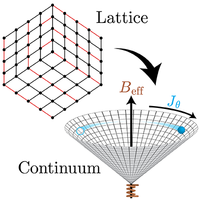
What happens when fermions hop on a lattice with crystalline defects? The answer depends on topological quantum numbers that specify the action of lattice rotations and translations in the low energy theory. One can understand the topological quantum numbers as a twist of continuum gauge fields in terms of crystalline gauge fields. We find that disclinations and dislocations—defects of crystalline symmetries—generally lead to a certain “emanant” quantized magnetic flux in the continuum. To demonstrate these facts, we study in detail tight-binding models whose low-energy descriptions are Dirac cones. Our map from lattice to continuum defects explains the crystalline topological response to disclinations and dislocations, and motivates the fermion crystalline equivalence principle used in the classification of crystalline topological phases. When the gap closes, the presence of emanant flux leads to pair creation from the vacuum with the particles and antiparticles swirling around the defect. We compute the associated currents and energy density using the tools of defect conformal field theory. There is a rich set of renormalization group fixed points, depending on how particles scatter from the defect. At half flux, there is a defect conformal manifold leading to a continuum of possible low-energy theories. We present extensive numerical evidence supporting the emanant magnetic flux at lattice defects, and we test our map between lattice and continuum defects in detail. We also point out a no-go result, which implies that a single Dirac cone in symmetry class AII is incompatible with a commuting rotational symmetry with .
Physics Subject Headings (PhySH)
Popular Summary
Defects in highly structured crystalline materials are a powerful playground for physicists to develop and test ideas about symmetry. Using tools from quantum field theory, we find that particles in a large class of gapless crystals “see” certain lattice defects as topologically quantized magnetic fluxes. These artificial magnetic fields induce genuine electrical currents which could be measured in laboratory samples, enabling direct observation of novel topological invariants. Our approach also readily applies to defects and materials beyond those which we considered. This work advances our understanding of crystalline symmetry and the consequences of breaking it, with the potential for application in emerging electronic technologies.
Article Text
References (111)
- X.-G. Wen, Quantum orders and symmetric spin liquids, Phys. Rev. B 65, 165113 (2002).
- M. Z. Hasan and C. L. Kane, Colloquium: Topological insulators, Rev. Mod. Phys. 82, 3045 (2010).
- M. Barkeshli and X.-L. Qi, Topological nematic states and non-Abelian lattice dislocations, Phys. Rev. X 2, 031013 (2012).
- A. M. Essin and M. Hermele, Classifying fractionalization: Symmetry classification of gapped spin liquids in two dimensions, Phys. Rev. B 87, 104406 (2013).
- W. A. Benalcazar, J. C. Y. Teo, and T. L. Hughes, Classification of two-dimensional topological crystalline superconductors and Majorana bound states at disclinations, Phys. Rev. B 89, 224503 (2014).
- Y. Ando and L. Fu, Topological crystalline insulators and topological superconductors: From concepts to materials, Annu. Rev. Condens. Matter Phys. 6, 361 (2015).
- H. Watanabe, H. C. Po, A. Vishwanath, and M. Zaletel, Filling constraints for spin-orbit coupled insulators in symmorphic and nonsymmorphic crystals, Proc. Natl. Acad. Sci. U.S.A. 112, 14551 (2015).
- C.-K. Chiu, J. C. Y. Teo, A. P. Schnyder, and S. Ryu, Classification of topological quantum matter with symmetries, Rev. Mod. Phys. 88, 035005 (2016).
- H. C. Po, A. Vishwanath, and H. Watanabe, Symmetry-based indicators of band topology in the 230 space groups, Nat. Commun. 8, 50 (2017).
- H. Song, S.-J. Huang, L. Fu, and M. Hermele, Topological phases protected by point group symmetry, Phys. Rev. X 7, 011020 (2017).
- S.-J. Huang, H. Song, Y.-P. Huang, and M. Hermele, Building crystalline topological phases from lower-dimensional states, Phys. Rev. B 96, 205106 (2017).
- K. Shiozaki, H. Shapourian, and S. Ryu, Many-body topological invariants in fermionic symmetry-protected topological phases: Cases of point group symmetries, Phys. Rev. B 95, 205139 (2017).
- J. Kruthoff, J. de Boer, J. van Wezel, C. L. Kane, and R.-J. Slager, Topological classification of crystalline insulators through band structure combinatorics, Phys. Rev. X 7, 041069 (2017).
- B. Bradlyn, L. Elcoro, and e. a. Jennifer Cano, Topological quantum chemistry, Nature (London) 547, 298 (2017).
- F. Schindler, A. M. Cook, M. G. Vergniory, Z. Wang, S. S. P. Parkin, B. A. Bernevig, and T. Neupert, Higher-order topological insulators, Sci. Adv. 4, eaat0346 (2018).
- R. Thorngren and D. V. Else, Gauging spatial symmetries and the classification of topological crystalline phases, Phys. Rev. X 8, 011040 (2018).
- S. Liu, A. Vishwanath, and E. Khalaf, Shift insulators: Rotation-protected two-dimensional topological crystalline insulators, Phys. Rev. X 9, 031003 (2019).
- Z. Song, C. Fang, and Y. Qi, Real-space recipes for general topological crystalline states, Nat. Commun. 11, 4197 (2020).
- T. Li, P. Zhu, W. A. Benalcazar, and T. L. Hughes, Fractional disclination charge in two-dimensional -symmetric topological crystalline insulators, Phys. Rev. B 101, 115115 (2020).
- N. Manjunath and M. Barkeshli, Crystalline gauge fields and quantized discrete geometric response for Abelian topological phases with lattice symmetry, Phys. Rev. Res. 3, 013040 (2021).
- N. Manjunath and M. Barkeshli, Classification of fractional quantum Hall states with spatial symmetries, arXiv:2012.11603.
- J. Cano and B. Bradlyn, Band representations and topological quantum chemistry, Annu. Rev. Condens. Matter Phys. 12, 225 (2021).
- Y. Zhang, N. Manjunath, G. Nambiar, and M. Barkeshli, Fractional disclination charge and discrete shift in the Hofstadter butterfly, Phys. Rev. Lett. 129, 275301 (2022).
- Y. Zhang, N. Manjunath, R. Kobayashi, and M. Barkeshli, Complete crystalline topological invariants from partial rotations in invertible fermionic states and Hofstadter’s butterfly, Phys. Rev. Lett. 131, 176501 (2023).
- Y. Zhang, N. Manjunath, G. Nambiar, and M. Barkeshli, Quantized charge polarization as a many-body invariant in crystalline topological states and Hofstadter butterflies, Phys. Rev. X 13, 031005 (2023).
- N. Manjunath, V. Calvera, and M. Barkeshli, Characterization and classification of interacting ()-dimensional topological crystalline insulators with orientation-preserving wallpaper groups, Phys. Rev. B 109, 035168 (2024).
- R. Kobayashi, Y. Zhang, N. Manjunath, and M. Barkeshli, Crystalline invariants of fractional Chern insulators, Phys. Rev. B 112, 035147 (2025).
In particular, -fold spatial rotation symmetries satisfying should be described using internal symmetries that have order while spatial rotation symmetries satisfying should be described in terms of internal symmetries that have order .
- A. Debray, Invertible phases for mixed spatial symmetries and the fermionic crystalline equivalence principle, arXiv:2102.02941.
- J.-H. Zhang, S. Yang, Y. Qi, and Z.-C. Gu, Real-space construction of crystalline topological superconductors and insulators in 2D interacting fermionic systems, Phys. Rev. Res. 4, 033081 (2022).
- N. Manjunath, V. Calvera, and M. Barkeshli, Nonperturbative constraints from symmetry and chirality on Majorana zero modes and defect quantum numbers in () dimensions, Phys. Rev. B 107, 165126 (2023).
Since one can always apply magnetic flux at the core of the lattice defect, it is important that the Hamiltonian in the presence of the lattice defect is determined, up to local operators at the core, by the lattice rotation and translation operators of interest.
- M. Cheng and N. Seiberg, Lieb-Schultz-Mattis, Luttinger, and ’t Hooft-anomaly matching in lattice systems, SciPost Phys. 15, 051 (2023).
- M. Billò, V. Gonçalves, E. Lauria, and M. Meineri, Defects in conformal field theory, J. High Energy Phys. 04 (2016) 091.
- N. Andrei et al., Boundary and defect CFT: Open problems and applications, J. Phys. A 53, 453002 (2020).
- A. Söderberg Rousu, Defects, renormalization and conformal field theory, Ph.D. thesis, Acta Universitatis Upsaliensis, 2023.
- A. Chalabi, Exact methods for defects in conformal field theory, Ph.D. thesis, University of Southampton, 2023.
- L. Bianchi, A. Chalabi, V. Procházka, B. Robinson, and J. Sisti, Monodromy defects in free field theories, J. High Energy Phys. 08 (2021) 013.
- G. Cuomo, Z. Komargodski, and A. Raviv-Moshe, Renormalization group flows on line defects, Phys. Rev. Lett. 128, 021603 (2022).
For example, consider the total magnetic flux of accumulated at the defect of conical angle . In a lattice model of system size , the leading finite-size correction scales as , which approaches in the limit . We refer to Sec. 6 for detailed discussions.
- A. H. Castro Neto, F. Guinea, N. M. R. Peres, K. S. Novoselov, and A. K. Geim, The electronic properties of graphene, Rev. Mod. Phys. 81, 109 (2009).
- J. González, F. Guinea, and M. A. H. Vozmediano, Continuum approximation to fullerene molecules, Phys. Rev. Lett. 69, 172 (1992).
- J. Gonzalez, F. Guinea, and M. A. Vozmediano, The electronic spectrum of fullerenes from the Dirac equation, Nucl. Phys. B406, 771 (1993).
- A. Krishnan, E. Dujardin, M. Treacy, J. Hugdahl, S. Lynum, and T. Ebbesen, Graphitic cones and the nucleation of curved carbon surfaces, Nature (London) 388, 451 (1997).
- P. E. Lammert and V. H. Crespi, Topological phases in graphitic cones, Phys. Rev. Lett. 85, 5190 (2000).
- P. E. Lammert and V. H. Crespi, Graphene cones: Classification by fictitious flux and electronic properties, Phys. Rev. B 69, 035406 (2004).
- Y. A. Sitenko and N. Vlasii, Electronic properties of graphene with a topological defect, Nucl. Phys. B787, 241 (2007).
- J. González, F. Guinea, and M. Vozmediano, Electron-electron interactions in graphene sheets, Phys. Rev. B 63, 134421 (2001).
- A. Morpurgo and F. Guinea, Intervalley scattering, long-range disorder, and effective time-reversal symmetry breaking in graphene, Phys. Rev. Lett. 97, 196804 (2006).
- B. Han, H. Wang, and P. Ye, Generalized Wen-Zee terms, Phys. Rev. B 99, 205120 (2019).
- J. May-Mann and T. L. Hughes, Crystalline responses for rotation-invariant higher-order topological insulators, Phys. Rev. B 106, L241113 (2022).
- N. Manjunath, A. Prem, and Y.-M. Lu, Rotational symmetry protected edge and corner states in Abelian topological phases, Phys. Rev. B 107, 195130 (2023).
- M. R. Hirsbrunner, A. D. Gray, and T. L. Hughes, Crystalline electromagnetic responses of higher-order topological semimetals, Phys. Rev. B 109, 075169 (2024).
- M. R. Hirsbrunner, O. Dubinkin, F. J. Burnell, and T. L. Hughes, Anomalous crystalline-electromagnetic responses in semimetals, Phys. Rev. X 14, 041060 (2024).
- A. Jahin, Y.-M. Lu, and Y. Wang, Many-body higher-order topological invariant for -symmetric insulators, Phys. Rev. B 109, 205123 (2024).
- D. Gaiotto, D. Mazac, and M. F. Paulos, Bootstrapping the 3D Ising twist defect, J. High Energy Phys. 03 (2014) 100.
- A. Söderberg, Anomalous dimensions in the WF model with a monodromy line defect, J. High Energy Phys. 03 (2018) 058.
- S. Giombi, E. Helfenberger, Z. Ji, and H. Khanchandani, Monodromy defects from hyperbolic space, J. High Energy Phys. 02 (2022) 041.
- A. Gimenez-Grau and P. Liendo, Bootstrapping monodromy defects in the Wess-Zumino model, J. High Energy Phys. 05 (2022) 185.
- J. S. Dowker, Entanglement entropy and for monodromy defects of fields on odd-dimensional spheres, arXiv:2201.13358.
- J. S. Dowker, On the Green function for an Aharonov-Bohm flux tube, arXiv:2205.08477.
- A. Söderberg Rousu, The O(N)-flavoured replica twist defect, J. High Energy Phys. 07 (2023) 022.
More generally, deformation classes of should be viewed as invariants of the UV theory.
- M. Barkeshli, P. Bonderson, M. Cheng, and Z. Wang, Symmetry fractionalization, defects, and gauging of topological phases, Phys. Rev. B 100, 115147 (2019).
- C. Jones, D. Penneys, and D. Reutter, A 3-categorical perspective on G-crossed braided categories, J. Lond. Math. Soc. 107, 333 (2023).
- M. Barkeshli, P. Bonderson, M. Cheng, C.-M. Jian, and K. Walker, Reflection and time reversal symmetry enriched topological phases of matter: Path integrals, non-orientable manifolds, and anomalies, Commun. Math. Phys. 374, 1021 (2019).
- S. D. Pace, G. Delfino, H. T. Lam, and O. M. Aksoy, Gauging modulated symmetries: Kramers-Wannier dualities and non-invertible reflections, SciPost Phys. 18, 021 (2025).
Note that, for concreteness, we are discussing models with no dynamical gauge fields in the IR description.
- R. M. Nandkishore and M. Hermele, Fractons, Annu. Rev. Condens. Matter Phys. 10, 295 (2019).
- X.-L. Qi and S.-C. Zhang, Topological insulators and superconductors, Rev. Mod. Phys. 83, 1057 (2011).
- X.-L. Qi, Y.-S. Wu, and S.-C. Zhang, Topological quantization of the spin Hall effect in two-dimensional paramagnetic semiconductors, Phys. Rev. B 74, 085308 (2006).
- Y. Zhang and M. Barkeshli, Electric polarization and discrete shift from boundary and corner charge in crystalline Chern insulators, Phys. Rev. B 111, 075168 (2025).
As we discuss later, this Lagrangian should be understood as determining changes in the couplings relative to a reference. Strictly speaking, Eq. (31) should have suitable counterterms, which specify the reference, in order to make this term well defined, in general.
- Y. Zhang and M. Barkeshli, Electric polarization in Chern insulators: Unifying many-body and single-particle approaches, Phys. Rev. B 112, 115124 (2025).
- Y. Nakayama, Is boundary conformal in CFT?, Phys. Rev. D 87, 046005 (2013).
- R. Kupferman, M. Moshe, and J. P. Solomon, Metric description of singular defects in isotropic materials, Arch. Ration. Mech. Anal. 216, 1009 (2015).
Our convention for gamma matrices is , , and .
- O. Aharony, G. Cuomo, Z. Komargodski, M. Mezei, and A. Raviv-Moshe, Phases of Wilson lines in conformal field theories, Phys. Rev. Lett. 130, 151601 (2023).
- O. Aharony, G. Cuomo, Z. Komargodski, M. Mezei, and A. Raviv-Moshe, Phases of Wilson lines: Conformality and screening, J. High Energy Phys. 12 (2023) 183.
- L. D. Landau and E. M. Lifshitz, Quantum Mechanics: Non-Relativistic Theory (Elsevier, New York, 2013), Vol. 3.
- D. B. Kaplan, J.-W. Lee, D. T. Son, and M. A. Stephanov, Conformality lost, Phys. Rev. D 80, 125005 (2009).
- C. J. Burges, D. Z. Freedman, S. Davis, and G. Gibbons, Supersymmetry in anti-de Sitter space, Ann. Phys. (N.Y.) 167, 285 (1986).
- E. D’Hoker and D. Z. Freedman, Supersymmetric gauge theories and the AdS/CFT correspondence, in Strings, Branes and Extra Dimensions: TASI 2001 (World Scientific, Singapore, 2004), pp. 3–159.
- I. Nagar, A. Sever, and D.-l. Zhong, Planar RG flows on line defects, J. High Energy Phys. 06 (2024) 110.
- S. S. Gubser and I. R. Klebanov, A universal result on central charges in the presence of double-trace deformations, Nucl. Phys. B656, 23 (2003).
- A. Kapustin, Wilson-’t Hooft operators in four-dimensional gauge theories and s-duality, Phys. Rev. D 74, 025005 (2006).
- L.-Y. Hung, R. C. Myers, and M. Smolkin, Twist operators in higher dimensions, J. High Energy Phys. 10 (2014) 178.
The Zamolodchikov distance on the conformal manifold is . We thank A. Sharon for a helpful discussion.
- H. Casini, I. Salazar Landea, and G. Torroba, Entropic theorem in general spacetime dimensions, Phys. Rev. Lett. 130, 111603 (2023).
- H. Casini, I. Salazar Landea, and G. Torroba, Irreversibility, QNEC, and defects, J. High Energy Phys. 07 (2023) 004.
- N. Kobayashi, T. Nishioka, Y. Sato, and K. Watanabe, Towards a -theorem in defect CFT, J. High Energy Phys. 01 (2019) 039.
- D. M. McAvity and H. Osborn, Energy momentum tensor in conformal field theories near a boundary, Nucl. Phys. B406, 655 (1993).
- D. M. McAvity and H. Osborn, Conformal field theories near a boundary in general dimensions, Nucl. Phys. B455, 522 (1995).
- P. Liendo, L. Rastelli, and B. C. van Rees, The bootstrap program for boundary , J. High Energy Phys. 07 (2013) 113.
- K. Jensen and A. O’Bannon, Constraint on defect and boundary renormalization group flows, Phys. Rev. Lett. 116, 091601 (2016).
We thank J. Maldacena for a discussion of this topic.
- A. Gromov and L. Radzihovsky, Colloquium: Fracton matter, Rev. Mod. Phys. 96, 011001 (2024).
In special cases where is an integer, there exist defect operators with spin 1 and scaling dimension 2. However, it is only when that they are the lowest-lying spin-1 operators.
- C. Fechisin, Crystalline Dirac Criticality, github.com/fechisin/crystalline-dirac-criticality (2025), 10.5281/zenodo.17980048.
- F. D. M. Haldane, Model for a quantum Hall effect without Landau levels: Condensed-matter realization of the “parity anomaly”, Phys. Rev. Lett. 61, 2015 (1988).
- J. R. Schaibley, H. Yu, G. Clark, P. Rivera, J. S. Ross, K. L. Seyler, W. Yao, and X. Xu, Valleytronics in 2D materials, Nat. Rev. Mater. 1, 1 (2016).
- S. A. Vitale, D. Nezich, J. O. Varghese, P. Kim, N. Gedik, P. Jarillo-Herrero, D. Xiao, and M. Rothschild, Valleytronics: opportunities, challenges, and paths forward, Small 14, 1801483 (2018).
- W. Chen, M. P. A. Fisher, and Y.-S. Wu, Mott transition in an anyon gas, Phys. Rev. B 48, 13749 (1993).
- M. Barkeshli and J. McGreevy, Continuous transition between fractional quantum Hall and superfluid states, Phys. Rev. B 89, 235116 (2014).
- T. Grover and A. Vishwanath, Quantum phase transition between integer quantum Hall states of bosons, Phys. Rev. B 87, 045129 (2013).
- W. A. Benalcazar, T. Li, and T. L. Hughes, Quantization of fractional corner charge in -symmetric higher-order topological crystalline insulators, Phys. Rev. B 99, 245151 (2019).
- L. Šmejkal, J. Sinova, and T. Jungwirth, Emerging research landscape of altermagnetism, Phys. Rev. X 12, 040501 (2022).
- S. S. Razamat, Quivers and fractons, Phys. Rev. Lett. 127, 141603 (2021).
- W. Mück, Spinor parallel propagator and Green function in maximally symmetric spaces, J. Phys. A 33, 3021 (2000).
- S. Giombi, E. Helfenberger, and H. Khanchandani, Fermions in AdS and Gross-Neveu BCFT, J. High Energy Phys. 07 (2022) 018.
- S. Giombi, E. Helfenberger, and H. Khanchandani, Line defects in fermionic CFTs, J. High Energy Phys. 08 (2023) 224.

