

- Open Access
Doping a Fractional Quantum Anomalous Hall Insulator
Phys. Rev. X 15, 031069 – Published 11 September, 2025
DOI: https://doi.org/10.1103/kcm5-hx56
Abstract
We study novel itinerant phases that can be accessed by doping a fractional quantum anomalous Hall (FQAH) insulator, with a focus on the experimentally observed Jain states at lattice filling . Unlike in the lowest Landau level, where charge motion is confined into cyclotron orbits, the charged excitations in the FQAH occupy Bloch states with well-defined crystal momenta. At a nonzero doping density, this feature enables the formation of itinerant states of the doped anyons just beyond the FQAH plateau region. Focusing on the vicinity of , we describe a few possible itinerant states, including a topological superconductor with chiral neutral fermion edge modes as well as a more exotic pair density wave (PDW) superconductor with non-Abelian topological order. A Fermi liquid metal with a doping-induced period-3 charge density wave also occurs naturally in our analysis. This Fermi liquid (as well as the PDW) arises from pairing instabilities of a composite Fermi liquid metal that can emerge near filling . Though inspired by the theory of anyon superconductivity, we explain how our construction is qualitatively different. At a general Jain filling , the same analytical framework leads to a wider variety of phases, including higher-charge superconductors and generalized composite Fermi liquids. We predict unusual physical signatures associated with each phase and analyze the crossover between different temperature regimes. These results provide a proof-of-principle that exotic itinerant phases can be stabilized by correlations intrinsic to the FQAH setup.
Physics Subject Headings (PhySH)
Popular Summary
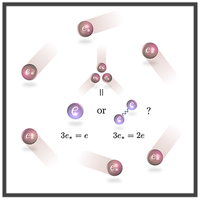
While elementary particles always obey bosonic or fermionic statistics, “anyonic” quasiparticles with fractional statistics in between bosons and fermions can emerge as collective excitations of certain 2D systems. Anyons are typically confined by magnetic fields into localized states, but recent discoveries of fractional quantum anomalous Hall (FQAH) insulators allow these quasiparticles to exist without an external magnetic field, enabling them to move freely. In this work, we explore what happens when many mobile anyons form a fluid, predicting exotic phases ranging from chiral superconductors to unusual non-Fermi liquid metals.
We develop a universal field-theoretic framework to describe the doping of FQAH insulators, which introduces a finite density of dispersive anyons. In our model, a crucial role is played by the minimal “normal” particle, P—the least-charged excitation carrying an integer multiple of the electron’s elementary charge—obtained by fusing together anyons with the lowest energy gap. If P is a boson, the system tends toward superconducting phases; if P is a fermion, it favors unconventional metallic behavior instead. This simple rule of thumb emerges naturally from our analysis and links microscopic fractionalization to large-scale electronic properties.
These results set the stage for deeper studies of anyonic quantum matter. Just as exploring doped Mott insulators revealed many unexpected phases in cuprates and related materials, we expect that detailed numerical simulations and new experimental probes of doped FQAH systems will uncover an equally rich variety of phenomena.
Article Text
References (81)
- R. B. Laughlin, Anomalous quantum Hall effect: An incompressible quantum fluid with fractionally charged excitations, Phys. Rev. Lett. 50, 1395 (1983).
- J. K. Jain, Composite-fermion approach for the fractional quantum Hall effect, Phys. Rev. Lett. 63, 199 (1989).
- H. L. Stormer, D. C. Tsui, and A. C. Gossard, The fractional quantum Hall effect, Rev. Mod. Phys. 71, S298 (1999).
- B. I. Halperin, P. A. Lee, and N. Read, Theory of the half-filled Landau level, Phys. Rev. B 47, 7312 (1993).
- D. J. Thouless, M. Kohmoto, M. P. Nightingale, and M. den Nijs, Quantized Hall conductance in a two-dimensional periodic potential, Phys. Rev. Lett. 49, 405 (1982).
- F. D. M. Haldane, Model for a quantum Hall effect without Landau levels: Condensed-matter realization of the “parity anomaly”, Phys. Rev. Lett. 61, 2015 (1988).
We use the terminology FQAH to refer to situations where quantum Hall phenomena occur in systems that are microscopically time-reversal invariant. A more general situation is where quantum Hall effects occur in lattice systems, with or without microscopic time-reversal symmetry, and we use the terminology “fractional Chern insulators” for this general case.
- T. Neupert, L. Santos, C. Chamon, and C. Mudry, Fractional quantum Hall states at zero magnetic field, Phys. Rev. Lett. 106, 236804 (2011).
- K. Sun, Z. Gu, H. Katsura, and S. Das Sarma, Nearly flatbands with nontrivial topology, Phys. Rev. Lett. 106, 236803 (2011).
- D. N. Sheng, Z.-C. Gu, K. Sun, and L. Sheng, Fractional quantum Hall effect in the absence of Landau levels, Nat. Commun. 2, 389 (2011).
- E. Tang, J.-W. Mei, and X.-G. Wen, High-temperature fractional quantum Hall states, Phys. Rev. Lett. 106, 236802 (2011).
- Y.-F. Wang, Z.-C. Gu, C.-D. Gong, and D. N. Sheng, Fractional quantum Hall effect of hard-core bosons in topological flat bands, Phys. Rev. Lett. 107, 146803 (2011).
- N. Regnault and B. A. Bernevig, Fractional Chern insulator, Phys. Rev. X 1, 021014 (2011).
- E. J. Bergholtz and Z. Liu, Topological flat band models and fractional Chern insulators, Int. J. Mod. Phys. B 27, 1330017 (2013).
- S. A. Parameswaran, R. Roy, and S. L. Sondhi, Fractional quantum Hall physics in topological flat bands, C.R. Phys. 14, 816 (2013).
- Y.-H. Zhang, D. Mao, Y. Cao, P. Jarillo-Herrero, and T. Senthil, Nearly flat Chern bands in moiré superlattices, Phys. Rev. B 99, 075127 (2019).
- P. J. Ledwith, G. Tarnopolsky, E. Khalaf, and A. Vishwanath, Fractional Chern insulator states in twisted bilayer graphene: An analytical approach, Phys. Rev. Res. 2, 023237 (2020).
- C. Repellin and T. Senthil, Chern bands of twisted bilayer graphene: Fractional Chern insulators and spin phase transition, Phys. Rev. Res. 2, 023238 (2020).
- P. Wilhelm, T. C. Lang, and A. M. Läuchli, Interplay of fractional Chern insulator and charge density wave phases in twisted bilayer graphene, Phys. Rev. B 103, 125406 (2021).
- A. Abouelkomsan, Z. Liu, and E. J. Bergholtz, Particle-hole duality, emergent Fermi liquids, and fractional Chern insulators in moiré flatbands, Phys. Rev. Lett. 124, 106803 (2020).
- F. Wu, T. Lovorn, E. Tutuc, I. Martin, and A. H. MacDonald, Topological insulators in twisted transition metal dichalcogenide homobilayers, Phys. Rev. Lett. 122, 086402 (2019).
- H. Yu, M. Chen, and W. Yao, Giant magnetic field from moiré induced Berry phase in homobilayer semiconductors, Natl. Sci. Rev. 7, 12 (2020).
- T. Devakul, V. Crépel, Y. Zhang, and L. Fu, Magic in twisted transition metal dichalcogenide bilayers, Nat. Commun. 12, 6730 (2021).
- N. Bultinck, S. Chatterjee, and M. P. Zaletel, Mechanism for anomalous Hall ferromagnetism in twisted bilayer graphene, Phys. Rev. Lett. 124, 166601 (2020).
- Y.-H. Zhang, D. Mao, and T. Senthil, Twisted bilayer graphene aligned with hexagonal boron nitride: Anomalous Hall effect and a lattice model, Phys. Rev. Res. 1, 033126 (2019).
- C. Repellin, Z. Dong, Y.-H. Zhang, and T. Senthil, Ferromagnetism in narrow bands of moiré superlattices, Phys. Rev. Lett. 124, 187601 (2020).
- J. Liu and X. Dai, Orbital magnetic states in moiré graphene systems, Nat. Rev. Phys. 3, 367 (2021).
- A. L. Sharpe, E. J. Fox, A. W. Barnard, J. Finney, K. Watanabe, T. Taniguchi, M. A. Kastner, and D. Goldhaber-Gordon, Emergent ferromagnetism near three-quarters filling in twisted bilayer graphene, Science 365, 605 (2019).
- E. Anderson, F.-R. Fan, J. Cai, W. Holtzmann, T. Taniguchi, K. Watanabe, D. Xiao, W. Yao, and X. Xu, Programming correlated magnetic states with gate-controlled moiré geometry, Science 381, 325 (2023).
- J. Cai, E. Anderson, C. Wang, X. Zhang, X. Liu, W. Holtzmann, Y. Zhang, F. Fan, T. Taniguchi, K. Watanabe, Y. Ran, T. Cao, L. Fu, D. Xiao, W. Yao, and X. Xu, Signatures of fractional quantum anomalous Hall states in twisted , Nature (London) 622, 63 (2023).
- H. Park et al., Observation of fractionally quantized anomalous Hall effect, Nature (London) 622, 74 (2023).
- F. Xu, Z. Sun, T. Jia, C. Liu, C. Xu, C. Li, Y. Gu, K. Watanabe, T. Taniguchi, B. Tong, J. Jia, Z. Shi, S. Jiang, Y. Zhang, X. Liu, and T. Li, Observation of integer and fractional quantum anomalous Hall effects in twisted bilayer , Phys. Rev. X 13, 031037 (2023).
- Y. Zeng, Z. Xia, K. Kang, J. Zhu, P. Knüppel, C. Vaswani, K. Watanabe, T. Taniguchi, K. F. Mak, and J. Shan, Integer and fractional Chern insulators in twisted bilayer , Nature (London) 622, 69 (2023).
- Z. Lu, T. Han, Y. Yao, A. P. Reddy, J. Yang, J. Seo, K. Watanabe, T. Taniguchi, L. Fu, and L. Ju, Fractional quantum anomalous Hall effect in multilayer graphene, Nature (London) 626, 759 (2024).
- P. A. Lee, N. Nagaosa, and X.-G. Wen, Doping a Mott insulator: Physics of high-temperature superconductivity, Rev. Mod. Phys. 78, 17 (2006).
A more exotic general possibility—discussed in the literature on symmetry enriched topological order—is that some symmetries act by permuting distinct anyons, which is not directly pertinent to the phases we discuss in this paper.
- M. Cheng, M. Zaletel, M. Barkeshli, A. Vishwanath, and P. Bonderson, Translational symmetry and microscopic constraints on symmetry-enriched topological phases: A view from the surface, Phys. Rev. X 6, 041068 (2016).
- N. Bultinck and M. Cheng, Filling constraints on fermionic topological order in zero magnetic field, Phys. Rev. B 98, 161119(R) (2018).
- R. B. Laughlin, Superconducting ground state of noninteracting particles obeying fractional statistics, Phys. Rev. Lett. 60, 2677 (1988).
- A. L. Fetter, C. B. Hanna, and R. B. Laughlin, Random-phase approximation in the fractional-statistics gas, Phys. Rev. B 39, 9679 (1989).
- D.-H. Lee and M. P. A. Fisher, Anyon superconductivity and the fractional quantum Hall effect, Phys. Rev. Lett. 63, 903 (1989).
- Y.-H. Chen, F. Wilczek, E. Witten, and B. I. Halperin, On anyon superconductivity, Int. J. Mod. Phys. A 04, 3983 (1989).
- B. I. Halperin, J. March-Russell, and F. Wilczek, Consequences of time-reversal-symmetry violation in models of high-t c superconductors, Phys. Rev. B 40, 8726 (1989).
- X. G. Wen and A. Zee, Compressibility and superfluidity in the fractional-statistics liquid, Phys. Rev. B 41, 240 (1990).
- T. Senthil and M. P. A. Fisher, gauge theory of electron fractionalization in strongly correlated systems, Phys. Rev. B 62, 7850 (2000).
A discussion of superconductivity near the case using flux-attached composite fermions can be found in Ref. [47].
- E. Tang and X.-G. Wen, Superconductivity with intrinsic topological order induced by pure Coulomb interaction and time-reversal symmetry breaking, Phys. Rev. B 88, 195117 (2013).
- T. Han, Z. Lu, Y. Yao, L. Shi, J. Yang, J. Seo, S. Ye, Z. Wu, M. Zhou, H. Liu, G. Shi, Z. Hua, K. Watanabe, T. Taniguchi, P. Xiong, L. Fu, and L. Ju, Signatures of chiral superconductivity in rhombohedral graphene, Nature (London) 643, 654 (2025).
One can prove that for every , this is the unique choice of Chern numbers that gives rise to the Jain topological orders up to permutations.
- E. M. Spanton, A. A. Zibrov, H. Zhou, T. Taniguchi, K. Watanabe, M. P. Zaletel, and A. F. Young, Observation of fractional Chern insulators in a van der Waals heterostructure, Science 360, 62 (2018).
- Y. Xie, A. T. Pierce, J. M. Park, D. E. Parker, E. Khalaf, P. Ledwith, Y. Cao, S. H. Lee, S. Chen, P. R. Forrester, K. Watanabe, T. Taniguchi, A. Vishwanath, P. Jarillo-Herrero, and A. Yacoby, Fractional Chern insulators in magic-angle twisted bilayer graphene, Nature (London) 600, 439 (2021).
- S. H. Aronson, T. Han, Z. Lu, Y. Yao, K. Watanabe, T. Taniguchi, L. Ju, and R. C. Ashoori, Displacement field-controlled fractional Chern insulators and charge density waves in a graphene/hBN moiré superlattice, arXiv:2408.11220.
- R. A. Jalabert and S. Sachdev, Spontaneous alignment of frustrated bonds in an anisotropic, three-dimensional Ising model, Phys. Rev. B 44, 686 (1991).
- T. Senthil and M. P. A. Fisher, gauge theory of electron fractionalization in strongly correlated systems, Phys. Rev. B 62, 7850 (2000).
- Y.-M. Lu, Y. Ran, and M. Oshikawa, Filling-enforced constraint on the quantized Hall conductivity on a periodic lattice, Ann. Phys. (Amsterdam) 413, 168060 (2020).
In the presence of additional lattice symmetries, it is possible to have a higher number of degenerate species that transform in a larger reducible representation of the projective algebra. See Ref. [47] for an example on the triangular lattice, where a sixfold degeneracy is enforced by a lattice rotational symmetry. By modifying the hopping parameters, we can reduce the rotational symmetry from to and lift the sixfold degeneracy. However, the projective lattice translation algebra requires that a threefold degeneracy always survives. In current experimental realizations (twisted and pentalayer graphene), we only have symmetry for valley-polarized electrons. Thus, we limit our analysis to this case and consider only the minimal threefold degeneracy of anyon species.
- X.-Y. Song, Y.-H. Zhang, and T. Senthil, Phase transitions out of quantum Hall states in moiré materials, Phys. Rev. B 109, 085143 (2024).
In our subsequent discussion, we will move on to a continuum field theory of Lagrangians such as these. In addition, it will be extremely useful to place this continuum theory on a general oriented space-time 3-manifold of the form (where denotes an -manifold) with a metric . This approach will enable us to keep track of important topological data such as the quantized thermal Hall conductivity. The restriction to manifolds of this form is appropriate as our theory is nonrelativistic. We will also need to specify whether any Abelian gauge field is an ordinary gauge field or a connection. The latter has a modified flux quantization condition around cycles. For a review, see Ref. [59] and references therein. As emphasized in Refs. [60, 61], this distinction cleanly enables keeping track of gauge fields whose elementary source fields are fermions from those whose source fields are bosons. Thus, the external probe field is a connection as its elementary sources are electrons. Similarly, since ’s are fermions, must be a connection and must be an ordinary gauge field.
- T. Senthil, D. T. Son, C. Wang, and C. Xu, Duality between () d quantum critical points, Phys. Rep. 827, 1 (2019).
- M. A. Metlitski, -duality of gauge theory with on non-orientable manifolds: Applications to topological insulators and superconductors, arXiv:1510.05663.
- N. Seiberg and E. Witten, Gapped boundary phases of topological insulators via weak coupling, Prog. Theor. Exp. Phys. 2016, 12C101 (2016).
- N. Seiberg, T. Senthil, C. Wang, and E. Witten, A duality web in dimensions and condensed matter physics, Ann. Phys. (Amsterdam) 374, 395 (2016).
- G. Moore and N. Read, Nonabelions in the fractional quantum Hall effect, Nucl. Phys. B360, 362 (1991).
- N. Read and D. Green, Paired states of fermions in two dimensions with breaking of parity and time-reversal symmetries and the fractional quantum Hall effect, Phys. Rev. B 61, 10267 (2000).
- H. V. Löhneysen, A. Rosch, M. Vojta, and P. Wölfle, Fermi-liquid instabilities at magnetic quantum phase transitions, Rev. Mod. Phys. 79, 1015 (2007).
- D. F. Mross, J. McGreevy, H. Liu, and T. Senthil, Controlled expansion for certain non-Fermi-liquid metals, Phys. Rev. B 82, 045121 (2010).
- M. A. Metlitski, D. F. Mross, S. Sachdev, and T. Senthil, Cooper pairing in non-Fermi liquids, Phys. Rev. B 91, 115111 (2015).
- Z. D. Shi, H. Goldman, D. V. Else, and T. Senthil, Gifts from anomalies: Exact results for Landau phase transitions in metals, SciPost Phys. 13, 102 (2022).
- H. Guo, A. A. Patel, I. Esterlis, and S. Sachdev, Large-N theory of critical Fermi surfaces. II. Conductivity, Phys. Rev. B 106, 115151 (2022).
- Z. D. Shi, Controlled expansion for transport in a class of non-Fermi liquids, Phys. Rev. B 109, 195110 (2024).
- F. D. M. Haldane, Berry curvature on the Fermi surface: Anomalous Hall effect as a topological Fermi-liquid property, Phys. Rev. Lett. 93, 206602 (2004).
- I. Sodemann, I. Kimchi, C. Wang, and T. Senthil, Composite fermion duality for half-filled multicomponent Landau levels, Phys. Rev. B 95, 085135 (2017).
- A. S. Patri, Z. Dong, and T. Senthil, Extended quantum anomalous Hall effect in moir’e structures: Phase transitions and transport, Phys. Rev. B 110, 245115 (2024).
- T. Senthil, S. Sachdev, and M. Vojta, Fractionalized Fermi liquids, Phys. Rev. Lett. 90, 216403 (2003).
- T. Senthil, M. Vojta, and S. Sachdev, Weak magnetism and non-Fermi liquids near heavy-fermion critical points, Phys. Rev. B 69, 035111 (2004).
- M. Kim, A. Timmel, L. Ju, and X.-G. Wen, Topological chiral superconductivity, Phys. Rev. B 111, 014508 (2025).
- S. Divic, V. Crépel, T. Soejima, X.-Y. Song, A. Millis, M. P. Zaletel, and A. Vishwanath, Anyon superconductivity from topological criticality in a Hofstadter-Hubbard model, Proc. Natl. Acad. Sci. U.S.A. 122,e2426680122 (2025).
- M. V. Milovanović and Z. Papić, Nonperturbative approach to the quantum Hall bilayer, Phys. Rev. B 79, 115319 (2009).
- G. Möller, S. H. Simon, and E. H. Rezayi, Paired composite fermion phase of quantum Hall bilayers at , Phys. Rev. Lett. 101, 176803 (2008).
- G. Möller, S. H. Simon, and E. H. Rezayi, Trial wave functions for quantum Hall bilayers, Phys. Rev. B 79, 125106 (2009).
- M. V. Milovanović, E. Dobardzić, and Z. Papić, Meron deconfinement in the quantum Hall bilayer at intermediate distances, Phys. Rev. B 92, 195311 (2015).

