

- Open Access
Demonstrating Coherent Quantum Routers for Bucket-Brigade Quantum Random Access Memory on a Superconducting Processor
Phys. Rev. X 16, 031051 – Published 25 August, 2026
DOI: https://doi.org/10.1103/h5m3-qrn9
Abstract
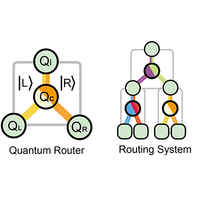
Quantum routers (QRouters) are essential components of bucket-brigade quantum random access memory (QRAM), enabling quantum applications such as Grover’s search and quantum machine learning. Despite significant theoretical advances, achieving scalable and coherent QRouters experimentally remains challenging. Here, we demonstrate coherent quantum routers using a superconducting quantum processor, laying a practical foundation for scalable QRAM systems. The quantum router at the core of our implementation utilizes the transition composite gate scheme, wherein auxiliary energy levels temporarily mediate conditional interactions. By leveraging two-qubit primitives in its construction, the quantum router preserves straightforward initialization and calibration while significantly reducing circuit depth and duration relative to traditional gate-based decompositions. Moreover, by encoding routing addresses in the nonadjacent qutrit states and , our design inherently enables erasure-detection capability, providing efficient postselection to mitigate routing errors. Experimentally, we achieve an average fidelity of 94.8% across three individual QRouters, and we validate scalability through a two-layer quantum routing network achieving a fidelity of 82.4%. Our results represent a significant advancement in quantum routing technology, providing enhanced fidelity, built-in error resilience, and practical scalability crucial for the development of future QRAM and large-scale quantum computing architectures.
Physics Subject Headings (PhySH)
Popular Summary
Quantum random access memory requires coherent quantum routers to direct information along superposed address paths, but physical implementations suffer from deep circuit overheads and hardware noise. We demonstrate coherent quantum routers on a superconducting processor using a transition composite gate scheme that leverages auxiliary energy levels to streamline gate operations and enables inherent error erasure via postselection. Our approach reduces circuit depth and operational complexity, allowing us to achieve high routing fidelity across individual devices and a cascaded two-layer network. Furthermore, we show that quantum information transfers accurately when routing addresses are prepared in arbitrary quantum superpositions. Our work establishes a hardware-efficient framework that advances the development of scalable quantum memory and large-scale quantum networks.
Article Text
References (106)
- V. Giovannetti, S. Lloyd, and L. Maccone, Quantum random access memory, Phys. Rev. Lett. 100, 160501 (2008).
- C. T. Hann, C.-L. Zou, Y. Zhang, Y. Chu, R. J. Schoelkopf, S. M. Girvin, and L. Jiang, Hardware-efficient quantum random access memory with hybrid quantum acoustic systems, Phys. Rev. Lett. 123, 250501 (2019).
- A. Paler, O. Oumarou, and R. Basmadjian, Parallelizing the queries in a bucket-brigade quantum random access memory, Phys. Rev. A 102, 032608 (2020).
- R. Asaka, K. Sakai, and R. Yahagi, Quantum random access memory via quantum walk, Quantum Sci. Technol. 6, 035004 (2021).
- K. C. Chen, W. Dai, C. Errando-Herranz, S. Lloyd, and D. Englund, Scalable and high-fidelity quantum random access memory in spin-photon networks, PRX Quantum 2, 030319 (2021).
- S. Jaques and A. G. Rattew, Qram: A survey and critique, arXiv:2305.10310.
- D. K. Weiss, S. Puri, and S. M. Girvin, Quantum random access memory architectures using 3d superconducting cavities, PRX Quantum 5, 020312 (2024).
- F.-Y. Hong, Y. Xiang, Z.-Y. Zhu, L. Z. Jiang, and L. N. Wu, Robust quantum random access memory, Phys. Rev. A 86, 010306(R) (2012).
- L. K. Grover, Quantum mechanics helps in searching for a needle in a haystack, Phys. Rev. Lett. 79, 325 (1997).
- J. Biamonte, P. Wittek, N. Pancotti, P. Rebentrost, N. Wiebe, and S. Lloyd, Quantum machine learning, Nature (London) 549, 195 (2017).
- M. Cerezo, G. Verdon, H.-Y. Huang, L. Cincio, and P. J. Coles, Challenges and opportunities in quantum machine learning, Nat. Comput. Sci. 2, 567 (2022).
- B. Duan, J. Yuan, C.-H. Yu, J. Huang, and C.-Y. Hsieh, A survey on hhl algorithm: From theory to application in quantum machine learning, Phys. Lett. A 384, 126595 (2020).
- R. Steijl, Quantum algorithms for nonlinear equations in fluid mechanics, in Quantum Computing and Communications, edited by Y. Zhao (IntechOpen, Rijeka, 2020) Chap. 2.
- I. M. Georgescu, S. Ashhab, and F. Nori, Quantum simulation, Rev. Mod. Phys. 86, 153 (2014).
- A. Kandala, A. Mezzacapo, K. Temme, M. Takita, M. Brink, J. M. Chow, and J. M. Gambetta, Hardware-efficient variational quantum eigensolver for small molecules and quantum magnets, Nature (London) 549, 242 (2017).
- Z.-Y. Chen et al., Enabling large-scale and high-precision fluid simulations on near-term quantum computers, Comput. Methods Appl. Mech. Eng. 432, 117428 (2024).
- Y. Kotukh, Cryptanalysis of the system based on word problems using logarithmic signatures, Radiotekhnika, https://api.semanticscholar.org/CorpusID:245324463 (2021).
- R. Babbush, C. Gidney, D. W. Berry, N. Wiebe, J. McClean, A. Paler, A. Fowler, and H. Neven, Encoding electronic spectra in quantum circuits with linear t complexity, Phys. Rev. X 8, 041015 (2018).
- Z.-Y. Chen, C. Xue, S.-M. Chen, B.-H. Lu, Y.-C. Wu, J.-C. Ding, S.-H. Huang, and G.-P. Guo, Quantum approach to accelerate finite volume method on steady computational fluid dynamics problems, Quantum Inf. Process. 21, 137 (2022).
- V. Giovannetti, S. Lloyd, and L. Maccone, Architectures for a quantum random access memory, Phys. Rev. A 78, 052310 (2008).
- C. T. Hann, G. Lee, S. M. Girvin, and L. Jiang, Resilience of quantum random access memory to generic noise, PRX Quantum 2, 020311 (2021).
- L. Zhou, S. Yang, Y. X. Liu, C. P. Sun, and F. Nori, Quantum zeno switch for single-photon coherent transport, Phys. Rev. A 80, 062109 (2009).
- C. Gonzalez-Ballestero, E. Moreno, F. J. Garcia-Vidal, and A. Gonzalez-Tudela, Nonreciprocal few-photon routing schemes based on chiral waveguide-emitter couplings, Phys. Rev. A 94, 063817 (2016).
- M.-T. Cheng, X.-S. Ma, J.-Y. Zhang, and B. Wang, Single photon transport in two waveguides chirally coupled by a quantum emitter, Opt. Express 24, 19988 (2016).
- L. Zhou, L.-P. Yang, Y. Li, and C. P. Sun, Quantum routing of single photons with a cyclic three-level system, Phys. Rev. Lett. 111, 103604 (2013).
- Y. T. Zhu and W. Z. Jia, Single-photon quantum router in the microwave regime utilizing double superconducting resonators with tunable coupling, Phys. Rev. A 99, 063815 (2019).
- J. Lu, Z. H. Wang, and L. Zhou, T-shaped single-photon router, Opt. Express 23, 22955 (2015).
- J. Lu, L. Zhou, L.-M. Kuang, and F. Nori, Single-photon router: Coherent control of multichannel scattering for single photons with quantum interferences, Phys. Rev. A 89, 013805 (2014).
- Z. Wang, Y. Wu, Z. Bao, Y. Li, C. Ma, H. Wang, Y. Song, H. Zhang, and L. Duan, Experimental realization of a deterministic quantum router with superconducting quantum circuits, Phys. Rev. Appl. 15, 014049 (2021).
- Y.-l. Ren, S.-l. Ma, J.-k. Xie, X.-k. Li, M.-t. Cao, and F.-l. Li, Nonreciprocal single-photon quantum router, Phys. Rev. A 105, 013711 (2022).
- Y. Li, Z. Bao, Z. Wang, Y. Wu, J. Wang, J. Yang, H. Xiong, Y. Song, H. Zhang, and L. Duan, Quantum switch for itinerant microwave single photons with superconducting quantum circuits, Phys. Rev. Appl. 21, 044030 (2024).
- L. Du, Y.-T. Chen, J.-H. Wu, and Y. Li, Nonreciprocal interference and coherent photon routing in a three-port optomechanical system, Opt. Express 28, 3647 (2020).
- G. S. Agarwal and S. Huang, Optomechanical systems as single-photon routers, Phys. Rev. A 85, 021801(R) (2012).
- X. Yuan, J.-J. Ma, P.-Y. Hou, X.-Y. Chang, C. Zu, and L.-M. Duan, Experimental demonstration of a quantum router, Sci. Rep. 5, 12452 (2015).
- K. Bartkiewicz, A. Černoch, and K. Lemr, Implementation of an efficient linear-optical quantum router, Sci. Rep. 8, 13480 (2018).
- N. E. Palaiodimopoulos, S. Ohler, M. Fleischhauer, and D. Petrosyan, Chiral quantum router with Rydberg atoms, Phys. Rev. A 109, 032622 (2024).
- C. Miao, S. Léger, Z. Li, G. Lee, L. Jiang, and D. I. Schuster, Implementation of a quantum addressable router using superconducting qubits, PRX Quantum 6, 040335 (2025).
- J. Koch, T. M. Yu, J. Gambetta, A. A. Houck, D. I. Schuster, J. Majer, A. Blais, M. H. Devoret, S. M. Girvin, and R. J. Schoelkopf, Charge-insensitive qubit design derived from the cooper pair box, Phys. Rev. A 76, 042319 (2007).
- R. Barends, J. Kelly, A. Megrant, D. Sank, E. Jeffrey, Y. Chen, Y. Yin, B. Chiaro, J. Mutus, C. Neill, P. O’Malley, P. Roushan, J. Wenner, T. C. White, A. N. Cleland, and J. M. Martinis, Coherent Josephson qubit suitable for scalable quantum integrated circuits, Phys. Rev. Lett. 111, 080502 (2013).
- F. Yan, P. Krantz, Y. Sung, M. Kjaergaard, D. L. Campbell, T. P. Orlando, S. Gustavsson, and W. D. Oliver, Tunable coupling scheme for implementing high-fidelity two-qubit gates, Phys. Rev. Appl. 10, 054062 (2018).
- S. E. Rasmussen, K. S. Christensen, and N. T. Zinner, Controllable two-qubit swapping gate using superconducting circuits, Phys. Rev. B 99, 134508 (2019).
- F. Arute, K. Arya, R. Babbush, D. Bacon, J. C. Bardin, R. Barends, R. Biswas, S. Boixo, F. G. Brandao, D. A. Buell et al., Quantum supremacy using a programmable superconducting processor, Nature (London) 574, 505 (2019).
- W. Feng and D. W. Wang, Quantum fredkin gate based on synthetic three-body interactions in superconducting circuits, Phys. Rev. A 101, 062312 (2020).
- T. Roy, S. Hazra, S. Kundu, M. Chand, M. P. Patankar, and R. Vijay, Programmable superconducting processor with native three-qubit gates, Phys. Rev. Appl. 14, 014072 (2020).
- X. Gu, J. Fernández-Pendás, P. Vikstål, T. Abad, C. Warren, A. Bengtsson, G. Tancredi, V. Shumeiko, J. Bylander, G. Johansson, and A. F. Kockum, Fast multiqubit gates through simultaneous two-qubit gates, PRX Quantum 2, 040348 (2021).
- C. W. Warren, J. Fernández-Pendás, S. Ahmed, T. Abad, A. Bengtsson, J. Biznárová, K. Debnath, X. Gu, C. Križan, A. Osman et al., Extensive characterization and implementation of a family of three-qubit gates at the coherence limit, npj Quantum Inf. 9, 44 (2023).
- D. Gao et al., Establishing a new benchmark in quantum computational advantage with 105-qubit zuchongzhi 3.0 processor, Phys. Rev. Lett. 134, 090601 (2025).
- F. Shen et al., A bucket-brigade quantum random access memory, Nat. Phys. 22, 745 (2026).
- A. Barenco, C. H. Bennett, R. Cleve, D. P. DiVincenzo, N. Margolus, P. Shor, T. Sleator, J. A. Smolin, and H. Weinfurter, Elementary gates for quantum computation, Phys. Rev. A 52, 3457 (1995).
- M. A. Nielsen and I. L. Chuang, Quantum Computation and Quantum Information (Cambridge University Press, Cambridge, England, 2010).
- S. Zhang et al., Realizing scalable conditional operations through auxiliary energy levels, Sci. China Inf. Sci. (to be published).
- A. Kubica, A. Haim, Y. Vaknin, H. Levine, F. Brandão, and A. Retzker, Erasure qubits: Overcoming the limit in superconducting circuits, Phys. Rev. X 13, 041022 (2023).
- S. Vittal, P. Das, and M. Qureshi, Eraser: Towards adaptive leakage suppression for fault-tolerant quantum computing, 10.1145/3613424.3614251 (2023).
- K. S. Chou, T. Shemma, H. McCarrick, T.-C. Chien, J. D. Teoh, P. Winkel, A. Anderson, J. Chen, J. C. Curtis, S. J. de Graaf et al., A superconducting dual-rail cavity qubit with erasure-detected logical measurements, Nat. Phys. 20, 1454 (2024).
- S. J. de Graaf, S. H. Xue, B. J. Chapman, J. D. Teoh, T. Tsunoda, P. Winkel, J. W. Garmon, K. M. Chang, L. Frunzio, S. Puri et al., A mid-circuit erasure check on a dual-rail cavity qubit using the joint-photon number-splitting regime of circuit QED, npj Quantum Inf. 11, 1 (2025).
- H. Levine et al., Demonstrating a long-coherence dual-rail erasure qubit using tunable transmons, Phys. Rev. X 14, 011051 (2024).
- D. K. Weiss, S. Puri, and S. M. Girvin, Quantum random access memory architectures using superconducting cavities, arXiv:2310.08288.
- B. Foxen et al. (Google AI Quantum), Demonstrating a continuous set of two-qubit gates for near-term quantum algorithms, Phys. Rev. Lett. 125, 120504 (2020).
- Y. Sung, L. Ding, J. Braumüller, A. Vepsäläinen, B. Kannan, M. Kjaergaard, A. Greene, G. O. Samach, C. McNally, D. Kim, A. Melville, B. M. Niedzielski, M. E. Schwartz, J. L. Yoder, T. P. Orlando, S. Gustavsson, and W. D. Oliver, Realization of high-fidelity cz and -free iswap gates with a tunable coupler, Phys. Rev. X 11, 021058 (2021).
- F. Arute et al., Observation of separated dynamics of charge and spin in the Fermi-Hubbard model, arXiv:2010.07965.
- C. Neill, T. McCourt, X. Mi, Z. Jiang, M. Niu, W. Mruczkiewicz, I. Aleiner, F. Arute, K. Arya, J. Atalaya et al., Accurately computing the electronic properties of a quantum ring, Nature (London) 594, 508 (2021).
- J. A. Gross, É. Genois, D. M. Debroy, Y. Zhang, W. Mruczkiewicz, Z.-P. Cian, and Z. Jiang, Characterizing coherent errors using matrix-element amplification, npj Quantum Inf. 10, 123 (2024).
- F. Motzoi, J. M. Gambetta, P. Rebentrost, and F. K. Wilhelm, Simple pulses for elimination of leakage in weakly nonlinear qubits, Phys. Rev. Lett. 103, 110501 (2009).
- J. Butscher, S. Krinner, and A. Wallraff, Shaping of fast flux pulses for two-qubit gates: Inverse filtering (2018).
- E. A. Sete, J. M. Martinis, and A. N. Korotkov, Quantum theory of a bandpass purcell filter for qubit readout, Phys. Rev. A 92, 012325 (2015).
- Y. Sunada, S. Kono, J. Ilves, S. Tamate, T. Sugiyama, Y. Tabuchi, and Y. Nakamura, Fast readout and reset of a superconducting qubit coupled to a resonator with an intrinsic purcell filter, Phys. Rev. Appl. 17, 044016 (2022).
- L.-L. Guo, P. Duan, S. Zhang, X.-X. Yang, C. Zhang, L. Du, H.-F. Zhang, H.-R. Tao, T.-L. Wang, Z.-L. Jia, Z.-Y. Chen, and G.-P. Guo, Universal scalable characterization and correction of pulse distortions in controlled quantum systems, Phys. Rev. Appl. 21, 064060 (2024).
- M. A. Rol, F. Battistel, F. K. Malinowski, C. C. Bultink, B. M. Tarasinski, R. Vollmer, N. Haider, N. Muthusubramanian, A. Bruno, B. M. Terhal, and L. DiCarlo, Fast, high-fidelity conditional-phase gate exploiting leakage interference in weakly anharmonic superconducting qubits, Phys. Rev. Lett. 123, 120502 (2019).
- V. Negîrneac, H. Ali, N. Muthusubramanian, F. Battistel, R. Sagastizabal, M. S. Moreira, J. F. Marques, W. J. Vlothuizen, M. Beekman, C. Zachariadis, N. Haider, A. Bruno, and L. DiCarlo, High-fidelity controlled- gate with maximal intermediate leakage operating at the speed limit in a superconducting quantum processor, Phys. Rev. Lett. 126, 220502 (2021).
- Y. Wang, S. Zhang, T. Sun, Z. Zhao, X. Xu, X. Zhuang, H. Liu, C. Xue, P. Duan, Y. Wu, Z. Chen, and G. Guo, Hardware-efficient quantum random access memory design with a native gate set on superconducting platforms, Adv. Quantum Technol. 8, 2400519 (2025).
- Z.-Y. Chen, C. Xue, Y.-J. Wang, T.-P. Sun, H.-Y. Liu, X.-N. Zhuang, M.-H. Dou, T.-R. Zou, Y. Fang, Y.-C. Wu, and G.-P. Guo, Efficient and error-resilient data access protocols for a limited-sized quantum random access memory, arXiv:2303.05207.
- X.-Y. Yang, H.-F. Zhang, L. Du, H.-R. Tao, L.-L. Guo, T.-L. Wang, Z.-L. Jia, W.-C. Kong, Z.-Y. Chen, P. Duan et al., Fast, universal scheme for calibrating microwave crosstalk in superconducting circuits, Appl. Phys. Lett. 125 (2024).
- P. Wang, B.-H. Lu, T.-L. Wang, S. Zhang, Z.-Y. Chen, H.-F. Zhang, R.-Z. Zhao, X.-Y. Yang, Z.-A. Zhao, Z.-Z. Zhang, X.-X. Song, Y.-C. Wu, P. Duan, and G.-P. Guo, Spectator leakage elimination in cz gates via tunable coupler interference on a superconducting quantum processor, arXiv:2507.14531.
- J. Preskill, Quantum Computing in the NISQ era and beyond, Quantum 2, 79 (2018).
- J. W. Z. Lau, K. H. Lim, H. Shrotriya, and L. C. Kwek, Nisq computing: Where are we and where do we go?, AAPPS Bull. 32, 27 (2022).
- U. Khalid, J. U. Rehman, S. N. Paing, H. Jung, T. Q. Duong, and H. Shin, Quantum network engineering in the nisq age: Principles, missions, and challenges, IEEE Network 38, 112 (2024).
- Y.-J. Wang, T.-P. Sun, X.-N. Zhuang, X.-F. Xu, H.-Y. Liu, C. Xue, Y.-C. Wu, Z.-Y. Chen, and G.-P. Guo, Refined criteria for qram error suppression via efficient large-scale qram simulator, Phys. Rev. Appl. 25, 044069 (2026).
- P. Mundada, G. Zhang, T. Hazard, and A. Houck, Suppression of qubit crosstalk in a tunable coupling superconducting circuit, Phys. Rev. Appl. 12, 054023 (2019).
- P. Zhao, K. Linghu, Z. Li, P. Xu, R. Wang, G. Xue, Y. Jin, and H. Yu, Quantum crosstalk analysis for simultaneous gate operations on superconducting qubits, PRX Quantum 3, 020301 (2022).
- S. Rodrigo, S. Abadal, C. G. Almudéver, and E. Alarcón, Modelling short-range quantum teleportation for scalable multi-core quantum computing architectures, 10.1145/3477206.3477461 (2021).
- X. Li, Y. Ma, J. Han, T. Chen, Y. Xu, W. Cai, H. Wang, Y. P. Song, Z.-Y. Xue, Z. Q. Yin, and L. Sun, Perfect quantum state transfer in a superconducting qubit chain with parametrically tunable couplings, Phys. Rev. Appl. 10, 054009 (2018).
- M. Christandl, N. Datta, T. C. Dorlas, A. Ekert, A. Kay, and A. J. Landahl, Perfect transfer of arbitrary states in quantum spin networks, Phys. Rev. A 71, 032312 (2005).
- B. R. Johnson, Controlling photons in superconducting electrical circuits, ProQuest Dissertations and Theses, 2011, https://www.proquest.com/dissertations-theses/controlling-photons-superconducting-electrical/docview/884221402/se-2.
- Z. Chen, Metrology of Quantum Control and Measurement in Superconducting Qubits (University of California, Santa Barbara, 2018), https://api.semanticscholar.org/CorpusID:196194358.
- Z. Yan, Y.-R. Zhang, M. Gong, Y. Wu, Y. Zheng, S. Li, C. Wang, F. Liang, J. Lin, Y. Xu, C. Guo, L. Sun, C.-Z. Peng, K. Xia, H. Deng, H. Rong, J. Q. You, F. Nori, H. Fan, X. Zhu, and J.-W. Pan, Strongly correlated quantum walks with a 12-qubit superconducting processor, Science 364, 753 (2019).
- N. J. Glaser, F. A. Roy, I. Tsitsilin, L. Koch, N. Bruckmoser, J. Schirk, J. H. Romeiro, G. B. P. Huber, F. Wallner, M. Singh, G. Krylov, A. Marx, L. Södergren, C. M. F. Schneider, M. Werninghaus, and S. Filipp, Sensitivity-adapted closed-loop optimization for high-fidelity controlled-z gates in superconducting qubits, arXiv:2412.17454.
- B. Chiaro and Y. Zhang, Active leakage cancellation in single qubit gates, Phys. Rev. Lett. 135, 130601 (2025).
- E. Genois, N. J. Stevenson, N. Goss, I. Siddiqi, and A. Blais, Quantum optimal control of superconducting qubits based on machine-learning characterization, arXiv:2410.22603.
- E. Genois, N. J. Stevenson, N. Goss, I. Siddiqi, and A. Blais, Quantum optimal control of superconducting qubits based on machine-learning characterization, Phys. Rev. Appl. 24, 034073 (2025).
- B. J. Chapman, S. J. de Graaf, S. H. Xue, Y. Zhang, J. Teoh, J. C. Curtis, T. Tsunoda, A. Eickbusch, A. P. Read, A. Koottandavida, S. O. Mundhada, L. Frunzio, M. H. Devoret, S. M. Girvin, and R. J. Schoelkopf, High-on-off-ratio beam-splitter interaction for gates on bosonically encoded qubits, PRX Quantum 4, 020355 (2023).
- X.-L. Li, Z. Tao, K. Yi, K. Luo, L. Zhang, Y. Zhou, S. Liu, T. Yan, Y. Chen, and D. Yu, Hardware-efficient and fast three-qubit gate in superconducting quantum circuits, Front. Phys. 19, 51205 (2024).
- W. Shi, N. K. Kundu, M. R. McKay, and R. Malaney, Error-mitigated quantum random access memory, arXiv:2403.06340.
- D. C. McKay, C. J. Wood, S. Sheldon, J. M. Chow, and J. M. Gambetta, Efficient gates for quantum computing, Phys. Rev. A 96, 022330 (2017).
- B. Nachman, M. Urbanek, W. A. de Jong, and C. W. Bauer, Unfolding quantum computer readout noise, npj Quantum Inf. 6, 84 (2020).
- F. S. Richards, A method of maximum-likelihood estimation, J. R. Stat. Soc. Ser. B 23, 469 (1961).
- A. Morvan, V. V. Ramasesh, M. S. Blok, J. M. Kreikebaum, K. O’Brien, L. Chen, B. K. Mitchell, R. K. Naik, D. I. Santiago, and I. Siddiqi, Qutrit randomized benchmarking, Phys. Rev. Lett. 126, 210504 (2021).
- J. Johansson, P. Nation, and F. Nori, Qutip 2: A Python framework for the dynamics of open quantum systems, Comput. Phys. Commun. 184, 1234 (2013).
- Suppressing quantum errors by scaling a surface code logical qubit, Nature (London) 614, 676 (2023).
- Z. Meng et al., Simulating unsteady flows on a superconducting quantum processor, Commun. Phys. 7, 349 (2024).
- Quantum error correction below the surface code threshold, Nature (London) 638, 920 (2025).
- T. Uusnäkki, T. Mörstedt, W. Teixeira, M. Rasola, and M. Möttönen, Experimental realization of a quantum heat engine based on dissipation-engineered superconducting circuits, Nat. Commun. 17, 6054 (2025).
- W. Teixeira, T. Mörstedt, A. Viitanen, H. Kivijärvi, A. Gunyhó, M. Tiiri, S. Kundu, A. Sah, V. Vadimov, and M. Möttönen, Many-excitation removal of a transmon qubit using a single-junction quantum-circuit refrigerator and a two-tone microwave drive, Sci. Rep. 14, 13755 (2024).
- F. Battistel, B. M. Varbanov, and B. M. Terhal, Hardware-efficient leakage-reduction scheme for quantum error correction with superconducting transmon qubits, PRX Quantum 2, 030314 (2021).
- N. Li, Y.-H. Li, D.-J. Fan, L.-C. Han, Y. Xu, J. Lin, C. Guo, D.-D. Li, M. Gong, S.-K. Liao et al., Optical transmission of microwave control signal towards large-scale superconducting quantum computing, Opt. Express 32, 3989 (2024).
- Y. Sung, L. Ding, J. Braumüller, A. Vepsäläinen, B. Kannan, M. Kjaergaard, A. Greene, G. O. Samach, C. McNally, D. Kim, A. Melville, B. M. Niedzielski, M. E. Schwartz, J. L. Yoder, T. P. Orlando, S. Gustavsson, and W. D. Oliver, Realization of high-fidelity cz and -free iswap gates with a tunable coupler, Phys. Rev. X 11, 021058 (2021).
- B. Foxen et al. (Google AI Quantum), Demonstrating a continuous set of two-qubit gates for near-term quantum algorithms, Phys. Rev. Lett. 125, 120504 (2020).

